
Money kept for saving and investing in a covered deposit account at an insured bank or federally insured credit union is protected through the applicable insurance limit if that institution fails. That answer changes when cash sits above a limit, inside a nonbank app, in a brokerage product, or in an account whose ownership records do not match your assumption.
Deposit insurance also does not stop scams, prevent every access delay, reverse an authorized payment you regret, or cover an investment that loses value. A useful safety check asks three separate questions: Is the institution insured? Is this product a covered deposit? Are the account records and totals within the rules for that ownership category?
Short answer: Verify the institution in an official federal database, total every deposit you own in the same category at the same bank, and use the federal estimator for the account titles you actually have. Do not rely on a logo or the number of accounts shown in an app.
What “safe” can mean for bank money
| Risk | Main protection | What it does not solve |
|---|---|---|
| Bank or credit-union failure | FDIC deposit insurance or NCUA share insurance for covered funds within applicable limits | Amounts above the limit, uncovered products, or a nonbank company failure |
| Temporary access trouble | Backup payment access, current records, and a small second account when practical | A lost phone, app outage, locked card, frozen account, or delayed third-party records |
| Fraud or account takeover | Strong login controls, alerts, prompt reporting, and consumer protections that apply to the transaction | Every scam payment, every late report, or every transfer the customer authorized |
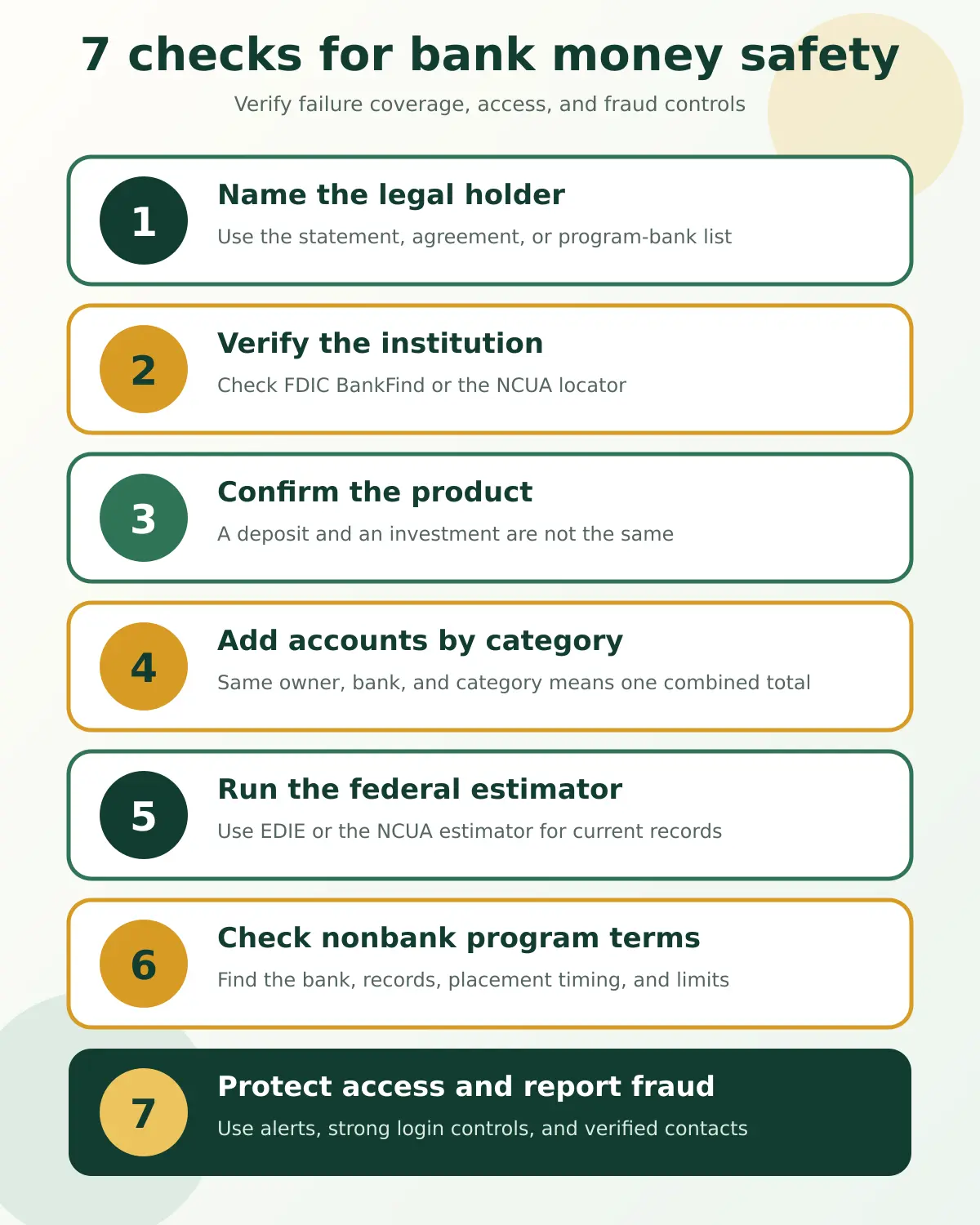
Seven checks for money held in a bank or app
1. Identify who actually holds the money
The name on the app may not be the legal bank holding the deposit. Write down the provider name, the legal institution name, the account title, the account type, and the last four digits of the account number. Look for the deposit agreement, monthly statement, or program-bank list rather than relying on a home-screen badge.
If the provider is a fintech company, payroll app, payment app, prepaid program, or brokerage, find the named bank or credit union that is said to hold the cash. A nonbank company is not FDIC-insured merely because it works with a bank.
2. Verify the bank or credit union in an official database
Search the institution name and website in the FDIC BankFind Suite. For a credit union, use the NCUA Credit Union Locator and confirm that it is federally insured.
Compare the legal name and website with your statement and account agreement. A familiar brand, separate branch, division name, or online trade name may belong to the same insured bank charter. Deposits at branches or trade names of one bank are not insured as if each name were a separate bank.
Do not trust an urgent text as proof of identity. Call the number printed on your debit card or use the bank’s verified website. The FDIC warns that fake bank sites and impersonation messages may copy bank and FDIC branding.
3. Confirm that the product is a covered deposit
FDIC insurance covers deposit products at insured banks, including checking accounts, savings accounts, money market deposit accounts, and certificates of deposit. NCUA share insurance covers comparable share accounts at federally insured credit unions.
FDIC insurance does not cover stocks, bonds, mutual funds, crypto assets, annuities, life insurance, municipal securities, or the contents of a safe deposit box. A product does not become an insured deposit merely because it was bought inside a bank branch or bank app.
A money market deposit account is a bank deposit. A money market mutual fund is an investment. The similar names do not create the same protection.
4. Add deposits by bank and ownership category
The standard FDIC insurance amount is $250,000 per depositor, per insured bank, for each ownership category. Opening several single-owner checking, savings, and CD accounts at the same bank does not create a new $250,000 limit for every account. The bank adds deposits held by the same owner in the same category.
Separate coverage can apply at separately chartered insured banks. Different ownership categories can also receive separate coverage when every rule is met. Common categories include single accounts, joint accounts, certain retirement accounts, trust accounts, business accounts, employee benefit plan accounts, and government accounts.
Do not rename an account or add a person solely to chase coverage. Account ownership carries real rights, estate effects, tax questions, creditor issues, and access rights. Use the title that matches the real ownership and get legal or tax help when those rights matter.
5. Use the federal estimator for joint, trust, retirement, or business funds
Use the FDIC Electronic Deposit Insurance Estimator for bank deposits and the NCUA Share Insurance Estimator for credit-union shares. Enter every account held at one institution before moving to the next institution.
Trust coverage depends on owners, eligible beneficiaries, records, and current rules. FDIC rules that took effect April 1, 2024 cap insurance for all trust deposits at one bank at $1,250,000 per trust owner when five or more beneficiaries are involved. NCUA states that new trust-account share-insurance rules take effect December 1, 2026. Check the rule and estimator in force on the date you review the account.
An estimator result is a planning aid. The actual determination after a failure uses the institution’s records and the law in force at that time.
6. Treat nonbank apps and pass-through claims as a separate check
A payment app or fintech company may say that customer funds are eligible for pass-through insurance at a partner bank. That protection depends on the money reaching an insured bank and on records that identify each customer and ownership interest. Deposit insurance protects against the insured bank’s failure. It does not insure the nonbank company against bankruptcy or solve every recordkeeping or access failure.
Ask these questions:
- Which insured bank or banks hold the funds?
- Can you verify each bank in BankFind?
- Does the agreement say when funds are placed at the bank?
- Can you see the balance and institution on a statement?
- Are your funds pooled with other customers?
- What records identify your share of a pooled account?
- Does the program combine your balance with other deposits you already have at the same bank?
- What happens if the app company, not the bank, closes?
The CFPB says balances left in person-to-person payment apps often do not receive FDIC or NCUA insurance unless the user has enrolled in a qualifying service and the program meets the applicable conditions. For money needed for rent, food, medicine, transport, or other near-term bills, a direct account at an insured institution can remove one layer of uncertainty.
7. Protect access and report fraud quickly
Deposit insurance is not account-takeover insurance. Turn on transaction alerts, use a unique password, protect the email account tied to banking, use the strongest multifactor option the institution offers, lock a lost card, and review statements.
Report an unauthorized transfer as soon as you see it. Federal rules can tie a consumer’s possible liability to how fast a lost card, stolen access code, or unauthorized electronic transfer is reported. The CFPB says a consumer should report an unauthorized transfer shown on a statement no later than 60 days after the statement was sent, and much faster rules can apply to a lost or stolen access device.
If a caller tells you to move money to a “safe account,” buy gift cards, share a one-time code, or install remote-access software, stop. Contact the institution through a verified number. A real fraud alert does not make an unknown caller trustworthy.
What happens if an FDIC-insured bank fails?
The FDIC pays insured deposits through an acquiring bank or a direct payment. Its deposit insurance FAQ says insured funds are historically made available within a few days, usually by the next business day, though accounts needing extra ownership documents can take longer.
When another bank assumes the deposits, branches may reopen quickly and checks or automatic payments may keep working. In a direct payoff with no acquiring bank, uncleared checks and payment requests can be returned. Keep a current list of automatic payments and one backup payment route so a short interruption does not become a missed housing, utility, or insurance payment.
Money above the insured amount is not paid as insured cash. The depositor receives a claim against the failed bank’s receivership and may recover part of that amount as assets are sold. Recovery can take time and may be less than the uninsured balance.
What if your deposits may be above the limit?
- Download statements for every deposit held under the same ownership category at the same legal bank.
- Include accrued interest and deposits held through brokered or sweep programs when they reach the same bank and category.
- Run the official estimator using the current account titles and beneficiaries.
- Ask the FDIC or NCUA for help when the result is unclear.
- Move an amount only after confirming the receiving institution, charter, product, ownership, transfer limit, hold period, and timing of upcoming bills.
One option is to keep deposits at separately chartered insured institutions. Another may be a valid ownership category that already matches the real account rights. A brokerage bank-sweep program may spread eligible cash across program banks, but you still need the bank list, allocation, and any deposits you already hold at those banks.
Bank Money Safety Check
Screen six parts of account safety: the holder, official insurance status, product type, ownership total, third-party terms, and access or fraud controls. This check does not determine federal coverage.
Private by design: entries stay in this browser tab. Nothing is sent to MoneyBucket or saved after the page closes.
Use FDIC BankFind or the NCUA Credit Union Locator.
Your account-safety screen
This screen does not declare funds insured or uninsured. Federal agencies determine coverage from the institution records, account ownership, balances, beneficiaries, program terms, and law in force.
Bank deposit, payment-app balance, or brokerage cash?
| Where the money appears | Possible protection | What to verify |
|---|---|---|
| Direct bank checking, savings, MMDA, or CD | FDIC deposit insurance within applicable limits | Bank charter, product, owner, category, and total at that bank |
| Federally insured credit-union share account | NCUA share insurance within applicable limits | Federal insurance status, share type, owner, category, and total |
| Payment app or fintech balance | Possible pass-through coverage when all conditions are met | Partner bank, placement timing, records, program terms, and nonbank-failure risk |
| Brokerage bank sweep | Possible FDIC coverage at participating banks | Program bank list, allocation, existing deposits at each bank, and sweep limit |
| Brokerage cash or money market mutual fund | Possible SIPC protection if a SIPC-member firm fails and customer property is missing | Firm membership, custody, product type, and the fact that market loss is not covered |
| Crypto or other investment | No FDIC insurance merely because a bank or app offers it | Issuer, custodian, contract, market, counterparty, and legal protections |
A 15-minute bank safety check
- Open the latest statement, not a message link.
- Write down the legal bank or credit-union name.
- Verify the institution in BankFind or the NCUA locator.
- Label each item as a deposit, share account, app balance, sweep, security, or other product.
- Total deposits by institution and ownership category.
- Run EDIE or the NCUA estimator when the total, title, or beneficiary structure needs a closer check.
- Turn on alerts and confirm your phone number, email address, beneficiaries, and emergency contact details are current.
- Save the bank’s verified fraud and customer-service numbers somewhere available if your phone is lost.
Frequently asked questions
Is money in a checking account FDIC-insured?
Yes, when the checking account is a deposit at an FDIC-insured bank and the depositor’s combined funds remain within the applicable limit for that bank and ownership category. Verify the bank in BankFind and include other deposits held in the same category at that bank.
Are online banks FDIC-insured?
Some are. An online bank can be FDIC-insured, while a fintech app may be a nonbank that places funds at one or more partner banks. Search the legal bank name and website in BankFind rather than relying on the app’s marketing.
Does every bank account receive $250,000 of insurance?
No. The standard amount is $250,000 per depositor, per insured bank, for each ownership category. Accounts owned by the same person in the same category at one bank are generally added together.
Are joint accounts insured for more than single accounts?
A qualifying joint account can provide up to $250,000 of coverage for each co-owner at one insured bank, separate from each owner’s qualifying single accounts. Every co-owner and account must meet the joint-account rules.
Is a money market account insured?
A money market deposit account at an insured bank is a covered deposit. A money market mutual fund is an investment and is not FDIC-insured. Check the product name and agreement.
Is money in a payment app insured?
It depends on the app, enrolled services, partner-bank placement, ownership records, and other conditions. The app company itself is not FDIC-insured, and deposit insurance does not protect against the app company’s own failure.
How fast does the FDIC return insured money after a bank failure?
The FDIC says insured deposits are historically paid within a few days, usually the next business day. Accounts needing trust, broker, or other ownership records can take longer.
Does FDIC insurance cover money stolen through a scam?
No. Deposit insurance applies when an insured bank fails. Unauthorized electronic transfers may receive separate federal protections, but timing, account type, facts, and whether the customer authorized the payment matter. Report suspicious activity at once through a verified bank channel.
Is cash in a brokerage account FDIC-insured?
It depends on where the cash is held. Cash swept to a deposit account at a participating insured bank may receive FDIC coverage within limits. Cash held by a SIPC-member brokerage may receive SIPC protection if the firm fails and customer property is missing. SIPC does not cover market losses.
Related MoneyBucket guides
Educational use only: This page and tool do not provide personal legal, tax, banking, estate, insurance, investment, cybersecurity, or fraud advice. Coverage depends on the institution, product, account title, ownership records, balances, beneficiaries, program terms, and law in force. Confirm your result with the FDIC, NCUA, financial institution, and qualified advisers when needed.