A credit score can change after new information reaches a credit report. Paying a card, correcting an error, or opening an account does not guarantee an immediate change. The lender or collector must report the new information, the credit reporting company must add it to the file, and a scoring model must calculate a new score from that file.
That chain is why a payment made this morning may not appear tonight. It is also why two score services can show different numbers on the same day. The Consumer Financial Protection Bureau explains that a score can vary by the report data, scoring model, loan type, and calculation date.
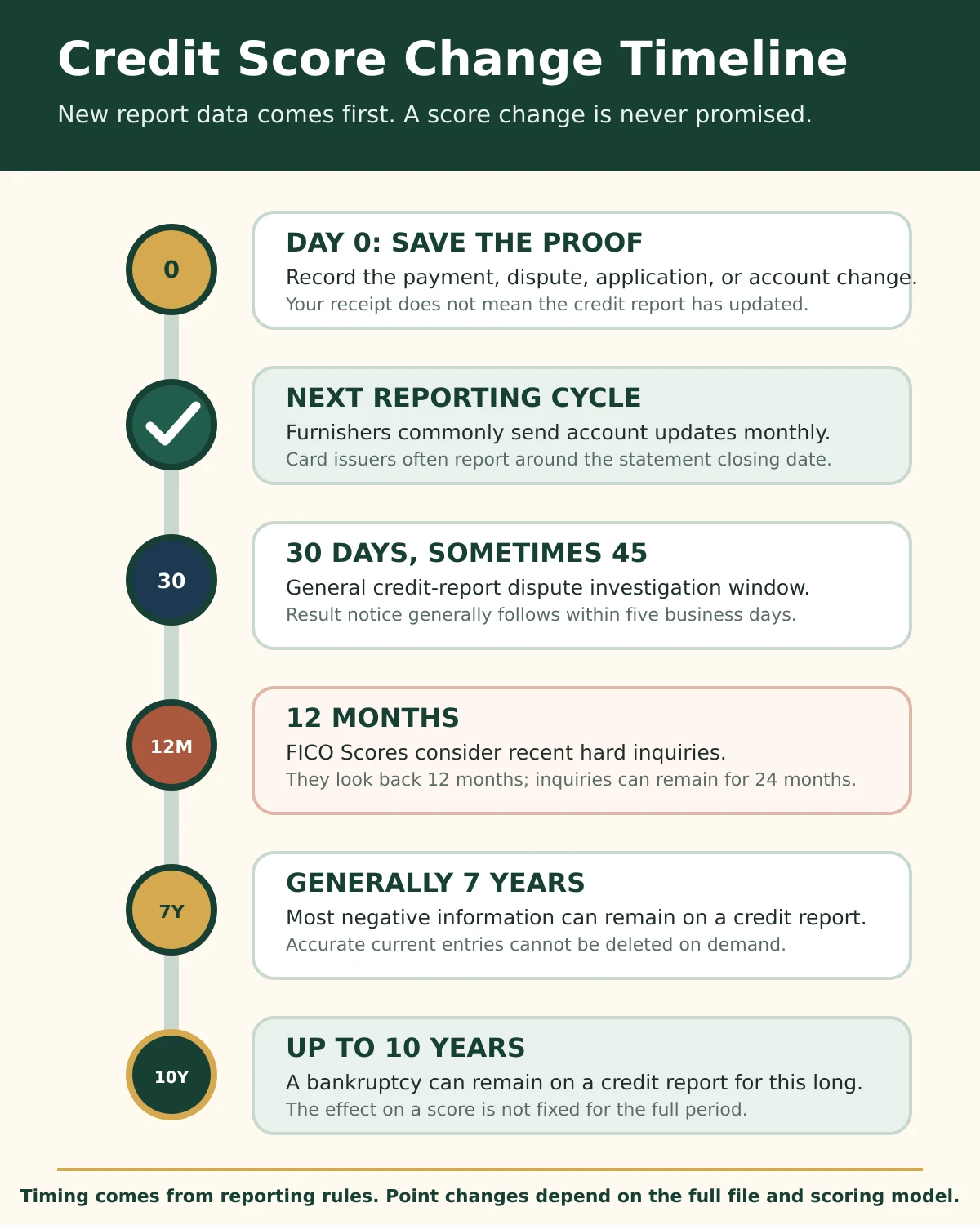
The credit score change timeline in one view
Record the action
Save the payment confirmation, statement, dispute submission, creditor message, and current credit-report entry. A receipt proves what you did. It does not prove that a credit reporting company has received an update.
Look for account data
Credit furnishers commonly send account updates monthly. A card issuer often reports a statement balance once per billing cycle, but schedules vary. Check the report entry before expecting the score to react.
Track a dispute
A credit reporting company generally has 30 days to investigate a dispute. Some cases allow up to 45 days. It generally has five business days after the investigation to notify you of the result.
Build a pattern
One on-time payment adds one reported month. A longer run of current payments can strengthen the file over time, but no official schedule promises a point gain after three, six, or twelve months.
Let hard inquiries age
FICO states that its scores consider hard inquiries posted in the last 12 months. The inquiries can remain on the report for 24 months. Other models can handle inquiry timing differently.
Know reporting limits
Most negative information can generally be reported for seven years. Bankruptcies can remain for up to ten years. Accurate current information cannot be erased simply because it lowers a score.
How long common credit events can take
| Credit event | When the report may change | What the score may do | What to verify |
|---|---|---|---|
| Pay down a credit card | Often after the issuer sends its next balance update, commonly once per billing cycle. | A lower reported revolving balance may help some scores. The size and direction still depend on the full file and model. | Statement closing date, reported balance, credit limit, and all card balances. |
| Pay a card in full by the due date | The old statement balance may remain until the next issuer update. | Interest avoidance and scoring are separate. Paying on time protects payment history; the displayed balance follows reporting timing. | Whether the issuer reported before or after the payment. |
| Correct a report error | After the investigation and any correction, generally within the 30-day process or an allowed 45-day window. | A correction can raise, lower, or leave a score unchanged, based on what changed and the model. | All three reports, written results, and the updated account entry. |
| Open a new account | The inquiry can appear quickly. The new account may appear after the creditor’s reporting cycle. | New credit, account age, balance, and available credit can pull in different directions. | Inquiry type, opening date, limit, balance, and which reports received the account. |
| Close a credit card | After the issuer reports the closed status and any limit or balance change. | Available revolving credit can fall, which can raise utilization. No fixed point loss applies. | Total limits, total reported balances, annual fee, and account status. |
| Pay or settle a collection | After the collector updates the account, if it reports the change. | FICO says paying a collection can increase, decrease, or leave a score unchanged. Model version and the rest of the file matter. | Original delinquency date, balance, status, collector, and whether the entry is accurate. |
| Miss a payment | After the creditor reports the delinquency. Reports often label 30, 60, or more days late. | Recent late payments can weigh heavily. Their effect can weaken with time, while the accurate entry can generally remain for years. | Due date, payment date, account status, and any hardship agreement. |
| Become an authorized user | Only after the issuer reports the account for the authorized user. | The account can help or hurt based on age, payment record, balance, and model treatment. | Whether the issuer reports authorized users and whether the account is managed well. |
Why paying a card does not change every score at once
Credit card scoring uses the balance shown in the credit report, not the live balance inside the card app. The CFPB’s credit-reporting study says furnishers typically send account updates monthly. FICO’s consumer education material says a card issuer generally reports once a month around the statement closing date.
Suppose a statement closes with a $1,000 balance and the cardholder pays it three days later. The card app can show zero while the report still shows $1,000. The lower balance may appear after the next statement update. The account can still be paid on time even while the earlier statement balance remains on the report.
Most FICO score versions use the most recently reported card balances and limits for utilization. FICO Score 10T can also consider report trends. VantageScore versions use their own factors and weights. This is one reason a tactic that changes one score may have a different result in another model.
What to expect after a credit report dispute
Dispute information only when it is inaccurate or incomplete. Send enough detail to identify the entry and explain the error. The CFPB provides free sample letters for disputes sent to a credit reporting company and to the business that supplied the information.
- Pull the reports. Use AnnualCreditReport.com, the federally authorized source for reports from Equifax, Experian, and TransUnion.
- Mark the exact error. Record the company name, account number fragment, dates, balance, status, and the reason the entry is wrong.
- Send proof. Keep copies of statements, payment confirmations, identity records, correspondence, and the submission receipt.
- Track the clock. The investigation is generally due within 30 days. An allowed extension can make the window 45 days.
- Read the result. The credit reporting company generally has five business days after completing the investigation to notify you.
- Compare every report. A furnisher may report to one, two, or all three nationwide credit reporting companies. Confirm each file separately.
A deleted or corrected entry does not promise a fixed score gain. Some errors do not affect scoring. Other changes can matter more. The result depends on the data removed or corrected, the rest of the report, and the model used at that moment.
Myths that create expensive mistakes
| Claim | Reality |
|---|---|
| “Pay this today and gain 50 points tomorrow.” | No scoring company can promise that result for every file. The new data must first reach the report, and the effect depends on the model and full file. |
| “Every score should match.” | Scores can differ by credit bureau data, scoring brand, model version, loan type, and calculation date. |
| “A paid collection must raise the score.” | FICO says the score could rise, fall, or stay unchanged, based on the reported change and the rest of the file. |
| “Accurate negative information can be deleted for a fee.” | Accurate current negative information generally cannot be removed on demand. Errors can be disputed at no cost. |
| “A dispute always finishes in exactly 30 days.” | Thirty days is the general investigation period. Some cases allow up to 45 days, followed by notice of the result. |
| “Checking a score tells me what every lender sees.” | The lender may use another report, model, version, or product score. |
A practical 90-day tracking plan
- Day 0: capture the baseline. Save all three report entries, the score name and version if shown, the date, and the action you took.
- Days 1 to 7: confirm processing. Make sure the creditor received the payment or the credit reporting company received the dispute. Fix missing documents promptly.
- Days 21 to 35: check the report entry. Look for the new balance, status, limit, account, or investigation result. Focus on report data before the score.
- Days 36 to 50: follow an allowed dispute extension. If the case falls under a 45-day window, keep the submission record and wait for the written result.
- Days 51 to 90: keep the pattern clean. Pay every account on time, avoid unnecessary applications, reduce revolving debt where possible, and check that corrected information stays corrected.
Write one line for each check: date, bureau, account, old data, new data, score brand, score version, score source, and next action. That log prevents a change in one score service from being mistaken for a universal result.
When waiting is not the right response
- An account is not yours, or identity theft may be involved.
- A payment was reported late even though records show it was on time.
- A debt appears more than once.
- A balance, limit, status, or delinquency date is wrong.
- A company promises a guaranteed point gain or removal of accurate current information.
- A credit repair company demands payment before completing promised work.
For an error, use the CFPB’s credit report dispute letters. For suspected identity theft, start at IdentityTheft.gov. For a problem with credit reporting or a financial company, the CFPB complaint portal explains the complaint process.
Credit score timing myth check
Read the video transcript
A payment is not an instant command to a credit score. First, you take the action. Next, the lender, servicer, or collector sends an update. A credit reporting company adds the data. Then a scoring model calculates from the available file. Credit card issuers commonly report around a monthly billing cycle. A credit report dispute generally takes 30 days, with up to 45 days in some cases. You also have more than one score because bureau data, model versions, loan types, and dates differ. Paying a collection does not promise one result. FICO says a score can rise, fall, or stay unchanged. Track the report entry, the score brand, the model, and the date. Ignore miracle-point promises. Evidence beats fairy dust.
Credit score change timeline FAQ
How soon can a credit score change after paying a credit card?
A score can react after the card issuer reports the lower balance and the credit report updates. Issuers commonly report around a monthly billing cycle, but the date varies. The score change is not guaranteed.
Why did my balance change but my score stay the same?
The change may not affect the score model enough to move the displayed whole number, or other report changes may offset it. The score brand, model version, bureau data, and calculation date also matter.
How long does a credit report dispute take?
A credit reporting company generally must investigate within 30 days. Some cases allow up to 45 days. It generally has five business days after completing the investigation to notify you of the result.
Will paying a collection raise my credit score?
Not always. FICO says paying a collection can cause a score to rise, fall, or stay unchanged. The reported status, score model, and rest of the credit file affect the result.
How long does a hard inquiry affect a FICO score?
FICO states that its scores consider hard inquiries from the last 12 months. The inquiry can remain on the credit report for 24 months.
Can accurate late payments be removed early?
A person can dispute inaccurate or incomplete information. Accurate current negative information generally cannot be removed simply because it hurts a score. Most negative information can generally remain for seven years.