A strong Risk Management plan protects more than property. It gives you a way to reach money, records, insurance contacts and trusted people when normal routines stop working. Financial disaster preparedness means organizing those parts before an emergency and keeping a short recovery plan you can follow while stressed.
Financial disaster preparedness is a system for protecting records, maintaining access to money, understanding insurance, planning for interrupted income and documenting recovery costs. Start with a secure contact and document list, two ways to pay, an emergency cash plan, a home inventory and a written first-week checklist.
Floods, fires, severe storms, earthquakes, extended outages and evacuations can create the same money problems even when the physical damage differs. You may need to leave quickly, pay for temporary needs, prove ownership, contact an insurer or lender, replace documents and watch for fraud at the same time. The goal is not to predict every emergency. It is to reduce the number of decisions you must make under pressure.
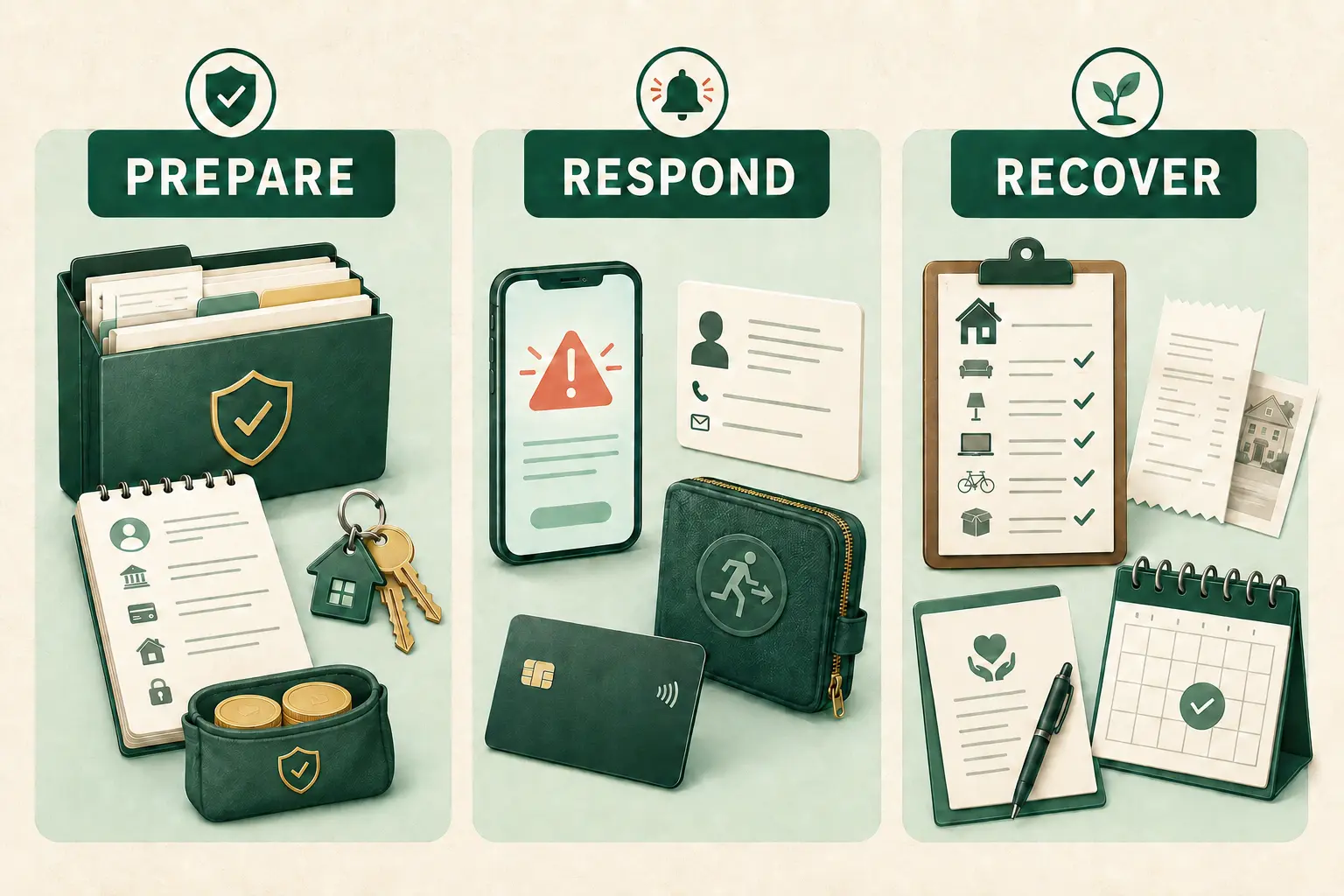
A three-stage financial disaster plan
Prepare
Protect contact details and records, review coverage, build payment backups and assign family roles.
Respond
Follow safety instructions, protect account access, document damage and start a dated claim and expense log.
Recover
Use verified assistance channels, replace documents, review bills and credit, and keep every receipt and case number.
10 steps for financial disaster preparedness
1. Build one emergency contact and account list
Write down the names, websites and contact methods for your bank or credit union, card issuers, insurers, mortgage company or landlord, utilities, employer, health providers and a trusted out-of-area contact. Include policy and account reference numbers, but do not keep passwords or security codes on the same sheet.
The Consumer Financial Protection Bureau disaster-preparation guide recommends gathering account numbers and contact information before an emergency. Review the list twice a year and after a move, job change, new loan or insurance change.
2. Protect copies of essential records
Keep copies of identification, insurance policies, property records, lease or mortgage information, recent tax records, vehicle titles, health information and pet records. Store them in more than one protected place. One copy might be in a fire- and water-resistant container, while an encrypted digital copy is kept in secure storage that can be reached away from home.
FEMA’s Emergency Financial First Aid Kit provides a structured way to organize financial, household and medical information. Do not carry every original document during an evacuation when a protected copy will meet the immediate need.
3. Create two ways to reach money and make payments
An outage can disable one payment route without affecting another. Keep a backup payment method, know how to reach your bank without a saved browser session and consider a modest amount of emergency cash in small denominations. Choose the amount from likely short-term needs, household size and storage safety. Do not keep your entire emergency fund at home.
Your larger reserve can stay in an accessible insured account. Use the MoneyBucket emergency fund guide to build it gradually, or check how long it may cover core expenses with the Emergency Fund Runway Calculator.
4. Read the coverage, exclusions and deductibles
Record each policy number, deductible, covered property and claim contact. Ask the insurer what is excluded, what proof of loss may be required and whether temporary living costs are covered. Photograph rooms and valuable property, save major-purchase receipts when available and update the inventory after renovations or expensive purchases.
Flood risk deserves its own check. The National Flood Insurance Program explains that most homeowners insurance does not cover flood damage. Coverage, waiting periods and eligibility can vary, so review the current policy and ask a licensed insurance professional about your property and location. The MoneyBucket guide to insurance and financial security can help you organize the larger review.
5. Plan for interrupted income
List the bills that must be paid first if income stops or access to your home is restricted. Housing, food, medicine, transportation, insurance and essential utilities usually belong near the top. Record the employer’s emergency contact method, remote-work rules, paid-leave process and any benefit or union contact that may apply.
Do not assume every automatic payment should continue unchanged. Keep a list of due dates so you can review charges and contact providers quickly. The Unexpected Expenses guide provides a bill-triage order for short cash gaps.
6. Protect account access before the emergency
Use unique passwords and multifactor authentication for email, banking and insurance accounts. Save account-recovery codes in a protected place that is separate from the device used to sign in. Check that a trusted contact knows where the emergency instructions are stored without giving that person unrestricted access to accounts.
If a phone, wallet or computer is lost during an emergency, change exposed credentials and contact financial providers through a verified website or the number printed on a card or statement. The Identity Theft Protection guide explains credit freezes, fraud alerts and recovery steps.
7. Assign roles and a meeting point
A financial plan works better when it is connected to the household emergency plan. Decide who takes the document container, who handles medication and pets, who contacts family, and who keeps the claim log. Choose a nearby meeting point and an out-of-area contact. Ready.gov’s emergency plan guidance can help households account for communication, shelter and evacuation needs.
8. Use a first-day response checklist
- Follow local safety and evacuation instructions first.
- Contact the insurer when it is safe and ask what documentation is required before cleanup or repairs.
- Photograph or record damage without entering an unsafe area.
- Start a dated log for calls, claim numbers, assistance applications and expenses.
- Save receipts for temporary housing, food, transportation, cleanup and replacement items.
- Tell lenders, utilities and service providers when disruption may cause a missed payment.
9. Apply through verified recovery channels
Use DisasterAssistance.gov to check federal assistance after a declared disaster. Save the application number, every document submitted and the date of each contact. Assistance rules, deadlines and covered costs depend on the event and program. Insurance and federal assistance are not interchangeable, so follow the instructions from both sources.
If essential identification was lost or damaged, use FEMA’s Replacing Vital Documents guide to reach the agency responsible for each record. The IRS may announce filing or payment relief for qualifying disaster areas. Check the IRS disaster tax relief page rather than assuming an extension applies.
10. Slow down recovery payments and verify every request
Urgency makes recovery fraud more effective. Do not send money because a caller claims to represent a government agency, insurer, utility or contractor. Find the official contact independently. Get repair scope, price, license information and payment terms in writing. Keep invoices and receipts, and avoid anyone demanding gift cards, cryptocurrency, wire transfers or full cash payment before work is complete.
The Federal Trade Commission lists common post-disaster scam warning signs. Verify contractors through the licensing authority that applies where the work will be performed.
Financial disaster preparedness checklist
| Item | What to record | Where to keep it | Review trigger |
|---|---|---|---|
| Contacts | Financial providers, insurers, housing, employer, utilities and trusted contact | Protected paper copy and encrypted digital copy | Move, job change or new account |
| Documents | Identification, policies, property, tax, medical and pet records | Two protected locations | Renewal or replacement |
| Money access | Backup payment route and modest emergency cash | Separate safe locations | Bank, card or household change |
| Insurance | Policy, deductible, exclusions, inventory and claim contact | With protected records | Renewal, move or major purchase |
| Recovery log | Dates, contacts, case numbers, claims, costs and receipts | Paper notebook plus protected digital backup | Every emergency or claim |
A 20-minute twice-yearly reset
- Open the contact list and remove outdated entries.
- Confirm that protected document copies are readable.
- Check insurance deductibles and the home inventory.
- Test account-recovery methods and backup payment access.
- Review the first-day checklist with household members.
- Check emergency reserves against current essential costs.
Track the reserve and recent preparedness purchases in your regular spending system. The Tracking Expenses guide can help separate ongoing household costs from one-time emergency preparation.
Financial disaster preparedness questions
What is financial disaster preparedness?
It is a plan for protecting records, keeping access to money, understanding insurance, managing interrupted income and documenting recovery costs before an emergency occurs.
Which documents should I copy for an emergency?
Start with identification, insurance policies, housing and vehicle records, recent tax information, health information, account contacts and pet records. Keep protected copies in more than one location.
How much emergency cash should I keep at home?
There is no universal amount. Choose a modest sum based on short-term food, fuel, medicine and transportation needs, household size and safe storage. Keep the larger emergency reserve in an accessible insured account.
Does homeowners insurance cover flood damage?
Most homeowners insurance does not cover flood damage. Review the current policy and ask a licensed insurance professional whether separate flood coverage fits the property’s risk.
When should I apply for disaster assistance?
Check DisasterAssistance.gov after a declared disaster and follow the event’s current instructions and deadlines. Save the application number and copies of every document submitted.
How can I avoid disaster recovery scams?
Contact agencies and companies through verified channels, check contractor licenses, get promises in writing, save receipts and reject demands for gift cards, cryptocurrency, wire transfers or full cash payment before work is complete.
Official preparedness and recovery resources
- Ready.gov Emergency Financial First Aid Kit
- Consumer Financial Protection Bureau disaster preparation
- DisasterAssistance.gov
- FEMA guide to replacing vital documents
- Federal Trade Commission disaster scam guidance