A personal loan is new debt, even when it is used to handle an old debt problem. Start with the MoneyBucket Debt Management Guide, then compare the full loan cost with the expense or balance you need to handle.
Many personal loans are installment loans with scheduled payments. Some are unsecured. Others may involve collateral. Rates, fees, loan amounts, payment rules and terms vary by lender, product and applicant.
How should you compare personal loans?
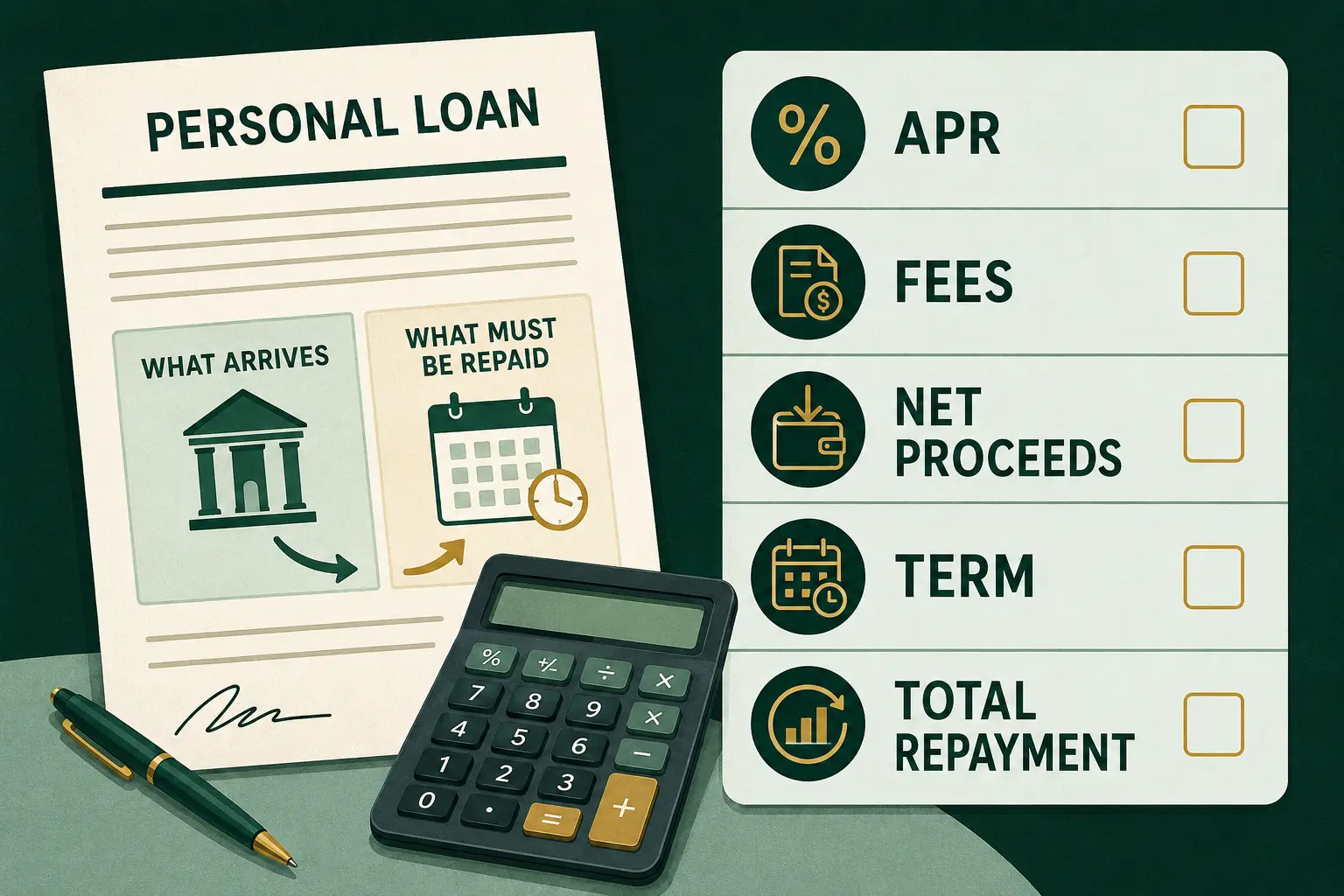
Compare APR, fees, net proceeds, rate type, monthly payment, payment count, total repayment and collateral. Then compare at least one alternative tied to the expense. A smaller payment or fast deposit does not prove that the loan costs less or solves the problem safely.
1. Record every term before applying
Do not compare personal loans by payment alone. Ask for a written offer or disclosure and copy each figure into one table.
| Term | Offer A | Offer B | Reason to compare |
|---|---|---|---|
| Requested amount | _____ | _____ | The starting amount may differ from what reaches your account. |
| Net proceeds | _____ | _____ | An upfront fee may be deducted before funds are sent. |
| APR | _____ | _____ | APR includes the rate and certain finance charges. |
| Rate type | _____ | _____ | Confirm whether the rate and payment can change. |
| Monthly payment | _____ | _____ | The payment must fit after essential bills. |
| Payment count | _____ | _____ | More payments may create a higher total cost. |
| Total repayment | _____ | _____ | This shows what the scheduled loan requires overall. |
| Collateral and fees | _____ | _____ | Record property at risk and every stated charge. |
CFPB notes that personal installment loans can carry origination fees, documentation fees, optional credit or disability insurance, late fees and other charges. Read the disclosures and agreement rather than treating the headline rate as the final cost.
2. Compare APR, not only the interest rate
The interest rate is the price charged for borrowing the principal. APR is a standardized annual measure that includes the rate and certain finance charges. A loan with a lower interest rate can have a higher APR when upfront loan charges are larger.
Compare APR with APR for similar loan amounts and terms. Then compare total repayment, since a longer term can keep the APR lower than another offer while producing more interest over time.
3. Check what arrives after fees
An origination fee may be paid separately or deducted from the funds. If a lender approves $10,000 and deducts a $700 fee, the borrower receives $9,300 even though the repayment obligation may be based on the full financed amount under the contract.
Make sure the net proceeds cover the bill. Do not borrow more only to replace money removed by a fee without checking the added repayment cost.
4. Test the payment and the term
A predictable payment can help with budgeting. It does not mean the loan is inexpensive. A longer term can lower each payment while raising the amount paid over the full schedule.
Payment test
Does the payment fit after housing, food, utilities, healthcare, transportation, insurance and required debt payments?
Total test
Is the finance charge and total repayment acceptable for the expense, and will the debt remain after the benefit is gone?
Use the MoneyBucket budgeting guide to place the payment inside an honest plan based on take-home income.
5. Confirm whether collateral is involved
Many personal loans are unsecured, but not all are. A secured installment loan may place a savings account, vehicle or other property at risk under the agreement. Ask what secures the loan, what counts as default and what remedies the lender may use.
6. Test a personal loan used for debt consolidation
Replacing credit-card balances with a loan does not automatically save money. Compare the current debts’ APRs and planned payoff cost with the new APR, origination fee, term and total repayment.
A loan can also fail when paid-off cards fill up again. Read the MoneyBucket debt-consolidation guide for the full cost and cash-flow tests.
7. Compare alternatives tied to the bill
Before converting a temporary shortage into months or years of payments, ask whether the expense has another route:
- A creditor or provider payment plan
- An insurance claim
- Employer or union assistance
- A utility hardship program
- Medical financial assistance
- A return, refund or sale
- A lower-cost offer from an existing bank or credit union
- Local nonprofit or government aid
The right comparison depends on the bill. A necessary repair that protects income is different from a purchase that can wait. If cash reserves are the missing piece, use the emergency fund guide to set the next savings target after the current problem is stable.
8. Reject advance-fee loan promises
The FTC warns about companies that promise a loan or credit, demand an upfront “processing,” “insurance” or similar fee, and never provide the loan. A legitimate lender may charge disclosed fees, but a company should not guarantee credit only because the applicant paid first.
Verify the lender through contact details found independently. Check any state license or registration through the applicable state financial regulator. Do not send money by gift card, cryptocurrency or wire transfer to secure a promised loan.
9. Read the agreement before accepting funds
- The legal lender name and contact information are clear.
- The amount borrowed and net proceeds are clear.
- The APR, interest rate and rate-change rules are clear.
- Every origination, documentation, insurance and late fee is listed.
- The payment, payment count and total repayment match the offer.
- Any collateral and default rights are identified.
- Automatic-payment terms and prepayment rules are understood.
- No approval guarantee required an upfront payment.
Personal-loan questions
Are personal loans always unsecured?
No. Many personal loans are unsecured, but some installment loans may be secured by collateral. Read the contract and identify any property at risk.
Do personal loans always have fixed rates?
No. Terms vary. Confirm whether the rate and payment are fixed or can change, and read how any change would be calculated.
What fees can a personal loan charge?
Depending on the lender and product, charges may include origination, documentation, late, optional insurance and other fees. Review the disclosures and agreement.
Can a personal loan help with credit-card debt?
It may simplify repayment or lower borrowing cost when the actual APR and fees are lower. It may cost more when the term is longer or paid-off cards are used again.
What are net proceeds on a personal loan?
Net proceeds are the funds the borrower receives after any charges deducted before disbursement. Compare that amount with the full amount and repayment obligation shown in the agreement.
Should I take a personal loan for an emergency?
Compare the loan with payment plans, insurance, hardship programs, local aid and lower-cost credit tied to the expense. If borrowing is still needed, test the APR, fees, payment and total repayment against the budget.
Compare what arrives with what leaves later
Write down the net proceeds, APR, every fee, payment count and total repayment. Then place the best alternative beside it.
Sources and further reading
MoneyBucket provides general educational information, not individualized financial, tax or legal advice. Loan terms, state rules, lender policies and household facts vary. Read the complete agreement and get qualified help when collateral, collections or an urgent deadline is involved.