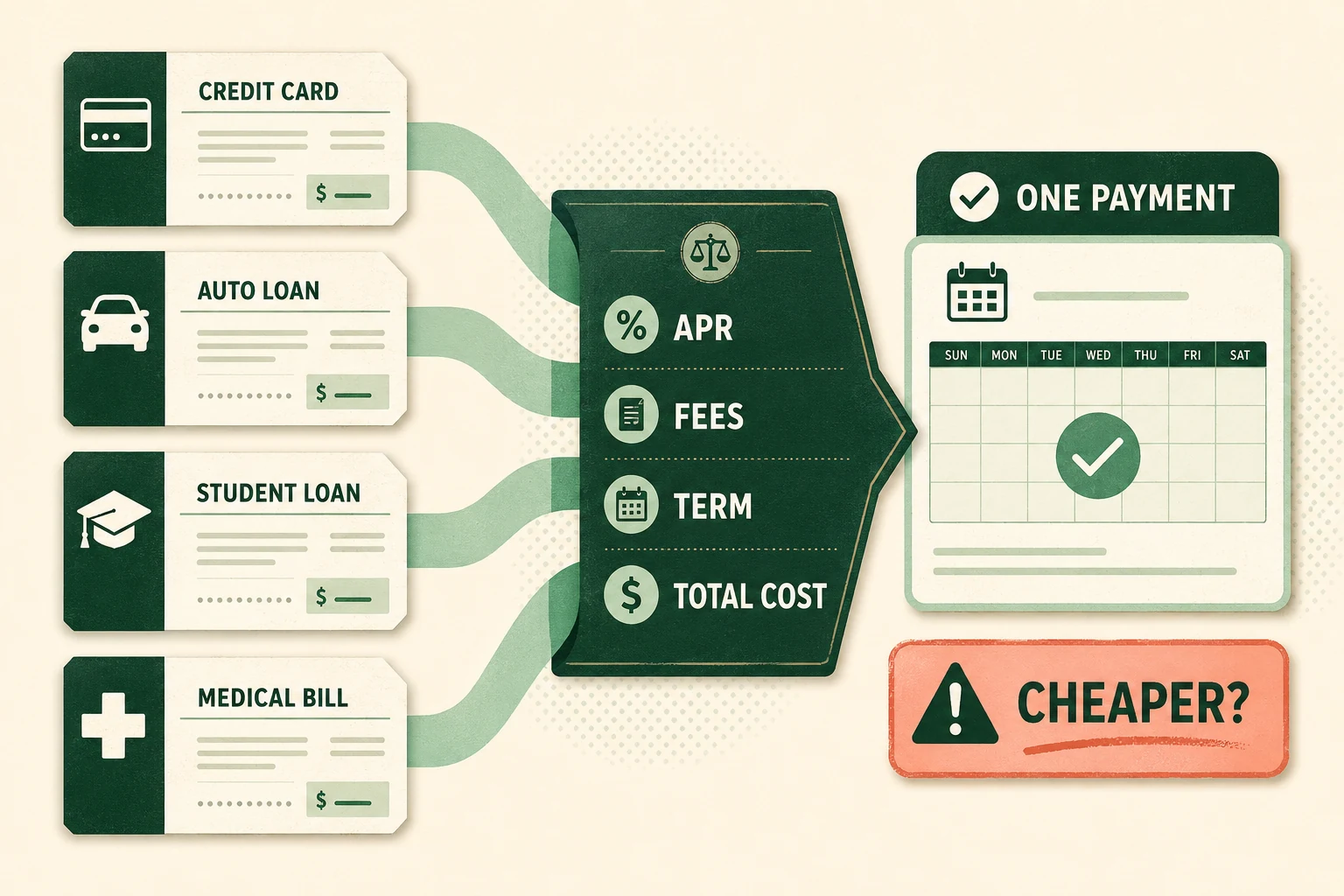
Debt consolidation can simplify several balances into one payment, but start with the MoneyBucket Debt Management Guide before applying for another account. The useful question is not “Can I get one payment?” It is “Will the new plan cost less, fit my budget and reduce the chance that I end up with both the old debt and new debt?”
The Consumer Financial Protection Bureau warns that a smaller payment can still cost more when the repayment period is longer or the account carries fees, promotional pricing or other costs. One payment is not a saving by itself.
When does debt consolidation make sense?
A consolidation plan may help when its APR and fees produce an acceptable total repayment, its payment fits the real budget, its term does not stretch debt needlessly, and the borrower has a plan to prevent new balances. Compare the new offer with the current payoff plan. Count promotional deadlines and collateral risk.
What debt consolidation means
Debt consolidation generally means using a new credit product or a structured repayment arrangement to combine or repay several existing debts.
Credit products
- Personal or consolidation loan
- Balance-transfer credit card
- Home-equity loan or line of credit
Repayment service
- Nonprofit credit-counseling plan
- One payment sent through the counseling organization
- Participating creditors paid under the plan
Debt settlement is different. A settlement company may seek creditor agreement to accept less than the full balance, often after payments stop. That can bring added interest, fees, collection calls, lawsuits, credit-report damage and possible tax effects. Do not treat settlement as another name for refinancing.
1. List every debt before moving any balance
Copy the figures from current statements. Include accounts that are current, late, charged off or in collections.
| Debt | Balance | APR or rate | Required payment | Remaining term | Fees and status |
|---|---|---|---|---|---|
| Credit card A | Your balance | Your APR | Your minimum | Open-ended | Current or late |
| Loan B | Your balance | Your rate | Your payment | Payments left | Fee and collateral notes |
| Collection C | Claimed balance | Check records | None or plan | Check status | Verify before paying |
Total the current monthly payments. Estimate the repayment cost under the payoff plan you would use without consolidation. The debt repayment budget guide puts essential expenses, required payments and a safety buffer ahead of extra payments.
2. Run the total-cost test
For each offer, record the amount borrowed or transferred, APR, origination or transfer fee, monthly payment, repayment term, promotional deadline, rate-change rules, total payments and collateral.
Compare that figure with the amount you expect to repay under the current plan. A payment that drops from $700 to $475 may feel easier. If the new term adds several years, the interest and fees may make it more expensive.
3. Check a debt-consolidation loan
A consolidation loan is commonly an installment loan used to pay several balances and replace them with scheduled payments. The offer may have a fixed payoff date, but the cost depends on the actual terms.
What may help
- One due date
- A fixed schedule when the terms are fixed
- A lower APR than some current debts
What can erase the benefit
- Origination fees
- A longer term
- A rate that is not lower
- Fresh card spending after payoff
Do not apply based on an advertised “as low as” rate. Compare the written offer issued for your application, including net proceeds and total repayment.
4. Calculate the balance-transfer deadline
A balance-transfer card may offer a low or 0% promotional APR for a limited period. Record the transfer fee, promotional end date, APR after the promotion, minimum payment, credit limit and any effect a late payment may have on the offer.
This simple target does not account for new charges or other contract terms. If the resulting payment is not realistic, the promotion may delay interest rather than remove it. Read the MoneyBucket Credit Cards Guide before using another revolving account.
5. Treat home equity as secured borrowing
A home-equity loan or line of credit may carry a lower rate than unsecured debt, but the home becomes collateral. Credit-card balances that were not secured by the home become debt tied to the property.
Compare the rate, closing or account fees, variable-rate risk, draw period, repayment period and total cost. Do not assume the interest creates a federal tax deduction. Tax treatment depends on current law, use of proceeds and household facts. Check current IRS material or ask a qualified tax professional.
6. Compare nonprofit credit counseling
A credit counselor may review the budget and discuss a debt management plan. CFPB explains that a debt management plan is not a new loan. The client sends one payment to the counseling organization, which pays participating creditors under the plan.
Ask about setup and monthly fees, creditor participation, rate or fee concessions, account-closing rules, plan length and what happens after a missed payment. Nonprofit status does not make every service free or suitable.
7. Separate debt consolidation from debt settlement
Be cautious when an ad says “consolidation” but the company asks you to stop paying creditors and send money to a settlement account. CFPB says settlement can bring added fees and interest, stronger collection activity and lawsuits, and some creditors may refuse to work with the company.
Get the exact service, fees, creditor contact plan, refund terms and expected timeline in writing before providing bank details. Federal rules limit when certain for-profit debt-relief companies may collect fees, but that does not remove the financial and legal risks of stopped payments.
8. Ask creditors about direct hardship help
Before opening another account, ask existing creditors whether they offer a hardship plan, temporary rate reduction, smaller payment, fee waiver, due-date change or structured repayment. Get any agreement in writing and ask how it affects credit reporting, interest and the payoff date.
9. Repair the cash-flow problem at the same time
Consolidation changes the debt structure. It does not change the cause of the balances. Build a budget that covers essential expenses, required payments and a small reserve. If reliable income is still lower than essential costs and required payments, another account may leave the household with the new loan and returning card balances.
Use MoneyBucket’s avoiding new debt guide to set spending limits and backup plans for expenses that used to land on credit.
Debt consolidation checklist
- The new APR is lower after fees are counted.
- The total repayment is acceptable.
- The term is not longer only to produce a smaller payment.
- The promotional deadline and later APR are clear.
- Any collateral risk is acceptable.
- The payment fits a budget based on reliable income.
- Creditor hardship options were checked.
- There is a plan for paid-off cards and future expenses.
Debt-consolidation questions
Does debt consolidation improve your credit score?
Not automatically. A new application, new account, balance changes, payment history, card use and account closures can affect credit. The goal should be a workable repayment plan, not a promised score increase.
Is a lower monthly payment always better?
No. A lower payment may come from a longer term, which can raise total interest and keep the debt open longer. Compare total repayment and fees as well as the payment.
Is debt settlement the same as debt consolidation?
No. Consolidation generally combines or refinances debt. Settlement seeks creditor agreement to accept less than the full balance and can involve stopped payments, added costs, collections, lawsuits and credit damage.
Should I use home equity to pay credit-card debt?
That turns debt not secured by the home into debt secured by the property. Compare the rate and total cost, but also weigh closing costs, rate changes and the risk to the home if the debt cannot be repaid.
Is a 0% balance transfer free?
Not necessarily. The card may charge a transfer fee, the promotion expires, and a later APR may apply to the remaining balance. Calculate the monthly amount needed to finish before the deadline.
Is a debt management plan a new loan?
No. A debt management plan is a structured payment arrangement administered by a credit-counseling organization. Review fees, participating creditors, account rules, concessions and the plan length.
Make one payment prove its value
Put the current payoff plan beside the new offer. Compare APR, fees, term, total repayment, collateral and the payment your budget can repeat.
Sources and further reading
- CFPB: Credit Counseling, Settlement and Consolidation
- CFPB: Consolidating Credit-Card Debt
- CFPB: Debt-Consolidation Advertising
- CFPB: Debt-Relief Program Risks
MoneyBucket provides general educational information, not individualized financial, tax or legal advice. Credit terms, tax treatment, state law, creditor policies and household facts vary. Read each agreement and seek qualified help when debt is tied to a home, lawsuit or urgent collection deadline.