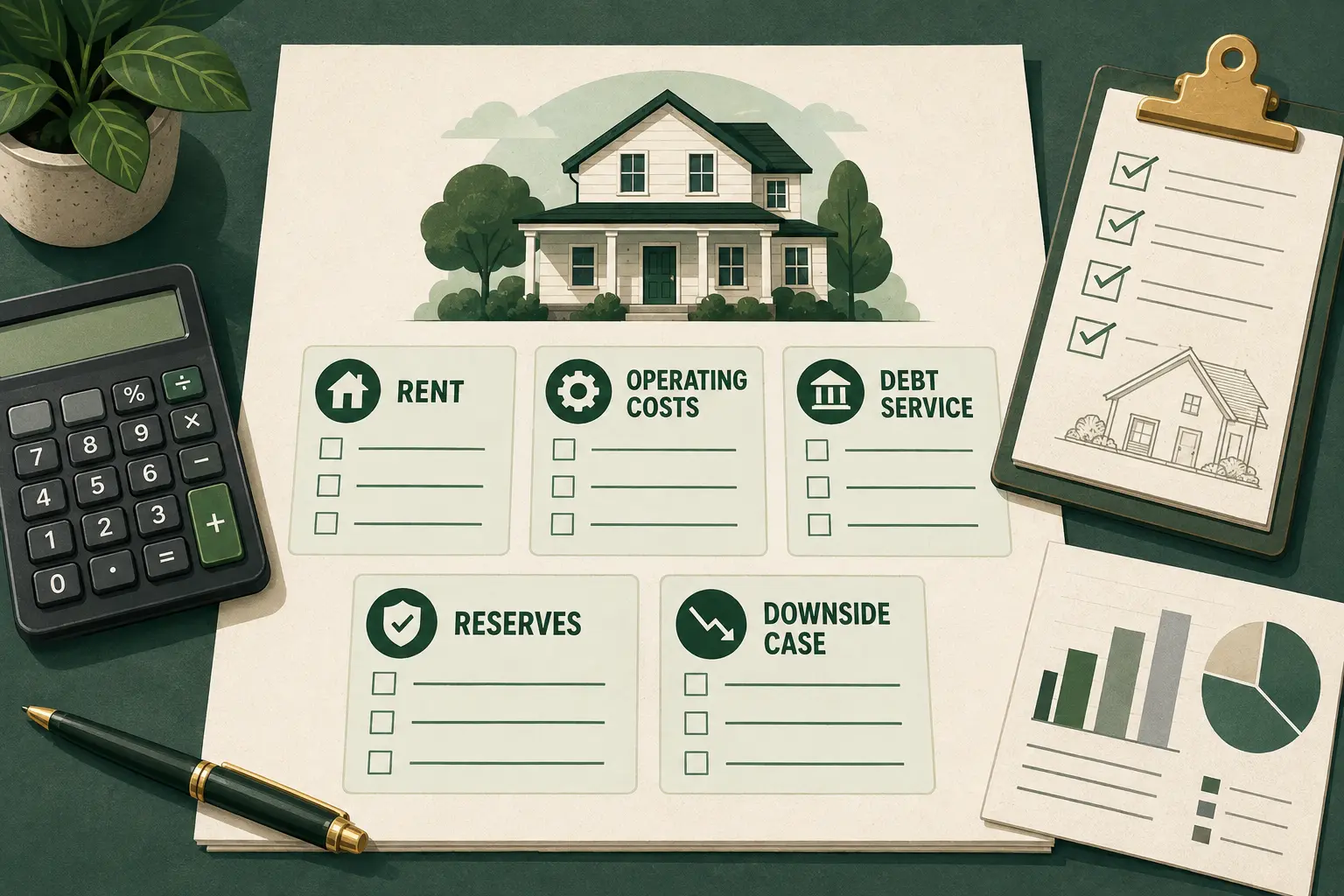
A rental property is an operating asset, not a guaranteed passive paycheck. Before buying, test the property using all-in cash needs, evidence-based rent, recurring costs, financing, reserves, management time and downside cases. The Real Estate Investing guide puts rental ownership alongside other ways to invest in property.
1. Calculate all-in cash before closing
| Cash item | What to collect |
|---|---|
| Purchase and financing | Purchase price, down payment, closing costs, lender fees and required escrows. |
| Due diligence | Inspection, appraisal, specialist inspections, title work and other review costs. |
| Pre-rental work | Immediate repairs, safety work, cleaning, turnover and leasing costs. |
| Cash after closing | Reserve balance left after every acquisition and repair cost is paid. |
Compare loan structures with the Investment Property Financing guide.
2. Estimate rent from evidence
Use comparable rentals that match location, size, condition, amenities and lease terms. A seller’s projected rent is a number to test, not proof.
- Current lease and rent when occupied
- Comparable asking rents
- Comparable signed rents when reliable data are available
- Vacancy and turnover assumptions
- Owner-paid utilities
- Concessions or leasing incentives
If the deal depends on a quick rent increase, verify that the increase is realistic and allowed before counting it.
3. Build a full operating-cost budget
| Cost group | Possible items |
|---|---|
| Fixed and required | Property taxes, landlord insurance, association dues, licenses, registrations and inspections. |
| Operations | Repairs, routine maintenance, owner-paid utilities, landscaping, pest control and accounting. |
| Leasing and management | Management, tenant placement, advertising, screening, lease work and turnover. |
| Irregular costs | Vacancy, major replacements and legal costs. |
4. Keep NOI, cash flow and taxable income separate
Gross scheduled rent
minus vacancy and credit loss
plus other property income
equals effective gross income
Effective gross income
minus operating expenses
equals net operating income, or NOI
NOI
minus debt service
minus planned owner capital spending not already counted
equals estimated pre-tax cash flow
Loan principal and interest are not operating expenses in the NOI calculation. Cash flow and taxable rental income are also different measures. IRS Publication 527 covers rental income, expenses, repairs, improvements and depreciation.
5. Run downside cases
Prepare at least a base case, a vacancy case and a major-repair case. Test insurance or property-tax increases, no rent growth, a major system failure and a financing change if the loan could reset or require refinancing.
Record the point where cash flow turns negative and how much cash would be needed to carry the property through that period.
6. Set a reserve policy
Rental ownership can create large irregular costs. Build reserves around the property’s age, condition, insurance deductible, financing and major systems rather than using one universal months-of-expenses rule.
- Roof and exterior
- Heating and cooling
- Plumbing and electrical
- Appliances
- Turnover
- Insurance deductibles
- Vacancy
7. Count management as a real cost
Self-management saves a management fee only if your time and systems can handle advertising, screening, leasing, rent collection, maintenance, vendors, accounting, notices, inspections and turnover. If using a manager, use the actual quoted fee structure, including leasing or renewal fees.
8. Keep fair-housing and local landlord rules in the operating plan
HUD states that the federal Fair Housing Act prohibits housing discrimination based on race, color, national origin, religion, sex, familial status and disability. State and local law can add protections or rules.
Use written rental criteria, apply them consistently, document the process and check current local requirements before advertising, screening, collecting deposits, issuing notices or ending a tenancy.
9. Plan the exit before you buy
Ask how long the property may take to sell, what selling costs could apply, whether you can hold through a weak rental market, what could force a sale and how much of your net worth would depend on one property or local market.
Use the Real Estate Portfolio guide to check concentration across properties and financing.
Rental-property due-diligence checklist
- All-in acquisition cash
- Rent evidence and current lease records
- Operating-cost estimates and insurance quote
- Property-tax estimate
- Major-system condition
- Financing terms
- Reserve plan
- Base, vacancy and repair cases
- Local landlord and licensing requirements
- Fair-housing compliant process
- Management plan and actual fees
- Exit and concentration assumptions
Frequently asked questions
Is rental property passive income?
Not automatically. Even with a manager, the owner keeps financial, legal and oversight duties.
Does rental property always appreciate?
No. Property values can rise or fall. The deal should not require a chosen appreciation rate to work.
What costs should I include before buying?
Include taxes, insurance, maintenance, major replacements, vacancy, management, leasing, owner-paid utilities, financing and other property costs.
Are rental-property tax benefits guaranteed?
No. Tax treatment depends on the property, use, income, expenses, depreciation, ownership and taxpayer facts.
Sources
- IRS Publication 527: Residential Rental Property
- IRS Topic 414: Rental Income and Expenses
- HUD: Fair Housing Act Overview
Educational information only, not investment, tax or legal advice. Property results, taxes and landlord duties vary by property, financing and location.