Pay Stub Guide
Paycheck Deductions Explained: Where Your Money Went
A deduction is money taken from gross pay for taxes, benefits, retirement savings, court orders, or another authorized charge. The fastest way to check one is to identify its label, find whether it is pretax or post-tax, compare the amount with your election or notice, and inspect the year-to-date total.
What are the deductions on a paycheck?
Common paycheck deductions include federal, state, and local income-tax withholding; Social Security and Medicare taxes; health and insurance premiums; retirement contributions; flexible or health savings contributions; union dues; wage garnishments; and employee purchases. Your pay stub may use abbreviations, so compare each label with your benefits election, W-4, state withholding form, payroll portal, and any written authorization.
Four Types of Paycheck Deductions
Tax withholding
Federal income tax, state or local income tax where applicable, Social Security tax, Medicare tax, and any extra withholding you requested.
Benefits and savings
Health, dental, vision, life or disability coverage, retirement-plan contributions, and eligible spending-account contributions.
Required orders
Amounts withheld under a valid child-support order, tax levy, creditor garnishment, bankruptcy order, or another lawful directive.
Other payroll deductions
Union dues, charitable gifts, loan repayments, parking, transit, uniforms, meals, equipment, or other charges permitted under the applicable rules.
Common Pay-Stub Abbreviations
| Possible label | What it usually means | What to compare |
|---|---|---|
| FIT, FITW or FED | Federal income-tax withholding | Your Form W-4 settings and taxable wages |
| SS, OASDI or FICA-SS | Employee Social Security tax | Social Security wages and the current employee rate |
| MED or FICA-MED | Employee Medicare tax | Medicare wages and the current employee rate |
| SIT or SWT | State income-tax withholding | Your state form, work state, and resident-state rules |
| MED, DENT or VIS | Medical, dental, or vision premium | Your enrollment confirmation and coverage tier |
| 401K, 403B or RET | Retirement-plan contribution | Your elected percentage or flat amount |
| HSA, FSA or DCFSA | Health, flexible, or dependent-care account | Your annual election and per-paycheck amount |
| GAR, LEVY or SUPPORT | Garnishment, tax levy, or support order | The official notice, balance, limits, and payroll contact |
Labels are not standardized across payroll systems. If a code is unclear, ask payroll for its full name and whether it changes federal income-tax, Social Security, Medicare, state, or local taxable wages.
Pretax vs. Post-Tax Deductions
Pretax deduction
A qualifying amount is subtracted before one or more taxes are calculated. The tax treatment depends on the benefit and plan. Some deductions reduce federal income-tax wages but do not reduce Social Security or Medicare wages.
Post-tax deduction
The deduction is taken after applicable taxes are calculated. It lowers take-home pay but does not lower taxable wages for that paycheck.
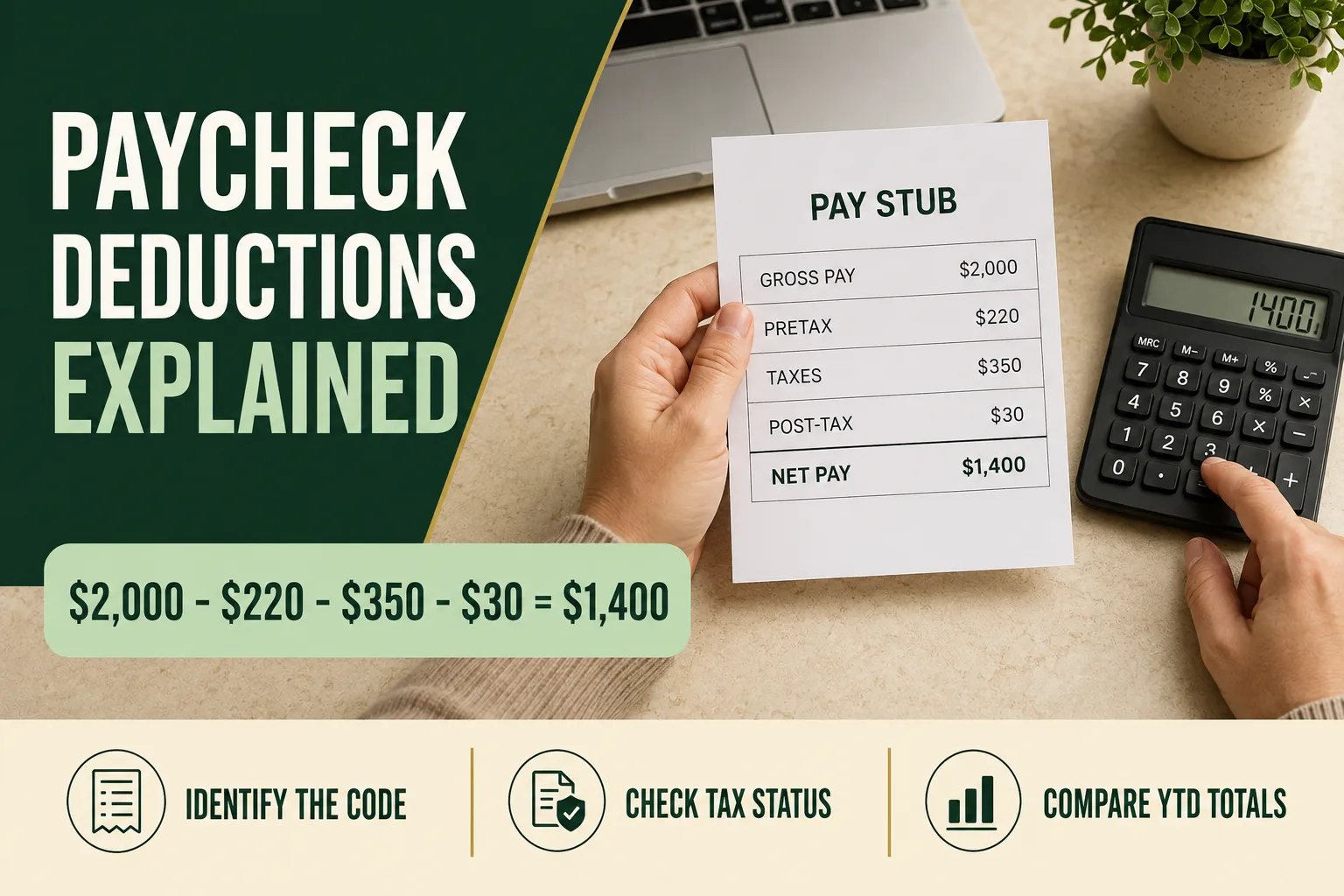
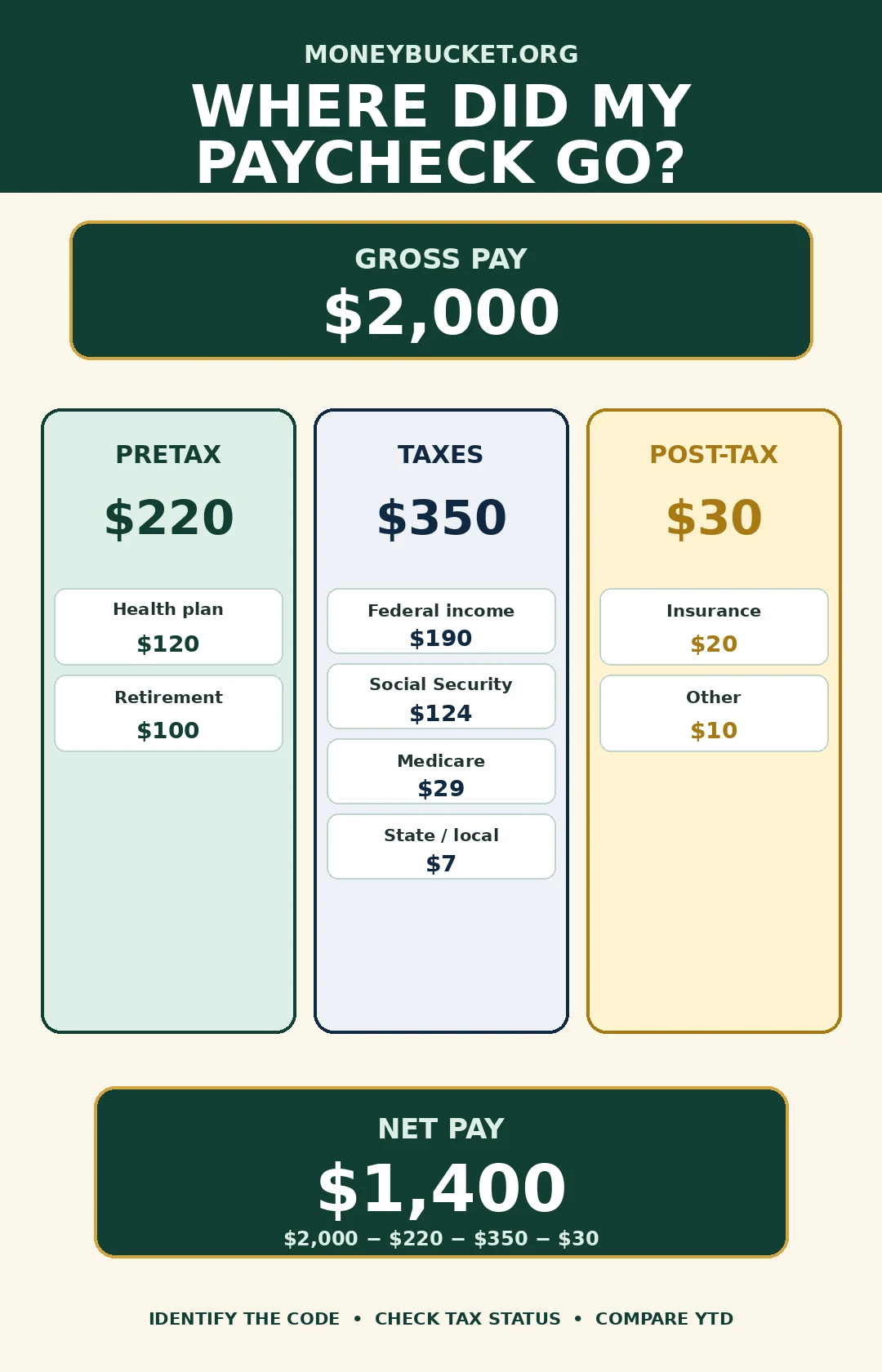
Worked Example: From $2,000 Gross to $1,400 Net
Gross pay: $2,000
Pretax deductions: $120 health plan + $100 retirement contribution = $220
Taxes withheld: $350
Post-tax deduction: $30
Net pay: $2,000 − $220 − $350 − $30 = $1,400
This example shows how the statement reconciles. It does not calculate the tax due because each tax can use a different wage base, and income-tax withholding depends on payroll frequency, earnings, Form W-4 settings, and current tax tables.
Paycheck Deductions Explained in 53 Seconds
Read the video transcript
- 00:00–00:06: Paycheck deductions explained. Every dollar taken out should have a name, a reason, and a record.
- 00:06–00:13: Start with gross pay. Confirm earnings before you inspect what came out of the paycheck.
- 00:13–00:19: Expand every code. Turn payroll abbreviations into full names before deciding a line is wrong.
- 00:19–00:26: Mark pretax and post-tax. Ask which taxable wage bases each deduction changes.
- 00:26–00:32: Compare benefit elections. Check the plan, coverage tier, amount, and effective date.
- 00:32–00:39: Review tax settings. Compare payroll records with your current W-4 and state withholding form.
- 00:39–00:45: Check current and year-to-date totals. Look for a duplicate, skipped deduction, sudden increase, or unexpected restart.
- 00:45–00:53: Reconcile net pay. $2,000 gross minus $220 pretax, $350 in taxes, and $30 post-tax equals $1,400 net pay.
The example is hypothetical and provided for general education.
Do the paycheck numbers add up?
If you are paid hourly, Paycheck Proof helps you compare recorded hours, base rate, overtime hours, and overtime pay against the pay stub. Use this page to review deductions, taxes, and net pay separately.
Check Every Deduction in Seven Steps
- Start with gross pay. Confirm the earnings total before reviewing money taken out.
- Expand every code. Use the payroll portal or ask payroll what each abbreviation means.
- Mark pretax and post-tax items. Ask which taxable wage bases each item changes.
- Compare benefit elections. Check the plan, coverage tier, annual election, percentage, and effective date.
- Review tax settings. Compare your current W-4 and state form with the payroll record. Use the W-4 withholding checkup for a step-by-step federal withholding review.
- Check current and year-to-date columns. Look for a duplicate, skipped deduction, sudden increase, or unexpected restart.
- Reconcile net pay. Gross pay minus all deductions and taxes should equal net pay, subject to any listed additions or reimbursements.
Why Did a Deduction Change?
Benefit coverage changed
A new plan year, dependent, coverage tier, premium, wellness credit, or employer contribution can change the employee amount.
Your earnings changed
Percentage-based retirement contributions and tax withholding can rise or fall with overtime, bonuses, commissions, or unpaid time.
A catch-up was applied
Payroll may collect an amount missed on an earlier check or spread an annual election across fewer remaining pay periods.
A limit or threshold was reached
A year-to-date limit, wage base, loan payoff, garnishment balance, or plan rule may change or stop a line.
If your total take-home pay changed unexpectedly, use the why did my take-home pay change guide to compare the two paychecks line by line.
Signs a Paycheck Deduction May Be Wrong
- A new deduction appears without a benefit election, order, notice, or other explanation.
- The same deduction appears twice in the current-pay column.
- The amount does not match your elected percentage, flat amount, coverage tier, or written notice.
- A canceled benefit, paid-off loan, or completed order continues.
- The current amount and year-to-date amount do not make sense together.
- The deduction starts before coverage or continues after its stated end date.
- An employer-required item appears to push covered wages below the applicable minimum wage or reduce required overtime pay.
Save the pay stub, election or authorization, plan confirmation, prior stub, and any notice. Ask payroll to name the deduction, explain the calculation, state whether it is pretax or post-tax, and confirm any correction date. Use the payroll correction message template to send a clear written request.
Important Federal Boundaries
Employers generally withhold federal income tax, Social Security tax, and Medicare tax from employee wages. Federal unemployment tax is normally paid by the employer from employer funds, not withheld from an employee’s paycheck.
Under federal wage rules, deductions for items such as required uniforms, tools, or cash shortages cannot cut a covered worker’s pay below the required minimum wage or reduce required overtime compensation. State law, union agreements, benefit-plan documents, and wage orders can provide other rules or stronger protections.
Paycheck Deduction Questions
Why are my gross pay and taxable wages different?
Qualifying pretax deductions and certain nontaxable items can make taxable wages differ from gross pay. The federal income-tax, Social Security, Medicare, state, and local wage bases may also differ from one another.
Why did my federal withholding change if my hourly rate did not?
Your hours, overtime, bonus, pay frequency, pretax deductions, Form W-4 settings, or payroll correction may have changed the withholding calculation. Compare this pay stub with the prior one line by line.
Can an employer deduct a uniform or cash shortage?
Rules depend on the facts and location. Under the federal FLSA, deductions for employer-benefit items such as required uniforms or cash shortages cannot reduce covered wages below the required minimum wage or cut required overtime pay. State rules may be stricter.
What should I do if I do not recognize a deduction?
Ask payroll for the full name, reason, authorization or order, start date, current calculation, year-to-date amount, tax treatment, and end date. Keep the answer with your pay records.
Is a retirement contribution always free from payroll taxes?
No. Tax treatment depends on the plan and contribution type. For example, a contribution may reduce federal income-tax wages while remaining part of Social Security and Medicare wages.
Why is the correction smaller than the wrong deduction?
A correction can change taxable wages and tax withholding, so the net deposit may not match the gross adjustment dollar for dollar. Ask for a corrected pay statement showing each change.
Official Sources
This page provides general educational information, not legal, tax, accounting, benefits, or employment advice. Deduction rules and tax treatment vary by worker, plan, employer, order, and state.