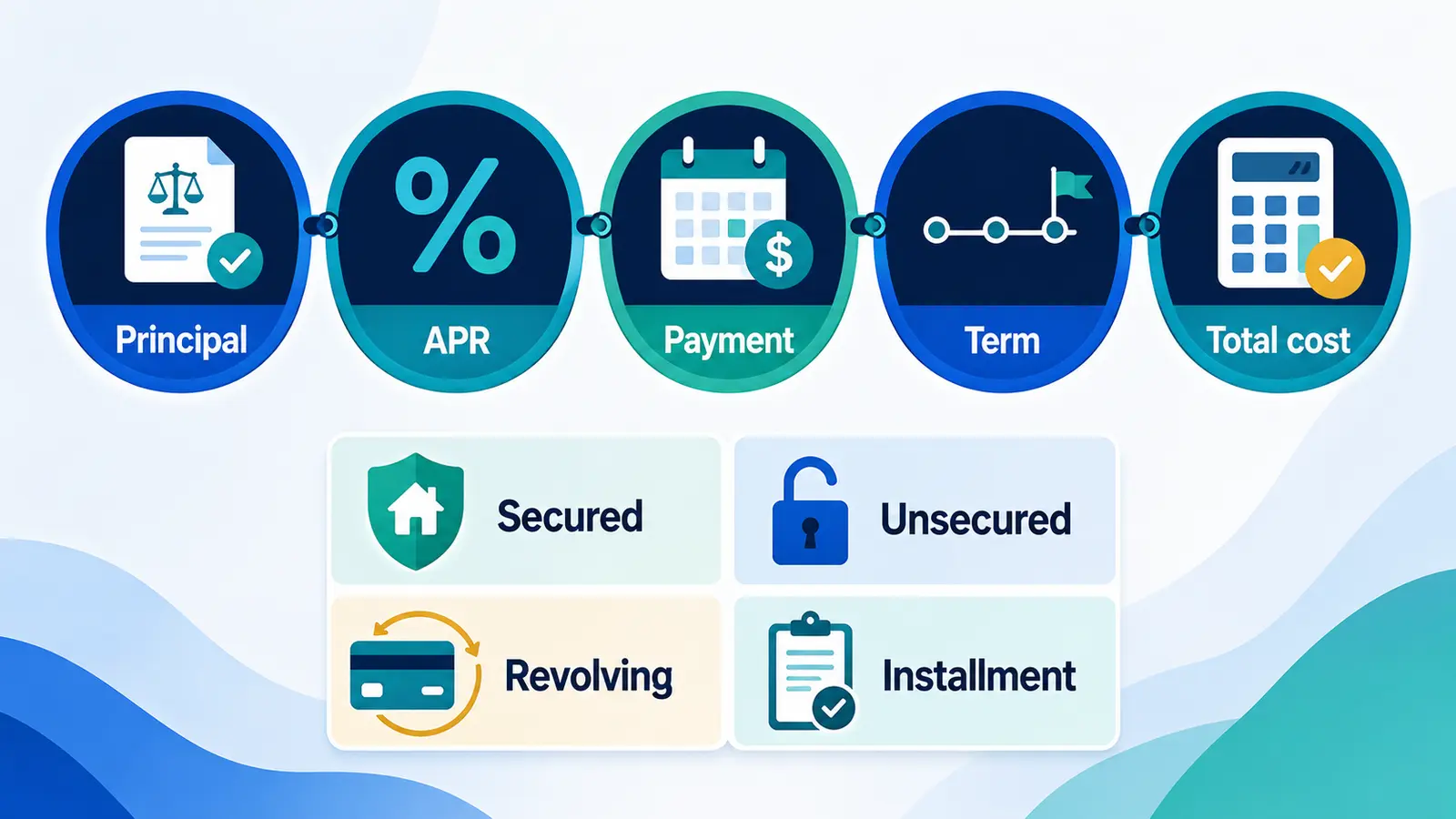
The Debt Management Guide provides a broader plan for balances you already owe. This guide focuses on how to read a debt, compare its cost, recognize its risks, and decide what to prioritize.
Which five numbers describe most debt?
A low monthly payment can still be costly if it comes from a long term. An advertised interest rate can also be lower than the APR when the loan includes covered fees. Read the disclosures and compare the same measures across offers.
What is the difference between an interest rate and APR?
The interest rate is the price charged for borrowing principal. The Consumer Financial Protection Bureau explains that annual percentage rate, or APR, is a broader measure that combines the interest rate with certain additional loan fees.
| Measure | What it tells you | What it may not tell you by itself |
|---|---|---|
| Interest rate | The rate charged for borrowing the principal | The full effect of loan fees |
| APR | An annualized cost measure that includes interest and certain fees | The monthly cash-flow burden or every possible charge |
| Payment | What is due on the payment schedule | Whether a longer term raises total cost |
| Total repayment | The dollars paid over the full agreement when disclosed or calculated | The timing risk of each required payment |
When comparing similar loans, compare APR with APR, term with term, and total repayment with total repayment. Do not compare one offer’s monthly payment with another offer’s APR and treat them as equivalent.
How do secured and unsecured debts differ?
Secured debt
A secured loan is backed by collateral. A mortgage can be secured by a home, and an auto loan can be secured by a vehicle. Missing payments can eventually put the pledged asset at risk under the contract and applicable law.
Unsecured debt
Unsecured debt is not tied to a specific pledged asset in the same way. Credit cards and many personal loans are common examples. Late fees, interest, collection activity, lawsuits, and credit-report effects can still create serious consequences.
Collateral can affect both pricing and risk. Before using an important asset to secure a loan, identify the default terms and consider what losing that asset would mean for housing, transportation, income, or daily life.
How do revolving and installment debts differ?
Revolving debt
A revolving account provides a credit line that can generally be borrowed against, repaid, and used again under the account terms. The balance and payment can change. Credit cards are the familiar example.
Installment debt
An installment loan generally provides a set amount with a repayment schedule. Auto loans, many personal loans, and mortgages are common examples. A fixed payment does not automatically mean a low-cost loan.
A debt can fit more than one category. An auto loan is commonly secured and installment debt. A credit card is commonly unsecured and revolving debt. The categories describe how the agreement works, not whether borrowing is automatically wise or unwise.
Why is the good-debt versus bad-debt shortcut too simple?
The financed item does not decide the quality of the agreement by itself. A mortgage can finance a useful home and still be unaffordable. A student loan can support valuable education and still create a difficult repayment burden. A business loan can fund growth and still fail to produce enough revenue. A car loan can be necessary for work and still become costly when the term is long or add-ons inflate the balance.
Evaluate each debt using:
- what the borrowing finances,
- the APR and total borrowing cost,
- the payment relative to reliable income,
- the repayment term,
- collateral and default risk,
- whether the purchase is necessary,
- whether lower-cost alternatives exist, and
- what happens if income falls or another expense rises.
How does the loan term change total cost?
A longer term can reduce the required monthly payment while increasing the number of payments and the time interest can accrue. This can make a loan look easier to fit into a monthly budget even when total borrowing cost is higher.
Before signing, compare at least two repayment scenarios when possible. Write down the payment, term, total interest, total fees, and total repayment for each. If a seller or lender discusses only the monthly payment, ask for the full written terms.
What should you check about fixed and variable rates?
A fixed-rate agreement generally keeps the stated interest rate from changing under the contract. A variable or adjustable rate can change based on the agreement and a referenced index or formula.
If the rate can change, ask:
- how often the rate can change,
- what index, margin, or trigger applies,
- how large each adjustment can be,
- whether lifetime or periodic caps apply, and
- what the payment could become after an increase.
Which loan fees can raise the cost?
Loan costs can include origination fees, documentation fees, late fees, balance-transfer fees, annual fees, optional credit insurance, other add-ons, and charges allowed by the agreement and law. Fee names and rules vary by product.
For personal installment loans, the CFPB advises borrowers to check the lender’s disclosures for applicable fees and compare multiple offers. Confirm how much cash you will actually receive if a fee is deducted from the proceeds, as well as how much you must repay.
Is the minimum payment a payoff plan?
Not necessarily. A minimum payment is the amount needed to keep an account current under its terms. For revolving balances, paying only the minimum can extend repayment and increase interest cost.
If cash flow allows, extra payments can be directed through a deliberate debt-reduction strategy. Cover core living costs and required payments first, then choose a method you can sustain. Check whether an agreement has prepayment terms that affect the calculation.
What are delinquency, default, and collections?
A payment can become delinquent when it is late under the account terms. Default is a more serious status whose timing and consequences depend on the product, contract, and applicable law.
If you expect to miss a payment, contact the creditor or servicer before the due date when possible. Ask about hardship programs, payment plans, due-date changes, temporary relief, or other available options. Get any new agreement in writing.
If a debt is placed with a collector, verify the debt and keep records of communications. The CFPB’s Debt Collection Rule governs many collection communications and disclosures. If you do not recognize a debt, believe the amount is wrong, or suspect identity theft, use the appropriate dispute or identity-theft process instead of paying only because someone is applying pressure.
How do you build a practical debt inventory?
Create one row for every balance. Use account statements and current disclosures rather than memory.
| Record | Why it matters |
|---|---|
| Creditor or servicer | Identifies who receives payment and handles questions |
| Current balance | Shows the amount currently owed |
| APR or interest rate | Supports cost comparison and payoff ordering |
| Minimum payment and due date | Supports cash-flow planning and current status |
| Term or expected payoff date | Shows how long repayment may last |
| Secured or unsecured | Identifies whether collateral is pledged |
| Fixed or variable rate | Shows whether the rate can change |
| Delinquency status | Surfaces accounts needing immediate attention |
| Promotional-rate expiration | Flags a future change in cost |
Which debts and bills should you prioritize?
A debt-repayment budget helps show what is available after required living costs. If taking on new balances is part of a recurring shortfall, use the avoiding new debt guide to address the cash-flow gap as well.
When can consolidation or settlement add risk?
New borrowing can make a situation worse when it covers a recurring monthly shortfall without correcting the cause. Before using a consolidation loan or balance transfer, compare the new APR, transfer or origination fee, new term, total repayment, promotional-rate expiration, and whether paid-off accounts are likely to be used again.
Debt settlement is different from a consolidation loan. The CFPB warns that settlement companies can charge substantial fees, may encourage missed payments, may not settle every debt, and cannot prevent a creditor from pursuing collection or a lawsuit. Compare direct negotiation and nonprofit credit counseling before hiring a settlement company.
For revolving-account details, see the Credit Cards guide.
What should you check before taking on debt?
- Write down principal, APR, payment, term, fees, and total repayment.
- Confirm whether the rate is fixed or variable.
- Identify any collateral and the consequences of default.
- Compare at least one alternative offer when practical.
- Test the payment against reliable income and core living costs.
- Review add-ons and remove anything you do not want or need when allowed.
- Check early-payoff and late-payment terms.
- Save a complete copy of the signed agreement and disclosures.
Understanding-debt questions
Is all debt bad?
No. Debt is a financing tool. Evaluate its purpose, APR, fees, payment, term, collateral, risks, and alternatives rather than relying on a blanket label.
What is the difference between interest rate and APR?
The interest rate is the price charged for borrowing principal. APR is a broader annualized cost measure that can include certain fees, which can make it useful for comparing similar loan offers.
Is a lower monthly payment always better?
No. A longer term can lower the required payment while increasing the number of payments and total interest cost.
What should you do if you cannot make a payment?
Contact the creditor or servicer as early as possible and ask about available hardship or payment options. The consequences and available programs depend on the debt, agreement, and applicable law.
Should you use a debt-settlement company?
Debt settlement can carry significant risks and fees. CFPB guidance recommends comparing alternatives, including direct negotiation with creditors and nonprofit credit counseling, before using a settlement company.
- CFPB: Interest rate versus APR
- CFPB: Personal installment-loan fees
- CFPB: Debt collection resources and Debt Collection Rule
- CFPB: Debt-relief and settlement risks
Source pages checked August 24, 2026.
This article provides general educational information and is not individualized financial or legal advice. Loan terms, remedies, and collection rules depend on the agreement, product, jurisdiction, and current law.