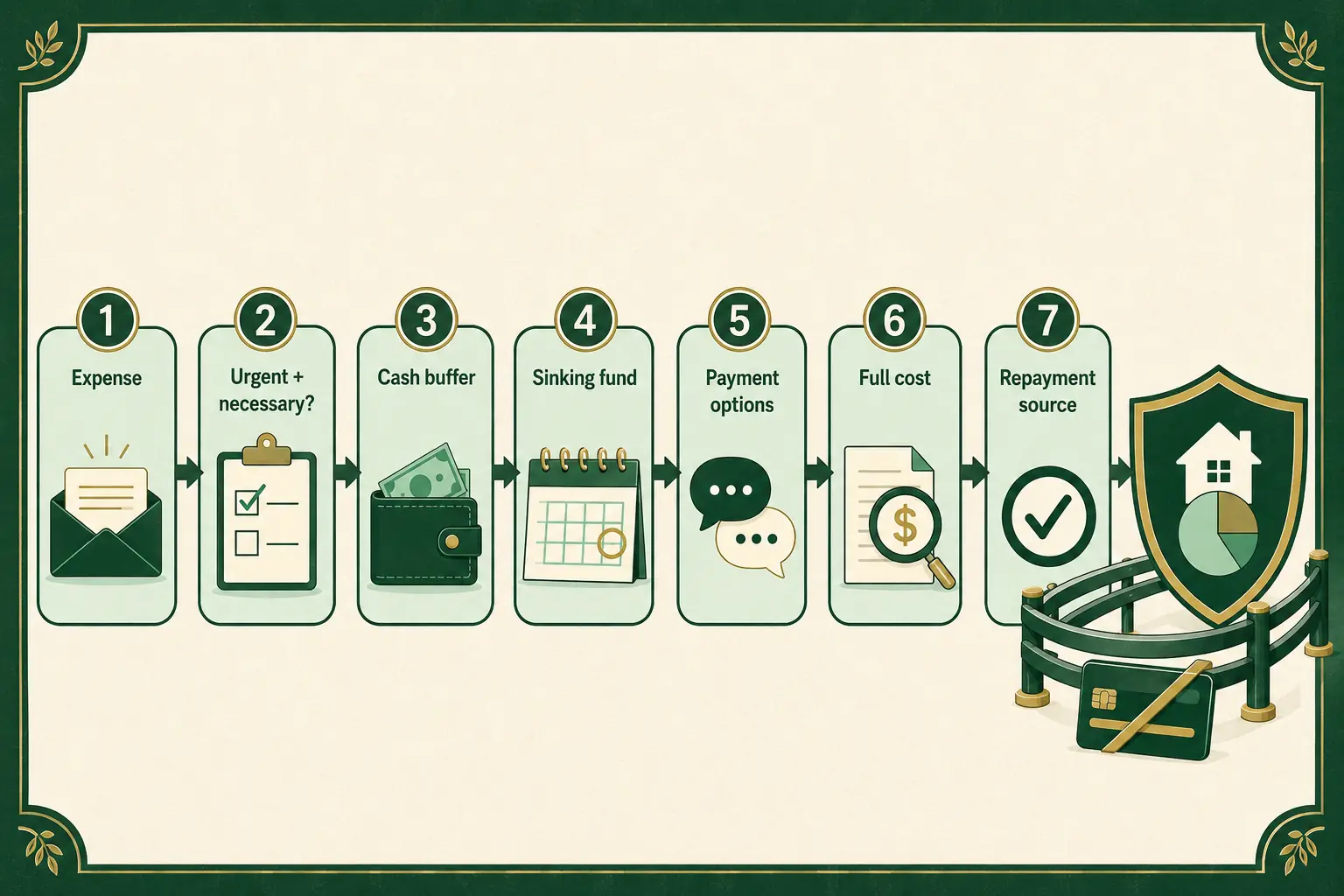
The Debt Management Guide can help you place this page inside a broader payoff plan. Avoiding new debt is not about never borrowing again. It is about making sure the next car repair, medical bill, slow work month, or expensive annual bill does not automatically become a new balance you have to carry.
A debt payoff plan works better when it has a second job: preventing relapse. That means protecting essentials, keeping required payments current, building a small cash buffer, planning for irregular costs, and adding a few guardrails before you borrow.
The quick answer
If you want to stop new debt from piling on, start in this order:
- Cover housing, food, utilities, medicine, insurance, transportation, and other essentials.
- Keep every required minimum debt payment current.
- Build a starter cash buffer for the next likely surprise.
- Turn predictable annual and irregular costs into monthly sinking funds.
- Put friction between an impulse and a new credit-card charge.
- If the numbers stop working, contact creditors before a missed payment when possible.
- Treat debt-relief promises that demand money up front or guarantee a fast fix as a warning sign.
The goal is not a perfect month. The goal is a system that makes borrowing the backup plan instead of the default.
Why new debt keeps coming back
New debt often starts before the purchase. It starts when the monthly plan has no room for a bill that was predictable, no buffer for a bill that was not, or no rule for what happens when income comes in lower than expected.
Common triggers include:
- A repair or medical bill that is larger than the cash in checking.
- Annual bills that were never converted into monthly savings.
- Variable income being budgeted as if every month will be strong.
- Aggressive debt payments that leave no emergency cushion.
- Credit cards being used for convenience without a clear payoff source.
- A necessary purchase being made under time pressure without comparing alternatives.
- A balance-transfer or consolidation offer that lowers the payment but does not fix the underlying cash-flow gap.
Debt prevention is less about willpower than cash-flow design.
1. Build a no-new-debt floor
Before deciding how much extra to send to debt, protect the expenses that keep the household functioning.
Start with five layers:
Essential living costs
Housing, basic utilities, groceries, medicine, insurance, necessary transportation, child or dependent care, and other costs you cannot safely skip.
Required debt payments
Keep minimums current on every account unless you have a documented hardship arrangement or other approved payment change.
Starter safety buffer
Keep enough cash to absorb a small surprise without reaching immediately for a card or loan.
Predictable irregular costs
Set aside money for expenses that do not happen every month but are still expected.
Focused extra debt payment
Only after the first four layers fit should you decide how much extra to send to one target debt.
This order may feel slower than sending every spare dollar to debt, but a payoff plan that forces you to borrow again after the next repair is not really moving forward.
Use the Budgeting for Debt Repayment guide when you need the full essentials-minimums-buffer-extra-payment framework.
2. Build a starter buffer before chasing a perfect emergency fund
A starter buffer does not have to equal six months of expenses before it becomes useful. Pick an amount that could cover your next likely problem.
A practical first target may be $500, $1,000, or the amount of your insurance deductible or common car repair. Once that first layer exists, work toward one month of essential expenses, then decide whether a larger reserve makes sense for your job stability, dependents, health needs, housing, transportation, and income variability.
The Federal Reserve’s 2025 household survey found that 63% of adults said they would cover a hypothetical $400 emergency expense with cash, savings, or a credit card paid off at the next statement. Fifty-five percent said they had money set aside for three months of expenses. Those figures are measures of household preparedness, not universal savings targets.
The point is simple: a cash reserve gives you more options before a surprise turns into a balance.
Use the Emergency Fund guide to set a target that fits your own risk rather than copying one number from someone else.
3. Turn “surprises” into sinking funds when the bill is actually predictable
Not every irregular bill is an emergency.
If you know a cost is likely to happen within the next year, divide the expected amount by the number of months until it is due and save that amount separately.
Examples include:
- Auto registration.
- Insurance premiums.
- School expenses.
- Holiday travel or gifts.
- Routine car maintenance.
- Pet care.
- Annual memberships.
- Property taxes.
- A known medical deductible.
- Home maintenance.
Example: If a $1,200 insurance bill is due in 12 months, save $100 per month.
That $100 is not “extra savings.” It is part of the real monthly cost of owning the policy.
Sinking funds keep predictable costs from competing with emergency savings and help prevent a credit card from becoming the default payment method.
4. Put guardrails around credit-card use
A credit card is easiest to control before the purchase is made.
Use a simple rule: do not charge a purchase unless you know where the repayment money will come from.
For routine spending, that may mean the money is already in checking and you plan to pay the statement balance in full. For a larger purchase, it may mean you have a written payoff schedule that still works after essential bills and required payments.
Useful friction can include:
- Turn on balance and transaction alerts.
- Remove saved card details from stores where impulse spending is common.
- Keep one shopping list and wait before buying non-urgent items.
- Check the total cost of a financed purchase, not only the monthly payment.
- Write down the promotional end date before using a balance-transfer offer.
- Do not treat available credit as available income.
If you are using a card because the cash is not there, stop and identify whether the purchase is urgent, necessary, or simply poorly timed.
The Credit Cards guide explains the difference between using credit as a payment tool and carrying debt.
5. Use a borrowing decision test before taking on a new balance
Before opening a loan, financing a purchase, or putting a large expense on a card, answer six questions:
- Is this expense necessary now? If the purchase can safely wait, waiting may be cheaper than financing it.
- Is there a non-debt way to reduce or delay the cost? Ask about payment plans, insurance coverage, employer benefits, discounts, due-date changes, or a smaller version of the purchase.
- What is the full cost? Include interest, fees, transfer charges, origination fees, late-payment risk, and any price increase tied to financing.
- What income will repay it? Name the actual paycheck, monthly surplus, or other source. “I will figure it out later” is not a repayment source.
- What happens if income drops? A payment that works only during a strong month may not be affordable.
- Will this solve the problem or move it? A consolidation loan or balance transfer can reorganize debt, but it does not fix a budget that remains negative after the transaction.
If you cannot answer these questions, the next step is more research, not a signature.
6. Keep debt payoff aggressive enough to matter, but not so aggressive that you reborrow
Paying debt faster can reduce interest and shorten the payoff timeline. Sending every available dollar to debt can also leave no room for the next necessary expense.
Use this order:
- Pay essential bills.
- Make all required minimum payments.
- Keep a starter cash buffer.
- Send the remaining planned amount to one target debt.
If the buffer is used, refill it before returning to the maximum extra payment.
The Debt Reduction Strategies guide can help you choose avalanche, snowball, or a hybrid payoff order. Once you are making progress, use this page to prevent the next balance from replacing the one you just paid off.
7. Budget variable income from a conservative base
Variable income needs a different rule than a fixed paycheck.
Instead of building the monthly plan around a strong month, use a conservative base that reflects what you can reasonably expect. Then decide in advance what happens when income comes in above that base.
A strong-month split might send extra money to:
- Upcoming irregular bills.
- Emergency savings.
- The target debt.
- Taxes if you are self-employed.
- A planned goal.
The exact split is yours. The important part is deciding before the money arrives.
When a weak month comes, reduce extra debt payments before skipping essentials or adding a new balance just to preserve an aggressive payoff schedule.
8. Contact creditors early when the payment no longer fits
If you think you may not be able to make a credit-card payment, the Consumer Financial Protection Bureau says to contact the card company right away.
Be ready to explain:
- Why you cannot make the minimum.
- How much you can afford.
- When normal payments may resume.
- What temporary payment amount you are asking for and for how long.
A lender may or may not offer the arrangement you want, but contacting the company before the situation gets worse can give you more information and options.
If several debts are becoming unmanageable, reputable credit counseling may be worth reviewing. Ask what the service costs, what it will do, how long the plan lasts, and what happens if you miss a payment.
9. Treat fast debt-relief promises as a scam check
Debt pressure makes fast promises sound especially attractive.
The Federal Trade Commission warns consumers about debt-relief companies that demand payment before helping, guarantee that debts will disappear, or contact people unexpectedly and ask for personal or financial information.
Before paying a debt-relief company:
- Get the services and fees in writing.
- Be skeptical of guarantees.
- Do not pay simply for a promise of fast forgiveness.
- Do not share sensitive information with an unexpected caller or texter.
- Confirm whether a nonprofit counseling option or direct creditor contact can address the problem first.
Debt relief should improve your position, not add another expensive obligation.
10. Make your environment support the plan
A good system reduces the number of decisions you have to make when you are tired, stressed, or in a hurry.
Try these low-friction changes:
- Automate transfers to the emergency fund or sinking funds after payday.
- Put bill due dates on one calendar.
- Keep a one-page list of recurring expenses.
- Use separate savings labels for emergencies and predictable irregular costs.
- Turn on low-balance alerts.
- Unsubscribe from retail messages that trigger unplanned spending.
- Review subscriptions and recurring charges quarterly.
- Keep the current target debt visible so progress is easy to see.
You do not need to turn money management into a full-time job. You need the important decisions to happen before the pressure arrives.
Your 30-day no-new-debt reset
- Day 1: List every debt, minimum payment, due date, and current balance.
- Day 2: Total essential monthly expenses.
- Day 3: Choose a starter safety-buffer target.
- Day 4: Identify three predictable irregular expenses and calculate a monthly sinking-fund amount for each.
- Day 5: Turn on balance, payment, and transaction alerts.
- Week 2: Review recurring charges and cancel or reduce the ones that no longer earn their place.
- Week 3: Write your six-question borrowing test somewhere you will see it before a major purchase.
- Week 4: Review the month. If you added no new revolving balance, keep the system. If you did, identify the trigger and repair the process rather than blaming yourself.
Frequently Asked Questions
Should I stop using credit cards completely to avoid debt?
Not necessarily. Some people use credit cards as payment tools and pay the statement balance in full. Others find that removing cards from everyday spending makes the budget easier to control. Choose the system that helps you avoid carrying balances you did not plan to carry.
Should I build emergency savings or pay off debt first?
You may need to do both. A small cash buffer can reduce the chance that the next repair goes back on a card. High-cost debt can make extra repayment valuable. Protect essentials and required minimums, keep a reasonable starter buffer, then decide how much extra to send to debt.
How much emergency savings do I need before focusing on debt?
There is no single amount that fits every household. Start with an amount that could cover a likely short-term surprise, then work toward a larger reserve based on income stability, dependents, insurance deductibles, health needs, housing, and transportation.
What if a necessary expense is larger than my savings?
Verify the bill and check insurance, benefits, payment plans, hardship options, discounts, and timing before borrowing. If debt is still necessary, compare the full cost and make sure the repayment amount fits the budget without sacrificing essentials or required payments.
Is consolidation a good way to avoid more debt?
It can help when the new total cost is lower and the new payment fits. It can hurt when fees are high, the term stretches for years, or the old accounts are charged up again. Consolidation changes debt structure. It does not automatically change spending or cash flow.
What should I do after I pay off a debt?
Redirect at least part of the old payment before it disappears into regular spending. Refill emergency savings, fund predictable irregular bills, then move the remaining amount to the next debt or another priority.