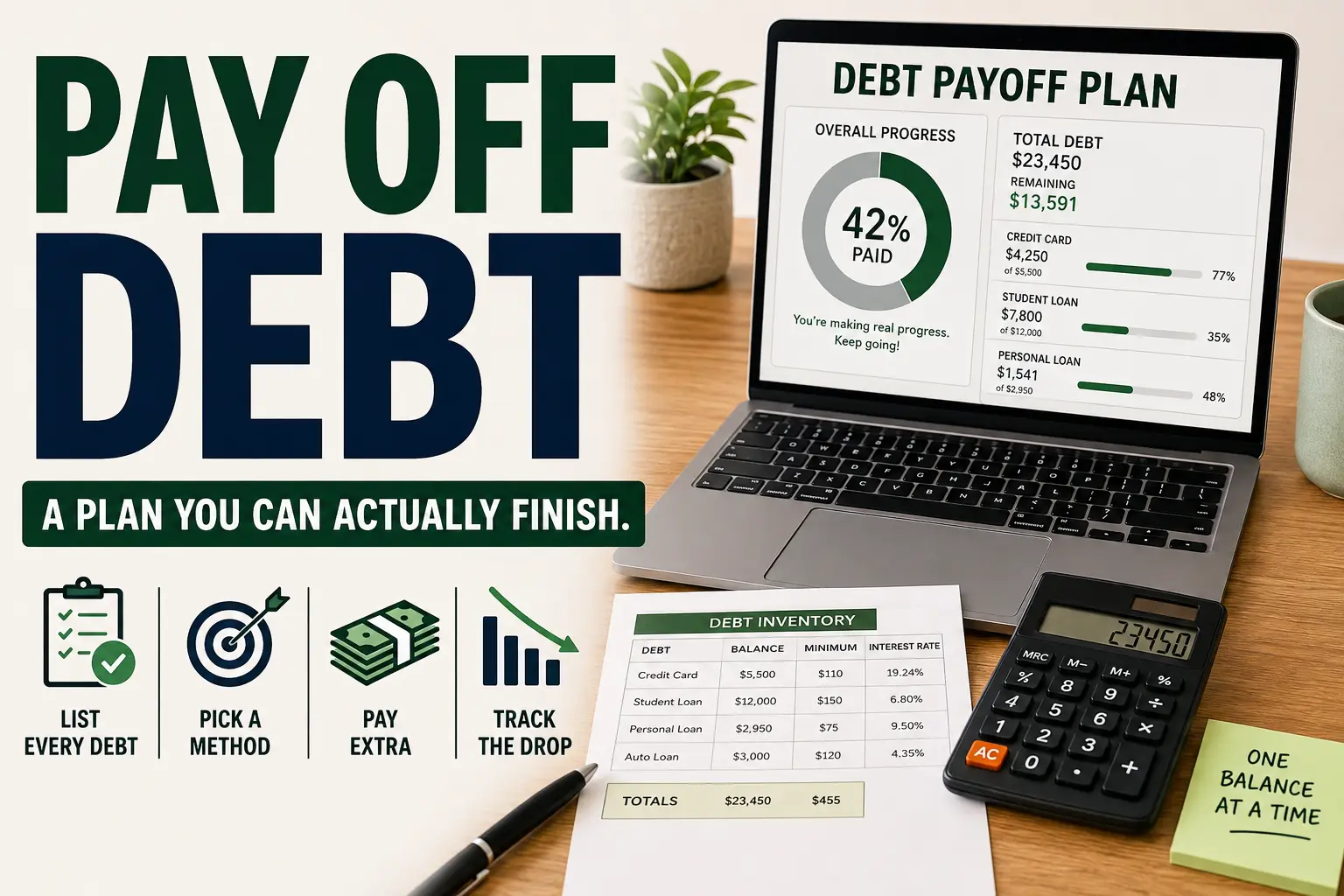
The Debt Management Guide connects this page with related MoneyBucket guidance. The best debt reduction strategy is the one you can repeat every month. Start by listing every balance, interest rate, minimum payment, and due date. Keep essential bills current, make the minimum payment on every debt, then send every extra dollar to one target balance.
Debt payoff plan at a glance
- Cover housing, utilities, food, transportation, insurance, and other essentials.
- Write down every debt and its current terms.
- Choose the avalanche method for lower interest costs or the snowball method for faster visible wins.
- Set automatic minimum payments where safe.
- Schedule one extra payment to the target debt each payday.
- Review the plan monthly and roll each paid-off payment into the next balance.
Step 1: Build your debt inventory
Guessing makes debt feel foggy. A one-page inventory turns it into a set of numbers you can act on. Pull your latest statements and record the fields below.
| Creditor | Balance | APR | Minimum | Due date | Status |
|---|---|---|---|---|---|
| Debt 1 | $ | % | $ | Current / late | |
| Debt 2 | $ | % | $ | Current / late | |
| Debt 3 | $ | % | $ | Current / late |
Include credit cards, personal loans, medical bills, student loans, auto loans, tax debt, accounts in collection, and money owed to family or friends. Note promotional rates and the date each offer ends. Keep secured debts, such as a mortgage or auto loan, clearly marked because missed payments can put the property at risk.
Step 2: Find your monthly debt-payoff amount
Add your reliable take-home income. Subtract essential expenses, minimum debt payments, and a small safety margin. The amount left is your monthly extra payment.
Simple formula: reliable take-home income minus essentials minus minimum payments minus safety margin equals your extra debt payment.
If the result is negative, do not skip necessities to force a payoff plan. Review bills for cuts, pause nonessential spending, and contact creditors before a missed payment. The Consumer Financial Protection Bureau recommends explaining why you cannot pay the minimum, how much you can pay, when regular payments may resume, and the temporary payment you are requesting.
Step 3: Choose your payoff method
| Method | First target | Best fit | Main tradeoff |
|---|---|---|---|
| Debt avalanche | Highest APR | You want to reduce total interest | The first payoff may take longer |
| Debt snowball | Smallest balance | Quick wins help you stay consistent | You may pay more interest |
| Hybrid method | One small balance, then highest APR | You want an early win plus interest savings | It requires one planned switch |
Debt avalanche example
Suppose you have a $900 card at 29% APR, a $2,400 card at 21% APR, and a $500 medical bill with no interest. Pay the required minimum on all three and direct the extra payment to the 29% card. When that card reaches zero, roll its full payment into the 21% card.
Debt snowball example
Using the same balances, target the $500 medical bill first. Paying it off removes one monthly obligation quickly. Roll that old payment into the $900 card, then continue to the $2,400 card.
Step 4: Put the plan on autopilot
- Protect minimum payments. Set reminders or automatic payments, but confirm enough cash will be in the account.
- Pay extra on payday. Money sent before it blends into everyday spending is easier to keep on plan.
- Keep the target visible. Track the starting balance, current balance, and next milestone.
- Roll payments forward. When one debt disappears, add its old payment to the next target instead of absorbing it into spending.
- Use windfalls with a rule. Decide in advance what share of a tax refund, bonus, gift, or sale will go to debt.
What to do when you cannot make the minimum payments
Contact the creditor as soon as you see trouble. Ask about hardship plans, reduced rates, waived fees, a different due date, or a temporary payment arrangement. Get the terms in writing and keep notes from every call.
A nonprofit credit counselor may help you review your budget or set up a debt management plan. Under these plans, you usually make one payment to the counseling organization, which pays participating creditors. Ask about fees, account closures, the full repayment period, and what happens if you miss a plan payment.
Debt relief warning signs
- A company demands payment before providing debt relief.
- It guarantees that debt will disappear or claims access to a secret government program.
- It tells you to stop speaking with creditors without explaining the risks.
- It will not provide fees, timing, and promises in writing.
- It pressures you to sign before reviewing your full financial picture.
Debt settlement can bring fees, late charges, collection activity, credit damage, and possible tax consequences. Compare it with direct creditor negotiations and nonprofit credit counseling before signing.
Should you consolidate debt?
A consolidation loan or balance transfer can help only when the new total cost is lower and the payment fits your budget. Compare the APR, transfer or origination fee, loan term, monthly payment, promotional end date, and rate after the promotion. A lower payment paired with a much longer term can cost more.
Do not turn unsecured card balances into debt secured by your home unless you fully understand the risk. If the new plan depends on charging the cards back up, consolidation has moved the debt rather than fixed the cash-flow problem.
Your first 30 days
- Day 1: Gather statements and complete the debt inventory.
- Day 2: Pick avalanche, snowball, or the hybrid method.
- Day 3: Set payment reminders and schedule the first extra payment.
- Week 1: Cancel or reduce three expenses and move the savings to the target debt.
- Week 2: Call creditors to ask about lower rates or hardship options.
- Week 3: Build a starter emergency cushion so a small surprise does not return to a credit card.
- Day 30: Update balances, record the drop, and set the next milestone.
How to stay debt-free after the final payment
Keep making the same monthly transfer, but redirect it to your emergency fund and future goals. Review your budget, strengthen your emergency fund, and check your credit score guide. For broader help, visit the Debt Management hub and the guide to saving money.
Use the Avoiding New Debt guide to keep the next repair, annual bill, or weak-income month from recreating the balance you just paid off.
Paying or settling a balance and seeing the new status are separate events. Use the credit score change timeline to track the payment, creditor update, report change, and score date without assuming a point gain.
Trusted help and consumer guidance
- CFPB: What to do if you cannot pay credit card bills
- CFPB: Credit counseling, settlement, consolidation, and repair
- FTC: How to get out of debt
- FTC: How to avoid debt relief scams
This guide provides general educational information. It is not financial, legal, or tax advice.