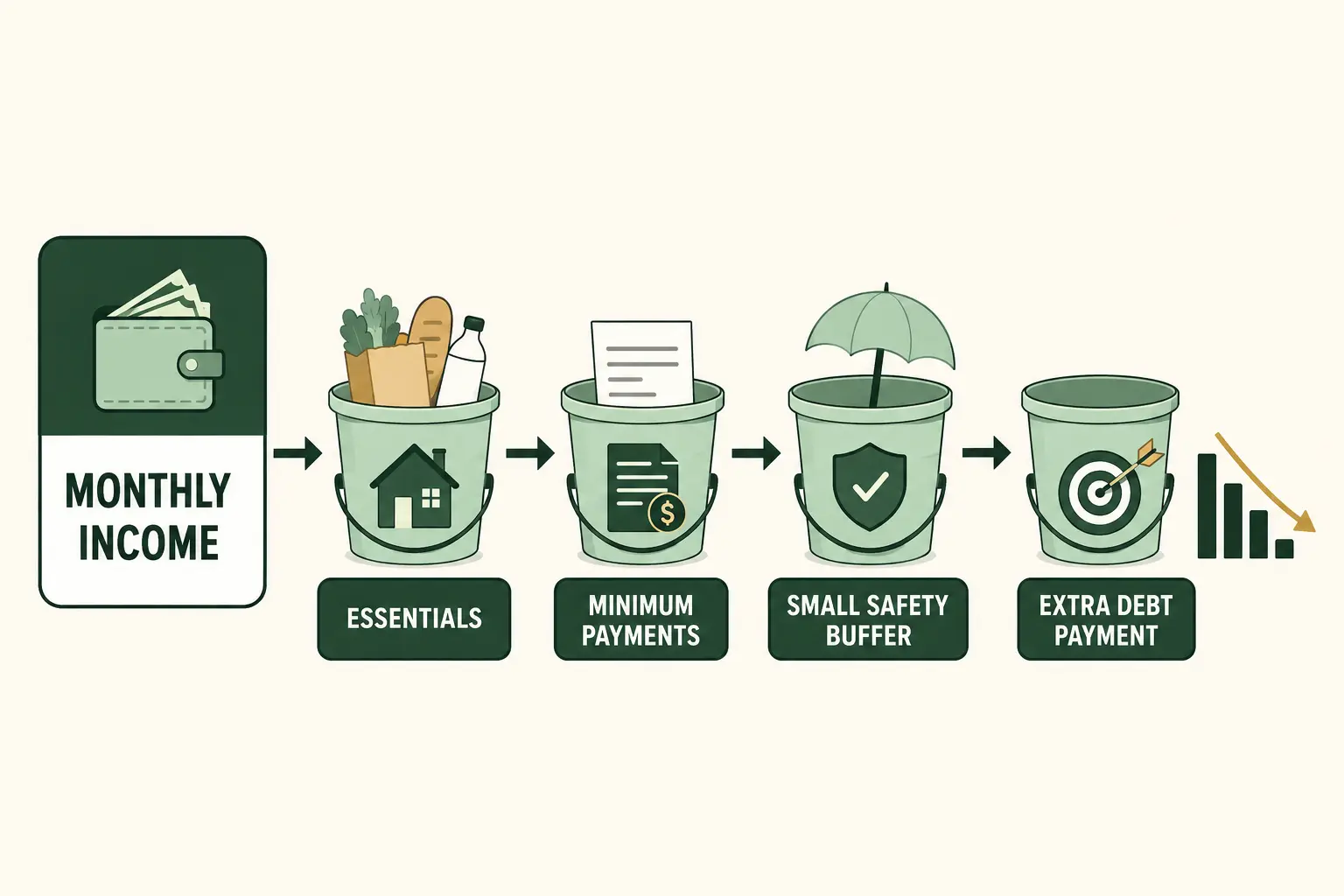
For related guidance, begin with the Debt Management Guide, then return here for this focused explanation. A debt repayment budget gives every dollar a job in this order: essential living costs, required minimum payments, a small safety buffer, then one focused extra debt payment. This keeps the plan aggressive enough to make progress without leaving you one surprise bill away from using credit again.
Start here: If you cannot cover housing, utilities, food, medicine, transportation to work, and required minimum payments, pause extra debt payments. Contact creditors before missing a payment and ask about hardship options or a payment plan you can afford.
Build Your Debt Repayment Budget in Six Steps
1. Protect essential expenses first
Write down the monthly costs that keep you housed, fed, safe, insured, and able to earn income. Include rent or mortgage, basic utilities, groceries, medicine, insurance, child care, and necessary transportation. A repayment plan that ignores these bills is likely to collapse.
2. List every debt and required payment
Create one debt list with the creditor, current balance, annual percentage rate, minimum payment, due date, and account status. Check statements instead of relying on memory. If a debt is in collections, verify the collector and the debt before agreeing to pay.
| Debt | Balance | APR | Minimum | Due date |
|---|---|---|---|---|
| Credit card A | Your balance | Your APR | Your minimum | Your date |
| Loan B | Your balance | Your APR | Your minimum | Your date |
3. Find a safe extra-payment amount
Use this monthly calculation:
Take-home income − essentials − minimum debt payments − small safety buffer = extra debt payment
Use income you can reasonably expect, not an unusually strong month. If your pay changes, build the base budget around a conservative income figure and decide in advance how extra income will be split.
4. Choose one debt to attack
| Method | How it works | Best fit | Tradeoff |
|---|---|---|---|
| Debt avalanche | Pay minimums on every debt and send the extra amount to the highest-APR debt. | People focused on reducing interest cost. | The first payoff may take longer. |
| Debt snowball | Pay minimums on every debt and send the extra amount to the smallest balance. | People motivated by faster account closures. | Total interest may be higher. |
| Urgent-priority method | Address debts tied to immediate legal, housing, transportation, or utility risks first. | People facing repossession, shutoff, court deadlines, or loss of essential services. | Interest-rate order becomes secondary. |
The Consumer Financial Protection Bureau describes both snowball and highest-interest-rate approaches. Neither method works if minimum payments on the other debts are skipped.
5. Automate the minimums, then schedule the extra
Set reminders or automatic payments for minimums only when your bank balance and pay timing make overdrafts unlikely. Schedule the focused extra payment after income arrives and essential bills are covered. When the target debt is paid, roll its old minimum and your existing extra amount into the next debt.
6. Review the plan once a month
Update balances, confirm every payment posted, and check the coming month for irregular expenses. A ten-minute review catches rising minimums, changing rates, subscription creep, and due dates that no longer fit your pay schedule.
How Much Should You Put Toward Debt Each Month?
There is no universal percentage that fits every household. The safe amount is what remains after essentials, all required minimums, and a modest cushion for likely surprises. Sending every available dollar to debt can look fast on paper, but a car repair or medical copay may push the same expense back onto a credit card.
- Stable income: Set a repeatable base payment and direct part of bonuses or refunds to the target debt.
- Variable income: Pay required minimums from the base budget, then use a written rule for stronger months.
- Past-due accounts: Ask the creditor what amount brings the account current and whether a hardship plan changes fees, rates, or reporting.
- No monthly surplus: Focus first on cash-flow repair, creditor calls, and qualified counseling rather than promising extra payments the budget cannot support.
A Simple Debt Repayment Budget Example
| Monthly category | Example amount |
|---|---|
| Take-home income | $4,000 |
| Essential living costs | − $2,650 |
| Minimum debt payments | − $650 |
| Safety buffer | − $200 |
| Extra target-debt payment | $500 |
This is an illustration, not a target. Replace every figure with your own after-tax income, bills, minimums, and near-term needs.
What to Cut Before Your Repayment Plan Cuts You
Start with expenses that can change without threatening health, housing, insurance, or income. Cancel unused subscriptions, reduce convenience spending, compare recurring bills, and set a weekly spending ceiling. Avoid cutting necessary insurance, medicine, food, or transportation just to produce a larger extra payment.
If the gap is still too small, look at both sides of the budget. A temporary extra shift, sale of unused items, or lower recurring bill can help, but do not build a permanent payment promise around income that may disappear.
What If You Cannot Make the Minimum Payments?
Act before the due date when possible. Contact the creditor, explain what you can afford, and ask about hardship programs, lower payments, fee relief, due-date changes, or a temporary plan. Get any agreement in writing and keep a record of dates, names, and terms.
A reputable credit counselor may help review the full budget and set up a debt management plan. The CFPB notes that these plans can combine enrolled debts into one payment through the counseling organization and may involve fees. Debt settlement is different and can carry serious risks. Be wary of any company that guarantees results, tells you to stop speaking with creditors, or demands money before providing debt-relief work.
Red flag: The Federal Trade Commission warns that debt-relief scams often promise to settle debt, charge upfront, and fail to deliver. Never let urgency silence basic checks.
How to Manage Debt While Budgeting
Keep debt repayment inside the monthly budget rather than treating it as money left over at the end. Protect essentials, pay every required minimum, hold a small buffer, and focus one extra payment at a time. If the numbers do not fit, reduce the extra amount before skipping necessities or borrowing again.
Debt Repayment Budget Checklist
- List every balance, APR, minimum, due date, and status.
- Protect essential living expenses.
- Pay required minimums on all debts.
- Keep a small safety buffer.
- Choose one target debt.
- Schedule the extra payment around payday.
- Roll paid-off payments to the next target.
- Review balances and next month’s expenses.
- Call creditors early when the plan stops fitting.
Frequently Asked Questions
Should I save money or pay off debt first?
Keep enough cash to cover likely short-term surprises before sending every spare dollar to debt. High-cost debt can make extra repayment valuable, but having no buffer can force new borrowing when an ordinary expense arrives.
Is the avalanche or snowball method better?
The avalanche method generally targets interest cost by paying the highest APR first. The snowball method targets momentum by paying the smallest balance first. The better method is the one you can follow while keeping every other minimum current.
Should I use a balance-transfer card or consolidation loan?
Compare the full cost, fees, promotional deadline, new APR, payment, and risk of adding fresh balances. Consolidation changes the structure of debt; it does not fix a budget that spends more than it receives.
Can a debt management plan erase debt?
No. Credit counseling and debt management plans may organize payments or secure creditor concessions, but they do not erase valid debt. Review fees and terms before enrolling.
What should I do after the last payment?
Redirect at least part of the old payment toward emergency savings and future goals before lifestyle costs absorb it. Confirm the lender reports a zero balance and keep the payoff record.
Related MoneyBucket Guides
Sources
- Consumer Financial Protection Bureau: How to Reduce Your Debt
- Consumer Financial Protection Bureau: Credit Counseling and Debt Settlement
- Federal Trade Commission: How to Get Out of Debt
- Federal Trade Commission: Avoid Debt-Relief Scams
Source check: Reviewed October 3, 2026 by the Money Bucket Editorial Team against the CFPB and FTC sources listed above. Corrections: moneybucket.org@gmail.com.
This guide provides general educational information. Debt terms, legal rights, taxes, and credit effects depend on the account and situation.