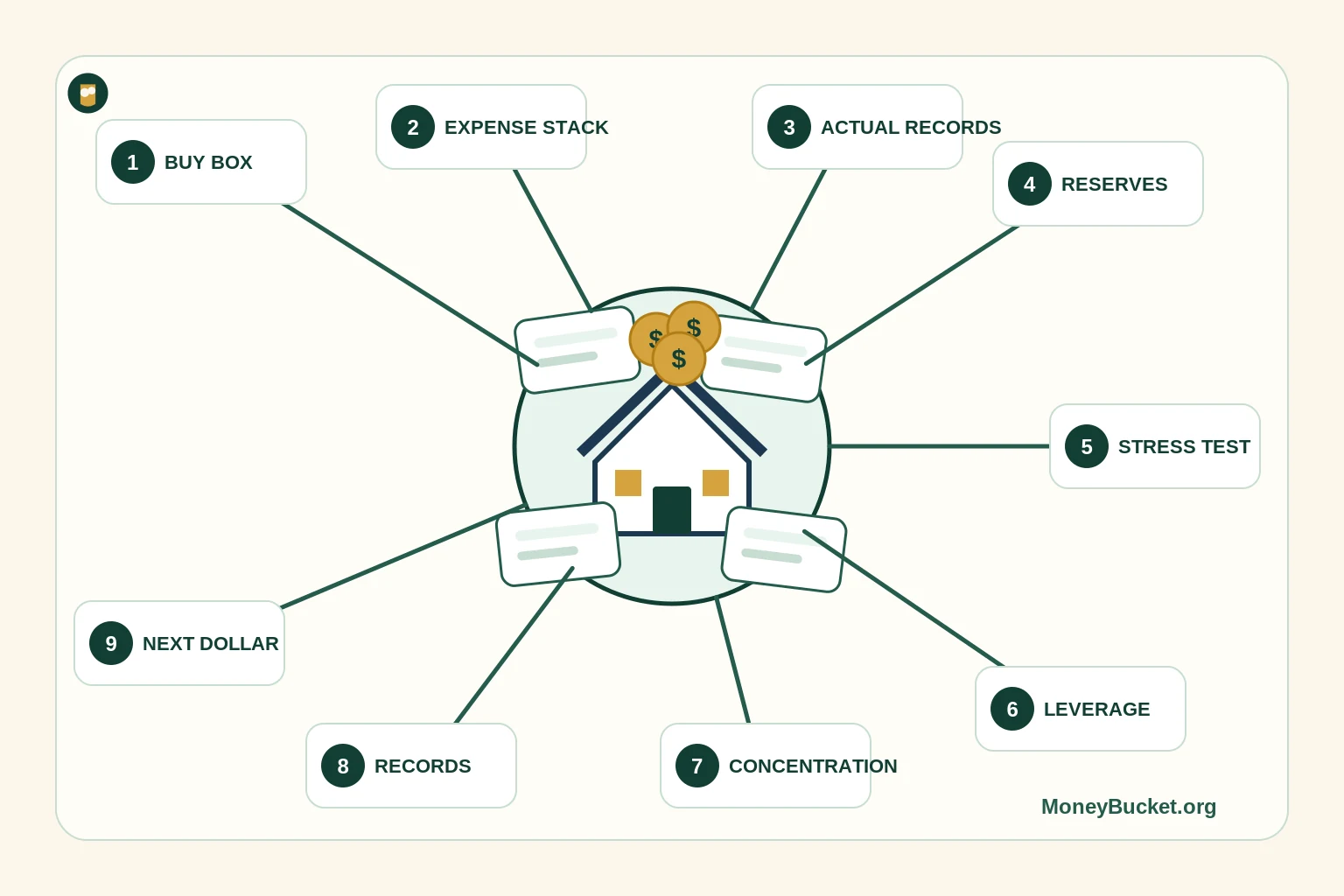
Building a real estate investment portfolio starts with a repeatable decision process, not a target number of properties. The MoneyBucket Real Estate Investing guide covers the broader choices, risks, and ways to invest. This page focuses on one question: when does adding another directly owned rental property make the full portfolio stronger rather than simply larger?
What a real estate investment portfolio should prove
A portfolio is more than a collection of addresses. It is a group of assets, debts, reserves, obligations, and operating systems that can create or consume cash at the same time. A strong plan answers four questions before another purchase:
Can each property stand on its own?
Property-level records should show rent collected, operating costs, debt service, repairs, capital work, and cash flow.
Can the portfolio survive overlap?
Stress tests should account for more than one vacancy, repair, insurance increase, or turnover happening close together.
Does enough liquid cash remain?
A lender reserve minimum and an owner operating reserve answer different questions. Closing should not leave routine risk unfunded.
Does the next property improve the mix?
More debt, more units, or a second market can reduce one risk while adding another. Measure the trade before buying.
9 rules for building a real estate investment portfolio
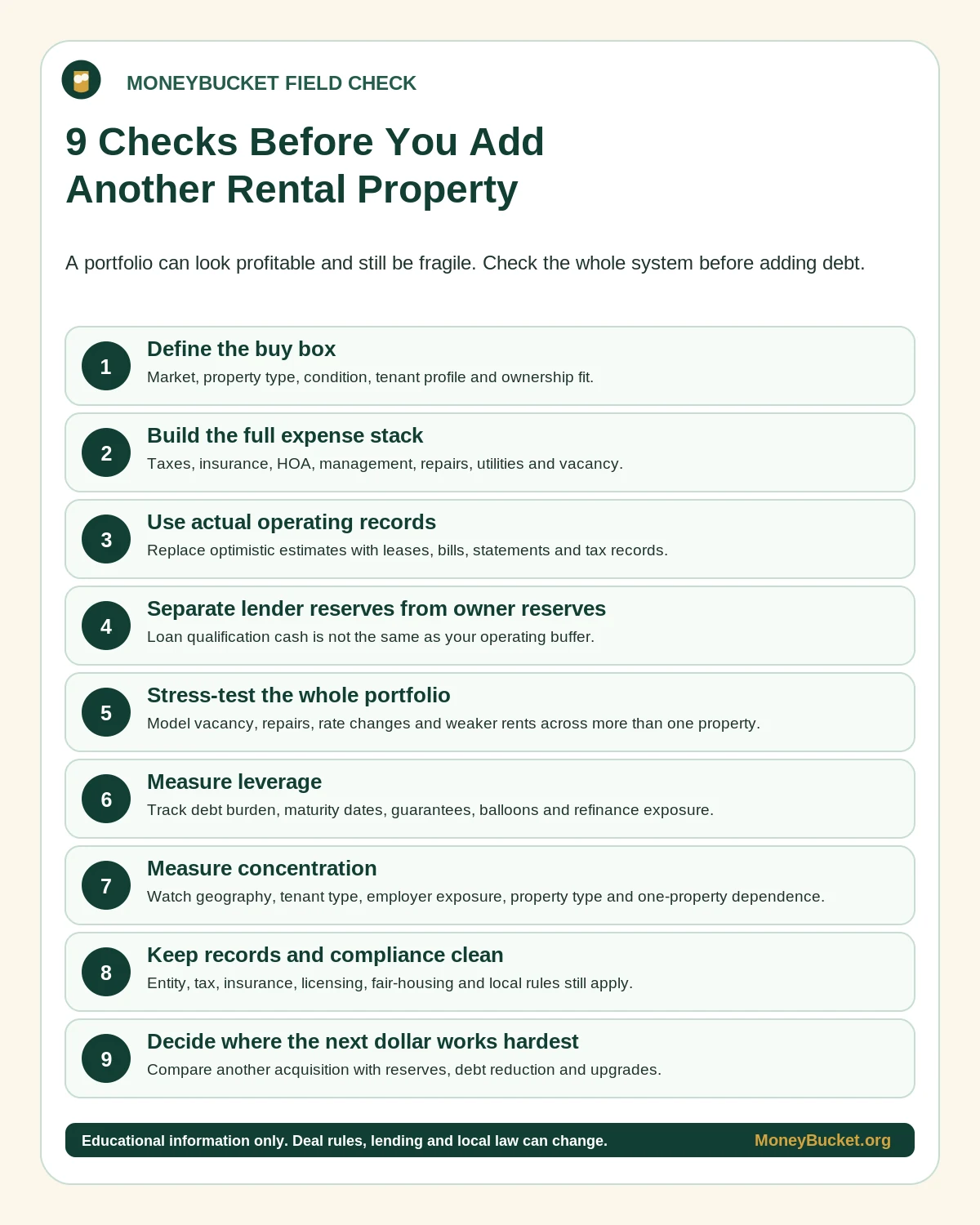
Write the buy box before shopping
Set the property type, location, price ceiling, renovation limit, minimum cash left after closing, insurance limits, management radius, and deal-breakers before a listing creates urgency. A buy box makes it easier to reject a property that only works after optimistic assumptions.
Underwrite the complete expense stack
Rent minus mortgage is not cash flow. Count vacancy, management, repairs, capital replacements, property tax, insurance, association fees, owner-paid utilities, licensing, bookkeeping, leasing costs, and other recurring expenses. Use local evidence for rent and costs rather than a fixed national percentage.
Require operating proof before the next purchase
Projected numbers become useful only after you compare them with actual results. Before adding another rental, review clean property-level records, unpaid maintenance, lease timing, insurance renewals, and whether reserves have stayed intact. The IRS currently requires rental income and expenses to be reported property by property on Schedule E for individual taxpayers using that form.
See the IRS Schedule E information page and IRS Publication 527 for current federal tax guidance.
Separate lender reserves from operating reserves
A lender may require reserves as part of underwriting, but that does not tell you how much cash your properties need after closing. Fannie Mae’s current Desktop Underwriter guidance lists six months of reserves for an investment-property transaction and can require extra reserves when the borrower owns other financed properties. Those rules are loan-program rules, not a universal emergency-fund target.
Review the current Fannie Mae minimum reserve requirements and confirm your own loan terms with the lender.
Stress-test the portfolio, not just the new deal
A new property can look healthy alone and still make the combined portfolio fragile. Test lower collected rent, higher vacancy, higher operating costs, and a large repair while every scheduled loan payment still exists. The tool below runs a simple base case and a harsher planning case without sending your numbers anywhere.
Track leverage and refinancing dependence
Debt can increase buying power, but it also makes the portfolio less forgiving when income falls or credit tightens. Track total loan balances against current property values, fixed versus adjustable rates, maturity dates, balloon features, and any plan that depends on a future refinance. A refinance should be an option, not the only way the numbers survive.
The Consumer Financial Protection Bureau’s Loan Estimate comparison guide shows the loan costs, payment details, cash to close, and other terms worth comparing across mortgage offers.
Measure concentration, not just property count
Five properties can still share the same employer base, weather exposure, insurer, neighborhood, property manager, loan structure, or lease-expiration window. A second market can reduce some local exposure but may add travel and oversight costs. Diversification can reduce overall investment risk, but owning more of one asset class does not automatically create a balanced financial plan.
The SEC’s Investor.gov 2026 bulletin explains the distinction between asset allocation and diversification.
Treat records, insurance, and compliance as operating costs
Keep purchase documents, settlement statements, leases, deposits, income and expense records, repair invoices, improvement records, insurance policies, inspection records, and tax support organized by property. Use written tenant-screening standards and review federal, state, and local housing rules before advertising or screening.
HUD states that the federal Fair Housing Act prohibits discrimination in covered housing activities. State and local rules can add other requirements.
Make the next-property decision compete with other uses of cash
The right move may be buying another property, holding cash, funding repairs, paying down expensive debt, improving an existing rental, or investing outside direct real estate. Door count is not the score. Compare what the next dollar of cash can do for income, liquidity, risk, and workload.
Metrics worth tracking at property and portfolio level
| Metric | Simple formula | What it helps you see |
|---|---|---|
| Net operating income | Effective rental income − operating expenses before debt | Property operating performance before financing and income taxes |
| Cash flow | NOI − debt service | Cash left after scheduled financing |
| Debt-service coverage ratio | NOI ÷ debt service | How much operating income sits above scheduled debt service in the model |
| Cap rate | Annual NOI ÷ property value | Unlevered operating yield based on the value used in the calculation |
| Cash-on-cash return | Annual pre-tax cash flow ÷ total cash invested | Pre-tax cash flow relative to invested cash |
| Portfolio loan-to-value | Total loan balances ÷ total property value | How much of the portfolio value is financed |
| Reserve coverage | Liquid property reserves ÷ monthly operating costs and debt service | How many modeled months of cash obligations the reserve could cover |
No single ratio proves a property is safe or suitable. Lenders, insurers, tax rules, property types, and investor needs use different definitions and thresholds.
Real Estate Portfolio Stress Test
Add at least one property, then run the test.
Planning assumptions used in the stress case: scheduled rent falls 5%, vacancy increases by 5 percentage points, operating expenses rise 15%, and the one-time repair shock is paid from liquid property reserves. These are test assumptions, not forecasts.
How to read the stress-test results
Base cash flow
Positive base cash flow means the model leaves cash after entered operating expenses and debt service. It does not prove the inputs are complete or that future results will match them.
Stress cash flow
A negative result shows the combined portfolio would need reserves or another cash source under the test assumptions.
DSCR
A ratio below 1.00 means modeled NOI is below modeled debt service. Do not treat any single ratio as a universal lender approval rule.
Reserve coverage
This simple figure divides liquid property reserves by one month of entered operating expenses plus debt service. Actual reserve needs depend on property and loan details.
When to pause before buying another rental
- The new deal needs appreciation, a quick refinance, or unusually high rent growth to produce acceptable cash flow.
- Closing would leave lender-required or operating reserves underfunded.
- Existing safety repairs or deferred maintenance are still unfunded.
- Property-level records cannot explain where cash is going.
- Several leases, insurance renewals, balloon dates, or major systems create the same timing risk.
- The next purchase would require personal emergency savings or costly unsecured debt.
- The portfolio stress case turns negative and there is no credible cash plan for the gap.
- You cannot explain why buying now is better than holding cash or improving current properties.
Related MoneyBucket guides
- Real Estate Investing Guide
- Investment Property Financing
- How Much to Invest in Real Estate
- Managing Investment Risk
Frequently asked questions
How many properties do you need for a real estate portfolio?
There is no required property count. One income-producing property can be part of an investment portfolio. The useful question is whether each property and the combined group fit your cash, risk, debt, and management plan.
When should I buy a second rental property?
Consider the next property after you have dependable operating records, funded repairs, adequate liquid reserves, and a combined stress test that you can support. Lender approval alone does not prove another property fits your finances.
How much reserve cash should a rental-property investor keep?
There is no universal amount. Lender rules, unit count, deductibles, major systems, vacancy risk, local costs, and the chance of overlapping problems all matter. Fannie Mae’s current DU guidance can require six months of reserves for an investment-property transaction plus extra reserves for other financed properties, but that is a loan-program rule rather than a universal owner reserve target.
What is a good DSCR for a rental property?
There is no single DSCR that fits every loan or investment plan. A DSCR below 1.00 in a simple property model means NOI is below scheduled debt service. Lenders can set their own definitions and minimums, and the ratio does not capture every repair, tax, insurance, or liquidity risk.
Should I use cap rate or cash-on-cash return?
They answer different questions. Cap rate compares annual NOI with property value before financing. Cash-on-cash return compares annual pre-tax cash flow with the cash invested. Review both alongside debt, reserves, property condition, taxes, insurance, and concentration.
Does owning rentals in different areas reduce risk?
It can reduce exposure to one local tenant pool, employer base, or property market, but distance can add management, travel, vendor, and oversight costs. Test the full trade rather than assuming geographic spread is automatically safer.
What records should I keep for each rental property?
Keep income and expense records, leases, deposits, settlement documents, invoices, repair and improvement records, insurance policies, tax support, and other records needed to explain the property’s operation. Tax and legal recordkeeping needs vary, so confirm retention requirements with qualified professionals.
When should I stop adding rental properties?
Pause when reserves are thin, existing maintenance is unfunded, records are unreliable, leverage is rising faster than cash flow, the stress case needs outside cash, or another use of the money would better fit your goals and risk limits.