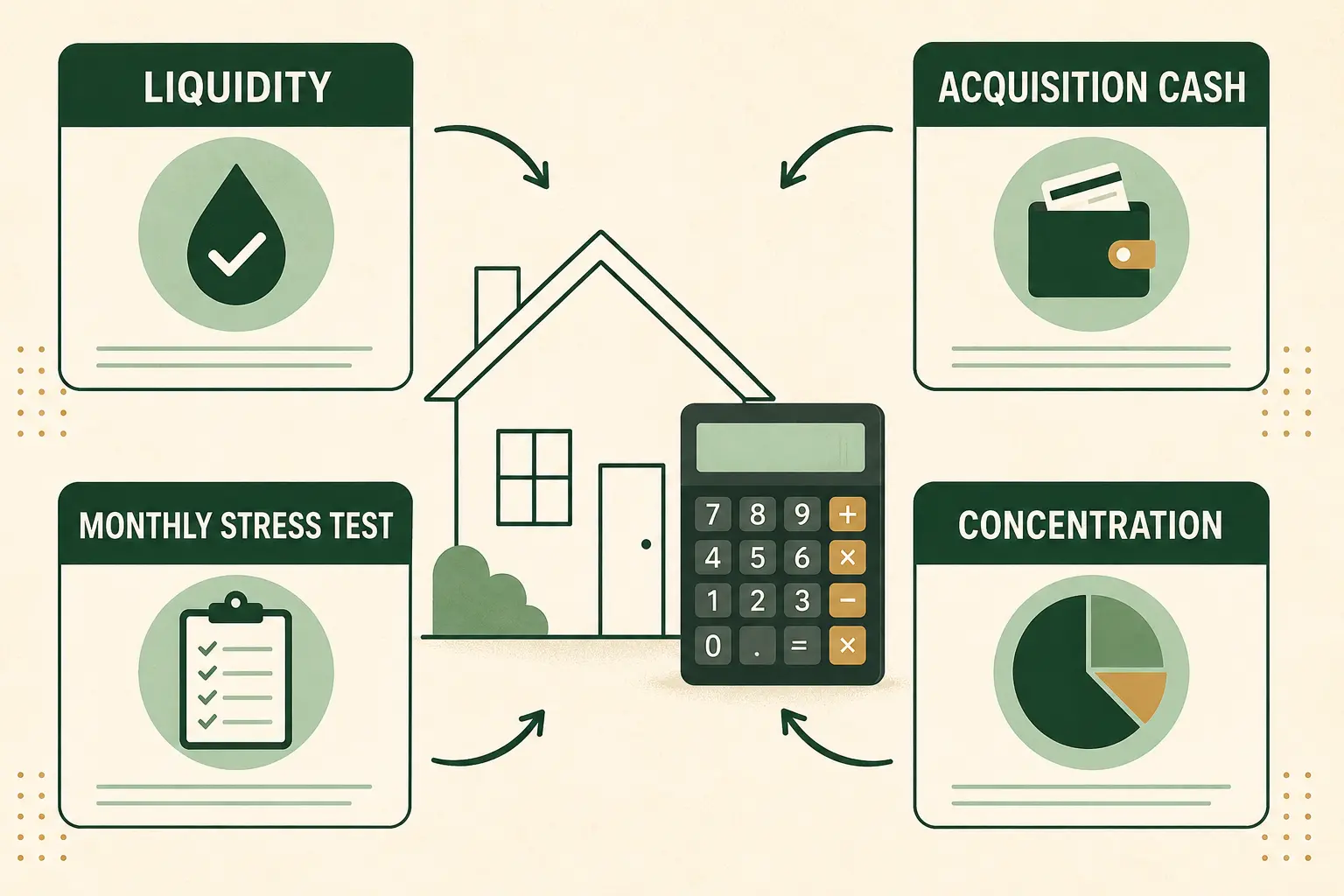
Before deciding how much to put into property, start with the MoneyBucket Real Estate Investing guide. There is no universal percentage of income, savings, or net worth that everyone should invest in real estate. A workable limit is the amount your household can commit without draining essential cash, overloading debt, or placing too much of your financial life in one property or market.
Use four limits instead of one magic number: liquidity, acquisition cash, monthly stress, and portfolio concentration. A deal should pass all four checks before you decide how much capital it can receive.
Important: This guide is general financial education, not individualized investment, legal, tax, insurance, or lending advice. Property rules and risks vary by location, financing, building, and household.
What are the four limits for a real estate investment?
| Limit | Question it answers | Core input |
|---|---|---|
| Liquidity | How much cash can leave the household without weakening near-term safety? | Liquid savings minus reserves and near-term obligations |
| Acquisition cash | What will it take to close, repair, and start operating the property? | Down payment, transaction costs, immediate work, and property reserve |
| Monthly stress | Can the household carry the property if income falls or costs rise? | Collected income minus expenses, debt service, and reserve contributions |
| Concentration | Would the purchase make one asset, city, or income source dominate the plan? | Real estate equity compared with investable net worth |
How do you set a household liquidity floor?
Money needed for near-term life expenses is not automatically investable capital. Direct property can take time and money to sell. A repair, vacancy, or cash-flow problem may arrive before a sale or refinance can close.
Separate cash for:
- Household emergency savings
- Taxes already owed or likely to be due
- Insurance deductibles
- Near-term housing, vehicle, medical, education, or family costs
- Business operating cash if self-employed
- Goals that cannot wait for a property sale
- A separate contingency amount for the property purchase process
Screening formula: Potentially investable liquid cash = liquid savings minus household emergency reserve minus near-term obligations minus separate purchase contingency.
The result is a ceiling for further analysis, not a recommendation to invest the full remainder. Review the MoneyBucket Emergency Fund guide before counting household reserves as property capital.
What belongs in all-in acquisition cash?
The down payment is only one part of the money required to buy a property. Build an acquisition budget that includes:
- Down payment
- Closing costs
- Inspection and due-diligence costs
- Appraisal or lender costs, when applicable
- Immediate repairs and safety work
- Utility setup
- Insurance paid before or at closing
- Initial vacancy, turnover, or leasing costs
- An initial operating reserve
Formula: All-in acquisition cash = down payment + transaction costs + immediate property costs + initial operating reserve.
If you can fund the down payment but not the rest of the acquisition budget, the purchase is not fully funded. Get written estimates when possible and leave room for costs discovered during inspection or lender review.
How do you stress-test monthly property cash flow?
Do not size an investment from advertised rent or the mortgage payment alone. Estimate income that the market can support, then subtract a complete set of recurring and irregular costs.
- Vacancy and nonpayment
- Property taxes
- Insurance
- Routine maintenance and repairs
- Capital expenditures for larger replacements
- Property management, when used
- Association fees
- Owner-paid utilities
- Local licensing or compliance costs, when applicable
- Debt service
- Ongoing reserve contributions
Planning formula: Property cash flow before tax = collected property income minus operating expenses minus debt service minus reserve contribution.
Keep cash-flow math separate from tax-return accounting. The IRS explains that rental income and expense reporting can include depreciation, passive-activity limits, personal-use rules, and other tax items in Publication 527. A depreciation deduction does not provide cash for the mortgage or a repair.
Which downside cases should you test?
Run more than the expected case. Test conditions that could arrive together:
- Rent is lower than expected.
- The property is vacant for several months.
- Insurance or property tax rises.
- A large repair arrives in the first year.
- Tenant turnover causes repair costs and lost rent.
- An adjustable loan payment rises or refinancing is unavailable.
- Household employment or business income falls.
Ask whether you could hold the property without using credit cards, taking a retirement withdrawal, skipping household bills, or forcing a sale. A downside case that needs new high-cost debt is a warning that the commitment may be too large.
How do you check real estate concentration?
List the household’s major financial exposures:
- Primary-residence equity
- Investment-property equity
- Mortgage and other property debt
- Retirement accounts
- Taxable investments
- Cash
- Business ownership and employer stock
Diagnostic formula: Real estate equity concentration = total real estate equity divided by investable net worth.
Do not treat any percentage as universally safe. Use the ratio to spot whether one asset class, city, property type, employer, or income source is becoming dominant. Investor.gov explains that asset allocation depends on time horizon and risk tolerance. Its diversification guidance also notes that diversification cannot guarantee against losses.
Use MoneyBucket’s investment risk guide to review concentration, liquidity, leverage, and other risks together.
How is direct property different from a REIT or real estate fund?
Direct ownership often requires substantial upfront cash, property-level debt, repairs, operating work, local compliance, and a long sale process. A publicly traded REIT or real estate fund can be easier to buy or sell and may spread exposure across more properties, but it still carries market risk, fees, and real estate exposure.
The two routes are not interchangeable. Choose based on the job the investment must perform, the risks you can carry, and the work you are willing to take on.
Which funding sources need extra caution?
Be careful when a property purchase depends on money that protects another goal or asset:
- Retirement-account withdrawals
- Home-equity borrowing
- Credit-card financing
- Personal loans
- Loans secured by important household assets
Borrowing can magnify gains and losses. A home-equity loan or line also places the pledged home at risk. The Consumer Financial Protection Bureau warns that a borrower who cannot repay a HELOC could lose the home securing it.
What should you write down before making an offer?
- Household liquidity floor: $_____
- Potentially investable liquid cash: $_____
- All-in acquisition cash: $_____
- Property reserve remaining after closing: $_____
- Expected monthly cash flow before tax: $_____
- Downside-case monthly cash flow: $_____
- Total household real estate equity: $_____
- Investable net worth: $_____
- Real estate concentration ratio: _____%
Then answer these questions:
- Does the purchase leave the household liquidity floor intact?
- Are closing, safety, and immediate repair costs funded?
- Will a property reserve remain after closing?
- Can the household carry the downside case?
- Does the purchase create uncomfortable concentration?
- Would it delay a more important goal?
- Does the plan rely on appreciation or refinancing to rescue weak cash flow?
If several answers are uncomfortable, the amount being committed may be too high. A lower price, larger reserve, lower debt load, or different route may change the result.
Why must you recalculate before buying another property?
A second or third property is not automatically affordable because the first one performed well. Recalculate household liquidity, property reserves, total debt, geographic concentration, lease rollover timing, insurance exposure, monthly debt service, and employment or business income risk.
The real estate portfolio guide can help you review properties as one connected set of exposures. The plan should become more resilient as it grows, not more dependent on every property working at once.
Frequently asked questions
What percentage of net worth should be in real estate?
There is no universal percentage for every household. Use a concentration ratio as a diagnostic, then review liquidity, debt, time horizon, other investments, and the effect of lower property values or cash flow.
How much cash should remain after buying an investment property?
Keep enough to protect household emergencies and realistic property operating risks. The amount depends on the property, financing, insurance, age and condition, tenant situation, and the rest of the household plan.
Should all available cash go toward a larger down payment?
Not automatically. A larger down payment can reduce borrowing, but draining cash can leave the household or property unable to absorb vacancy, repairs, or other emergencies.
Does appreciation make a weak rental deal acceptable?
Appreciation is uncertain and is not monthly cash flow. Review the property’s current economics before assuming a future buyer or refinance will fix a weak deal.