The Budgeting guide connects this comparison with the rest of your spending plan. Start by choosing the money problem that needs the most attention, then build a household budget around the method that fits.
The best budget method is the one that fixes the problem causing the most pressure. Use a paycheck budget when timing is the problem, zero-based budgeting when money needs close control, the envelope method when a few categories run over, 50/30/20 when you want simple guardrails, pay yourself first when one goal leads, and a bare-bones budget during a temporary crisis.
You do not have to stay loyal to one system. A household can assign every dollar with a zero-based plan, use envelopes for groceries and dining out, and move savings on payday. The method is useful only when it helps pay bills, prepare for known costs, and keep the plan current.
Budget methods compared
| Method | Best fit | How it works | Time needed | Watch for |
|---|---|---|---|---|
| Paycheck budget | Uneven bill timing, weekly or biweekly pay, or income that changes | Each deposit covers bills and spending due before the next deposit | Medium | Annual bills and low-income periods still need a reserve |
| Zero-based budget | Tight cash, debt payoff, or money that seems to disappear | Income minus planned spending, saving, and debt payments equals zero | High | Too many categories can make the plan hard to maintain |
| 50/30/20 budget | Beginners who want a fast view of needs, wants, and future goals | Uses 50% for needs, 30% for wants, and 20% for saving and extra debt payment | Low | High housing, care, health, or transport costs can make the shares unrealistic |
| Envelope method | Overspending in a few flexible categories | Each problem category receives a firm cash or digital limit | Medium | Moving money between envelopes can hide a plan that is too tight |
| Pay yourself first | Stable bills and one leading savings or debt goal | A transfer to the priority happens when income arrives | Low | The transfer must leave enough for essential and irregular costs |
| Bare-bones budget | Job loss, reduced hours, urgent bills, or another temporary crisis | Funds essential costs and minimum obligations while optional spending pauses | Medium | This is a short-term safety plan, not a permanent target |
Use the budget method decision tree
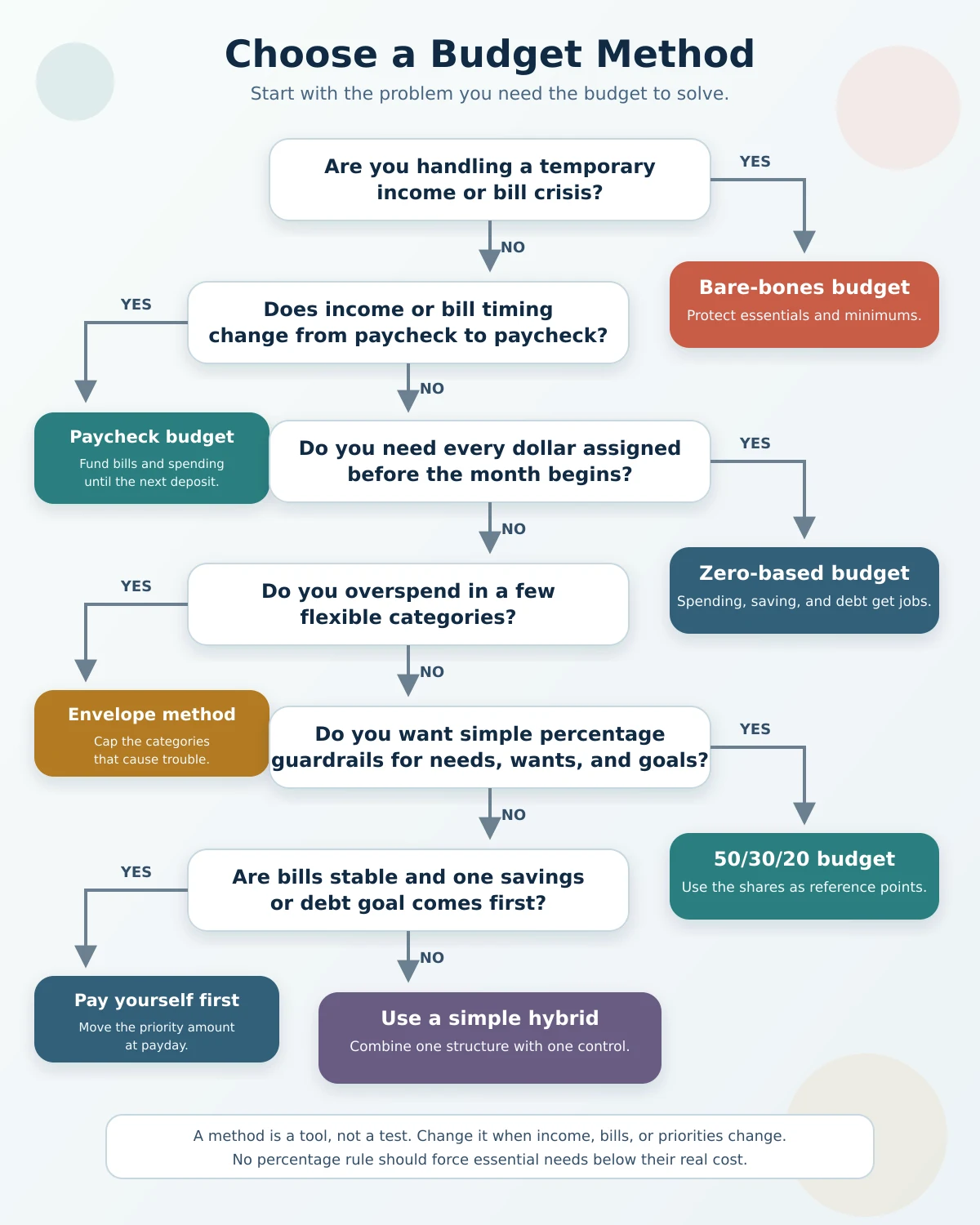
Text version of the decision tree
- If you face a temporary income or bill crisis, use a bare-bones budget.
- If income or bill timing changes from paycheck to paycheck, use a paycheck budget.
- If every dollar needs an assigned job, use a zero-based budget.
- If a few flexible categories run over, use the envelope method.
- If you want percentage guardrails for needs, wants, and goals, use 50/30/20.
- If bills are stable and one savings or debt goal comes first, pay yourself first.
- If none is a clean fit, combine one main structure with one control.
How each budget method works
Paycheck budgeting
Paycheck budgeting asks a short question: what must this deposit cover before the next one arrives? List every bill due in that period, food, transport, a share of upcoming nonmonthly costs, savings, and personal spending. Keep a small buffer when the timing or amount can change.
This system can be useful when you budget with changing income, receive biweekly pay, work variable hours, earn freelance income, or have bills clustered in one part of the month. Base required costs on a conservative income amount when pay changes. Give money from stronger periods a job before raising routine spending.
Zero-based budgeting
A zero-based plan assigns the full amount of expected income. The equation is income minus planned bills, spending, saving, and debt payments equals zero. Zero does not mean the bank account should be empty. Money placed in savings, a sinking fund, or a checking buffer has an assigned job.
Begin with broad categories. Add detail only where it helps a real choice. A plan with 40 categories may feel precise yet take too long to update.
The 50/30/20 budget
The 50/30/20 framework divides take-home income into 50% for needs, 30% for wants, and 20% for savings and extra debt payments. The Consumer Financial Protection Bureau uses the rule in educational budgeting activities. Treat the shares as reference points, not a judgment.
Required minimum debt payments belong with needs because missing them can create fees, collection activity, or credit harm. Extra principal payments belong in the 20% group. A household whose needs use more than 50% should record the real costs, protect essentials, and choose workable shares. Do not disguise a shortage by labeling a required expense as a want.
The envelope method
The envelope method places a limit around one or more spending categories. Cash envelopes make the remaining amount visible. Digital envelopes can use bank buckets, separate accounts, a spreadsheet, or app categories.
You do not need an envelope for every bill. Start with categories that change and tend to run over, such as groceries, dining out, entertainment, clothing, or household spending. If an envelope empties too early each month, check whether the limit is unrealistic before blaming the purchase decisions.
Pay yourself first
This method moves money to a leading goal as soon as income arrives. The transfer might fund emergency savings, retirement, a known annual bill, or an extra debt payment. It works best when essential bills, minimum obligations, and uneven costs are already measured.
A large automatic transfer can cause an overdraft if a bill arrives first. Check due dates and keep a buffer before setting the transfer.
A bare-bones budget
A bare-bones budget funds the expenses that protect housing, food, basic utilities, medicine, insurance, required transport, work-linked care, and minimum obligations. It pauses flexible spending while income or bills are under pressure.
Write an exit point into the plan. That might be the first full paycheck after returning to work, the month an urgent repair is paid, or the date a hardship plan ends. Rebuild reasonable personal spending and savings when the crisis passes, then build an emergency fund for the next unplanned cost.
How to separate needs from wants
A need protects health, safety, housing, income, required care, or a legal or contractual obligation. A want adds comfort, convenience, status, or fun. The same category can contain both.
- Food is a need. Premium brands, delivery fees, and restaurant meals may include wants.
- Housing is a need. Extra space or a high-cost location may include a choice, though moving may not be fast or affordable.
- Internet may be a need for work, school, healthcare, or access needs. A higher entertainment package may be a want.
- A vehicle may be required where safe public transport is not available. Features beyond reliable transport may be wants.
- Childcare may be required for work. Optional activities may sit in a separate group.
Context matters. Delivery may be necessary during illness, disability, grief, overtime, or caregiving. The useful question is not whether a purchase earns a perfect label. Ask whether the cost is required now, whether a lower-cost choice is workable, and what the budget gives up to fund it.
Build a simple hybrid budget
Choose one method for the full plan and one control for the hardest category or goal. Examples:
- Use zero-based budgeting for the month and a weekly grocery envelope.
- Use paycheck budgeting for bill timing and an automatic emergency-fund transfer.
- Use 50/30/20 as a quarterly check while assigning the monthly dollars with a zero-based plan.
- Use a bare-bones plan during reduced work hours, then move to pay yourself first after income recovers.
Keep the hybrid small. Two useful rules are easier to run than six overlapping systems.
Check the method after one month
Track your spending during the test month so the review uses real numbers instead of memory.
Pressure-test the habit side: Play Lifestyle Creep to see how optional upgrades and recurring costs change a fictional 12-month budget.
- Did every essential bill have enough money by its due date?
- Did the plan include annual and seasonal costs?
- Which category needed money moved into it?
- Was the income estimate accurate?
- Did the recordkeeping take more time than the choices were worth?
- Did the plan fund the goal that mattered most?
Keep what worked. Raise a category that was repeatedly too low, lower one that held unused money, and remove detail that did not help a choice. If the structure fits but consistency is difficult, use these steps to keep using the plan.
Budget method questions
What is the best budgeting method?
The best method addresses the main problem and is simple enough to keep using. Paycheck budgeting helps with timing, zero-based budgeting supplies close control, envelopes cap problem categories, 50/30/20 supplies broad guardrails, pay yourself first leads with one goal, and bare-bones budgeting protects essentials in a temporary crisis.
Does the 50/30/20 budget use gross or net income?
Use take-home income for a household spending plan. That is the amount available after payroll withholding and other deductions. Write down which amount you used so later comparisons stay consistent.
What if needs are more than 50% of take-home pay?
Record the real essential costs and use a ratio that fits the current numbers. High rent, childcare, healthcare, transport, or low income can push needs above 50%. The 50% share is a reference point, not a pass or fail line.
Does a zero-based budget mean I spend all my money?
No. It means every dollar has a planned purpose. Savings, a checking buffer, a sinking fund, retirement contributions, and extra debt payments all count as assigned purposes.
Can I combine budget methods?
Yes. Choose one main structure and one control. A zero-based plan with grocery envelopes or a paycheck budget with an automatic savings transfer can work without making the plan hard to run.
How often should I change budget methods?
Change the method when income, bill timing, household needs, or priorities change, or when the current system takes too much work. A one-month test is enough to reveal many fit problems.
Sources and worksheets