Missing Pay Guide
Missing Hours on Your Paycheck: What to Do
If your pay stub lists fewer hours than you worked, check the pay period before sounding the alarm. Then match each shift, calculate the gross shortage, save your records, and send payroll a request that is easy to verify. The MoneyBucket Pay & Work guide covers related paycheck and payroll problems.
Missing Hours Action Sheet
Check before contacting payroll
- Pay-period start and end dates
- Scheduled shifts inside that period
- Timecard or clock records
- Approved edits, leave, and unpaid breaks
- Regular hours, overtime hours, and rate
- Prior pay stub for comparison
| Date | Scheduled | Recorded | Missing regular | Missing overtime | Evidence |
|---|---|---|---|---|---|
Copy-ready message
Subject: Paycheck correction request for [pay period]
Hello [name], my paycheck for [pay period] appears to be missing [number] hours from [dates/shifts]. My records show [correct total] hours, while the pay stub shows [paid total]. I have attached [timecard, schedule, or approval]. Please review the discrepancy, confirm the gross correction amount, and tell me in writing when the correction will be paid. Thank you.
Keep the sent message, attachments, and every reply.
What should you do if hours are missing from your paycheck?
Compare the pay-period dates on your pay stub with your schedule, timecard, and clock records. Mark each missing shift or partial shift, then multiply missing regular hours by the applicable hourly rate to estimate the gross shortage. Save copies and ask payroll or your manager to confirm when and how the correction will be paid. If you want a quick numbers check before contacting payroll, use Paycheck Proof to compare hours, rates, and pay-stub figures.
Why Are Hours Missing From Your Paycheck?
The hours fall in another pay period
A shift worked after the payroll cutoff may belong on the next paycheck even if it happened before payday.
A punch is missing or incorrect
A forgotten clock-in, missed clock-out, or timecard edit can reduce the hours sent to payroll.
A correction was not approved
Your manager may have received an edit, schedule change, or paid-leave request after the payroll deadline.
Time appears under another code
Paid leave, training, travel, holiday time, or a different job code may appear on another earnings line.
A meal period was deducted
An automatic meal deduction may remain even when a record shows that the meal was interrupted or not taken.
The payroll record is wrong
The time was recorded and belongs in the pay period, but it was omitted, reduced, or paid at an incorrect rate.
Six Checks for Missing Paycheck Hours
Use this 46-second visual checklist to confirm the pay period, compare your shifts, calculate the shortage, gather proof, contact payroll, and track the correction.
How to Check Missing Hours in Six Steps
| Step | What to do | What to record |
|---|---|---|
| 1. Confirm the pay period | Find the first and last work dates covered by the check. | Pay-period dates and payday |
| 2. List every shift | Use your schedule, timecard, calendar, messages, and clock records. | Date, start time, end time, and unpaid meal time |
| 3. Match each pay line | Check regular hours, paid leave, training, overtime, and other codes separately. | Paid hours by earnings code |
| 4. Mark the gap | Identify each full or partial shift that is absent or reduced. | Missing date and missing hours |
| 5. Calculate gross pay | Multiply missing regular hours by the applicable rate. Keep overtime separate. | Hours × rate = estimated gross shortage |
| 6. Send a written request | State what the time record shows, what the pay stub shows, and ask for a correction date. | Date sent, recipient, response, and promised pay date |
Worked Example: Four Missing Hours
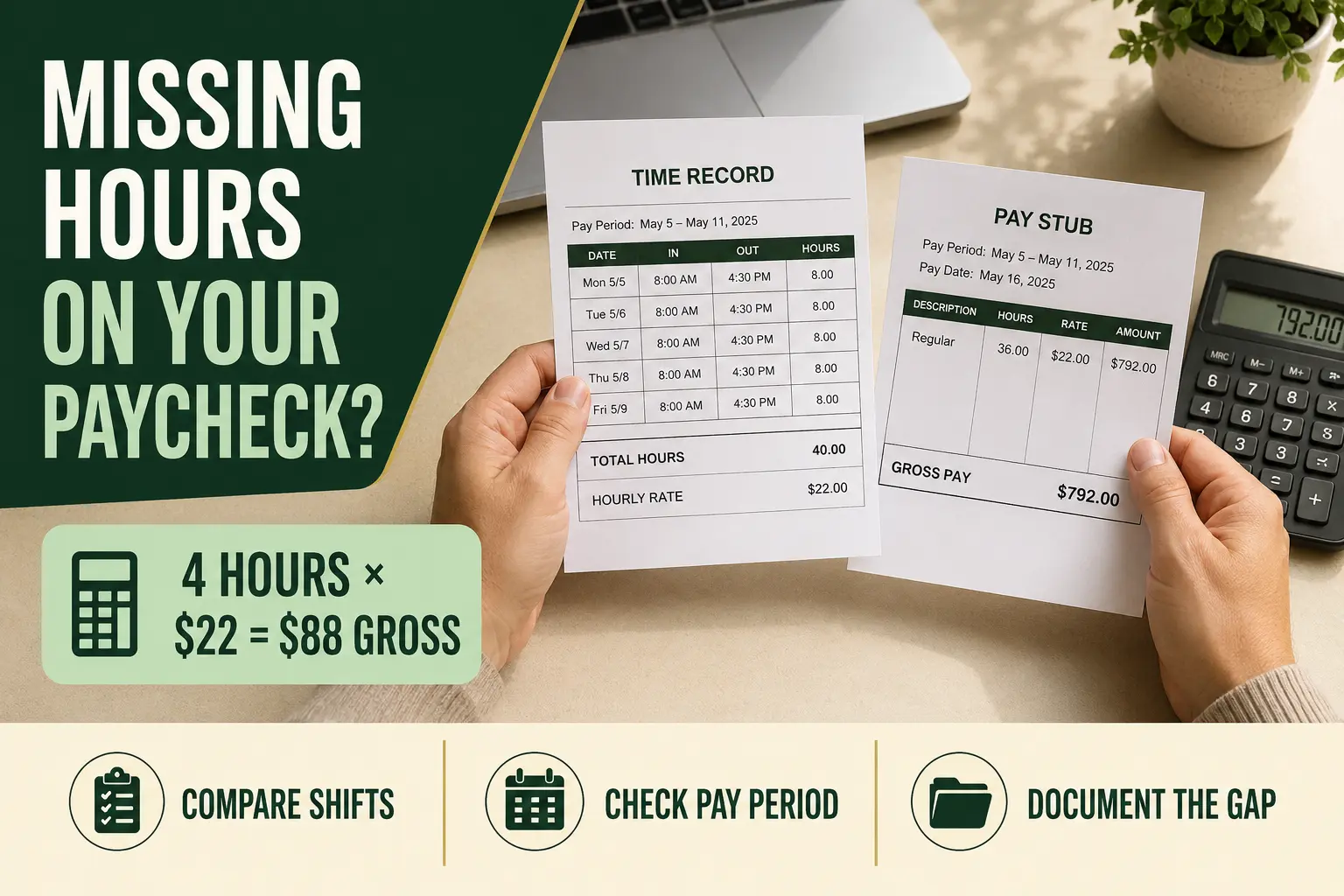
Time record: 40 regular hours
Pay stub: 36 regular hours at $22 per hour
Missing time: 40 − 36 = 4 hours
Estimated gross shortage: 4 × $22 = $88
The correction deposit may be less than $88 because taxes and applicable deductions can affect net pay. Use the $88 gross figure when describing the earnings gap.
Want help checking the gap?
Paycheck Proof helps you compare hours, rates, and pay-stub figures so you can identify the line that needs a second look.
Records That Can Support Your Request
Work records
- Schedule and shift-change notices
- Timecard or clock history
- Missed-punch correction forms
- Manager approvals and work messages
- Paid-leave or training records
Pay records
- The pay stub with missing hours
- An earlier pay stub showing your rate
- Offer letter or raise notice
- Bank activity for the payment
- Any payroll response or case number
Keep copies in a personal account or on a personal device you can access outside work. Write down the date and result of each conversation.
Message Payroll About Missing Hours
Keep the request factual and easy to check. Use the payroll correction message template to prepare a detailed written request.
What If the Missing Time May Be Overtime?
Do not calculate the issue solely from total hours in a two-week pay period. For covered nonexempt workers, federal overtime is generally based on hours over 40 in a workweek, not more than 80 in a two-week pay period. State rules can offer broader protection. Record the employer’s workweek and place each missing shift in the correct week. Use the overtime pay-stub guide to check the calculation by workweek.
What to Do If the Missing Hours Are Not Fixed
- Follow up in writing. Restate the dates, hours, gross calculation, and earlier request.
- Ask for the payroll-error process. Your handbook, payroll portal, union agreement, or HR team may identify the next contact.
- Keep working records. Preserve schedules, timecards, pay stubs, messages, and responses.
- Check your state’s rules. Payday timing, wage statements, correction deadlines, and remedies can vary.
- Contact the proper labor agency if needed. The U.S. Department of Labor offers information on state labor offices and filing a Wage and Hour Division complaint.
Federal law requires covered employers to keep certain records of hours worked and wages earned. The Department of Labor says Wage and Hour Division complaints are confidential and employers cannot retaliate against workers for exercising protected rights.
Missing Paycheck Hours Questions
Can missing hours be added to the next paycheck?
A payroll team may propose a later correction, but the deadline for paying earned wages can depend on federal coverage, state payday law, an agreement, and the facts. Ask for the correction date in writing and check the rules where you work.
Should I calculate missing hours using gross or net pay?
Use gross pay to describe missing earnings. Taxes and deductions can make the net correction smaller than hours multiplied by the rate.
What if my employer says the hours missed the payroll cutoff?
Ask which pay period contains the hours and on what date they will be paid. Save the written response and check the next pay statement.
What if only part of a shift is missing?
Compare the clock-in, clock-out, and meal-period records. Convert the missing time using the employer’s lawful timekeeping method, then show the date and gap in your request.
Can I use my own notes if the employer controls the timecard?
Your calendar, schedule, messages, location history, job records, or personal notes may help reconstruct the shifts. Save lawful copies of any records available to you and avoid taking confidential employer or customer information.
Official Sources
Source check: Reviewed October 2, 2026 by the Money Bucket Editorial Team against the U.S. Department of Labor sources listed above. Corrections: moneybucket.org@gmail.com.
This page provides general educational information, not legal, tax, accounting, or employment advice. Wage rules, correction timing, and remedies vary by worker, employer, pay type, and state.