The MoneyBucket Pay & Work guide covers this overtime check and other common paycheck problems. Paycheck Troubleshooting
Is My Overtime Pay Correct?
Start with one workweek, count the hours actually worked, identify your regular rate, and compare the overtime hours and rate with your pay stub. Under the federal baseline, covered nonexempt employees generally receive at least one and one-half times their regular rate for hours over 40 in a workweek.
Overtime Pay Calculator
Estimate straight-time and overtime gross pay for one workweek.
Planning estimate only. Bonuses, shift differentials, multiple rates, state rules, and exemptions can change the regular-rate calculation.
How do I check overtime on my pay stub?
For a basic hourly-pay example, multiply your hourly rate by 1.5 to find the overtime rate. Multiply that rate by the hours worked over 40 in the workweek. Then check that the pay stub lists the correct regular hours, overtime hours, rates, and gross earnings. If bonuses, commissions, shift differentials, multiple rates, or other compensation apply, the required regular-rate calculation may be different.
Basic Overtime Pay Calculation
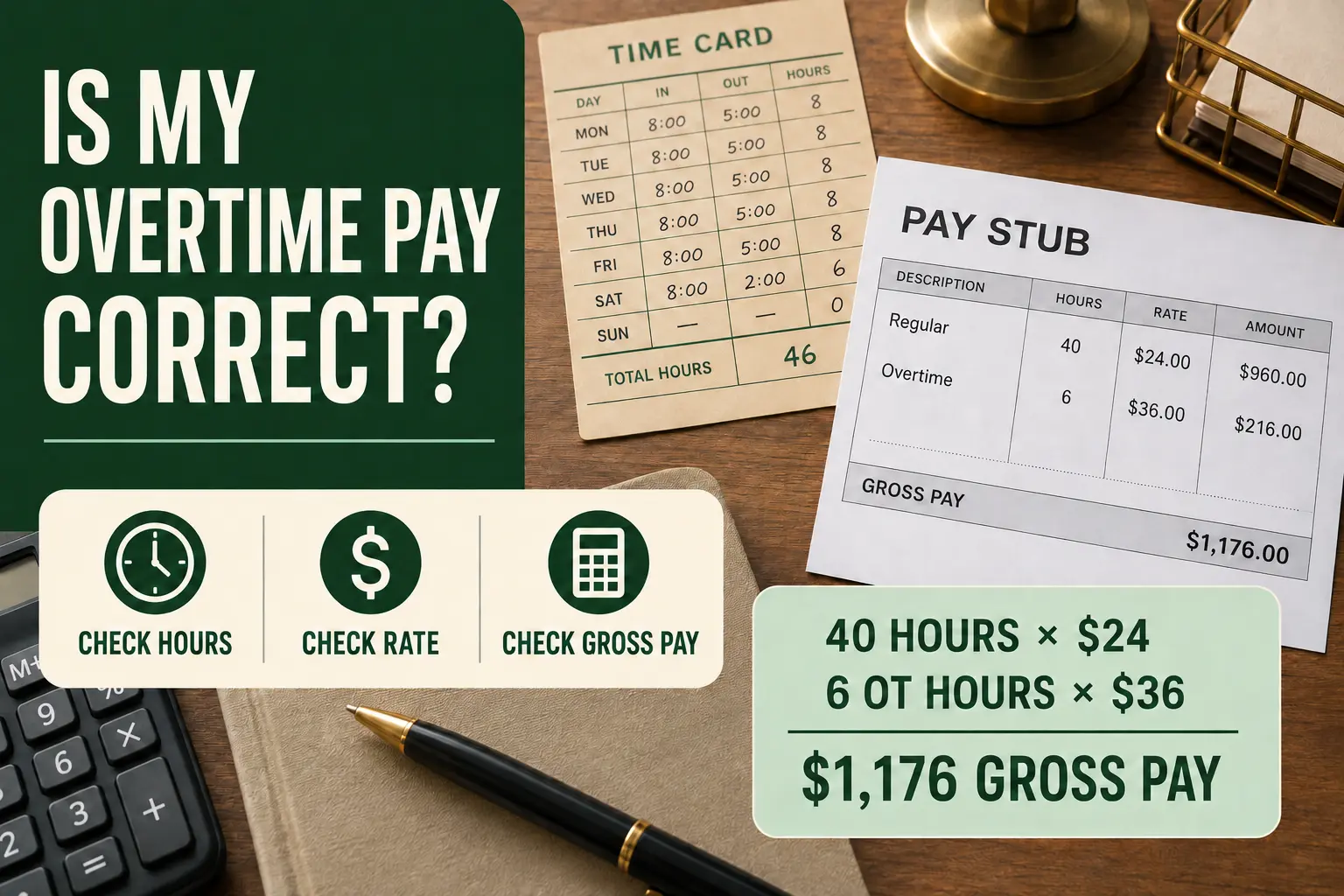
Worked example: 46 hours at $24 per hour
| Pay item | Calculation | Amount |
|---|---|---|
| Regular earnings | 40 hours × $24 | $960 |
| Overtime rate | $24 × 1.5 | $36 per hour |
| Overtime earnings | 6 hours × $36 | $216 |
| Total gross earnings | $960 + $216 | $1,176 |
Expected result: A pay stub for this simple example should show 40 regular hours, 6 overtime hours, a $36 overtime rate, and $1,176 in gross earnings before taxes and deductions.
Check Your Overtime Pay Stub in Seven Steps
- Find the employer’s workweek. Overtime is usually measured by a fixed seven-day workweek under federal law, not by the pay period total.
- Separate each workweek. A two-week pay period may contain one 35-hour week and one 45-hour week. The hours generally cannot be averaged into two 40-hour weeks.
- Match your time records. Compare clock-ins, clock-outs, approved edits, training, meetings, and other recorded work with the hours paid.
- Find the regular rate. Do not assume the base hourly rate is always the full regular rate.
- Check overtime hours. Compare hours over 40 in each workweek with the overtime quantity on the stub.
- Check the overtime rate. For a basic single-rate hourly example, it is at least 1.5 times the regular rate.
- Reconcile gross pay. Add every earnings line and compare the total with gross earnings.
Your Regular Rate May Be Higher Than Your Hourly Rate
The federal regular rate generally includes compensation for employment unless a legal exclusion applies. That can make overtime math more involved when a worker receives other forms of pay.
Pay that may affect the rate
- Nondiscretionary bonuses
- Commissions
- Shift differentials
- Multiple hourly rates
- Production incentives
Items that may be excluded
- Certain discretionary bonuses
- Qualifying expense reimbursements
- Certain gifts
- Qualifying benefit-plan contributions
- Certain premium payments
Labels do not settle the issue. For example, calling a promised attendance or production bonus “discretionary” does not necessarily remove it from the regular rate. The facts and payment terms matter.
Check the hours, rate, and gross pay together
Paycheck Proof helps you organize the numbers on your time record and pay stub so a possible overtime shortage is easier to spot and explain.
Signs Your Overtime May Need a Closer Look
- Hours from two workweeks were averaged together.
- Overtime is missing even though one workweek exceeded 40 hours.
- The overtime rate is below 1.5 times the regular rate for a covered nonexempt worker.
- Time spent working before clock-in, after clock-out, during training, or through an interrupted meal period is missing.
- A shift differential, commission, or nondiscretionary bonus appears to be left out of the regular-rate calculation.
- The employer moved hours into another week or changed a time record without a clear reason.
- You were treated as exempt only because you are salaried or have a job title that sounds managerial.
- The gross-pay arithmetic does not match the earnings lines.
A salary or job title alone does not settle whether an employee is exempt from federal overtime. Duties, pay method, salary level, employer coverage, and other rules can matter. The Department of Labor currently lists the standard federal salary level for certain executive, administrative, and professional exemptions as $684 per week.
What to Do If the Overtime Looks Wrong
- Save the records. Keep the pay stub, timecard, schedule, edits, messages, bonus plan, commission statement, and bank deposit record.
- Write down one workweek at a time. List each date, start time, stop time, unpaid break, rate, and total hours.
- Calculate the difference in gross pay. Keep taxes and deductions out of the first shortage calculation.
- Ask payroll for the workweek and formula used. Name the disputed hours, rate, and amount.
- Keep the response in writing. Save any correction date, explanation, or revised statement.
- Check state rules. Your state may provide stronger overtime rights, different deadlines, or another complaint route.
If regular hours are also missing, use the guide to missing hours on a paycheck. For a broader review, follow the paycheck error checklist. Once published, the payroll correction message will help you report the exact discrepancy.
What to Gather Before Asking for a Correction
Work records
Schedule, clock records, handwritten notes, training time, meeting time, work messages, and approved time edits.
Pay records
Pay stub, prior normal stub, rate notice, bonus or commission terms, direct-deposit record, and any payroll explanation.
Overtime Pay Questions
Is overtime based on 40 hours per week or 80 hours per pay period?
Under the federal baseline, overtime is generally based on hours over 40 in each workweek. An employer generally cannot average a short week and a long week across a two-week pay period to erase overtime.
Is overtime always time and a half?
Covered nonexempt employees generally receive at least 1.5 times the regular rate for hours over 40 in a workweek under federal law. State rules, contracts, and certain pay plans can affect the result.
Do paid holidays or vacation hours count toward 40 hours?
Federal overtime is generally based on hours actually worked. Paid leave or holiday hours not worked usually do not count toward the 40-hour threshold, though state law, a contract, or employer policy may offer stronger terms.
Do bonuses count when calculating overtime?
Some do. Nondiscretionary bonuses tied to promised attendance, production, quality, or other criteria generally must be included in the regular rate. A qualifying discretionary bonus may be excluded.
Can salaried employees earn overtime?
Yes. Being paid a salary does not automatically make an employee exempt. The applicable exemption tests can involve duties, pay method, salary level, and other facts.
Does working more than eight hours in one day require overtime?
Not under the general federal rule by itself. Some states require daily overtime, and contracts or employer policies may promise it.
Official Sources
This page provides general educational information, not legal, tax, accounting, payroll, or employment advice. Coverage, exemptions, workweek rules, regular-rate calculations, and remedies depend on the facts and applicable federal, state, and local law.