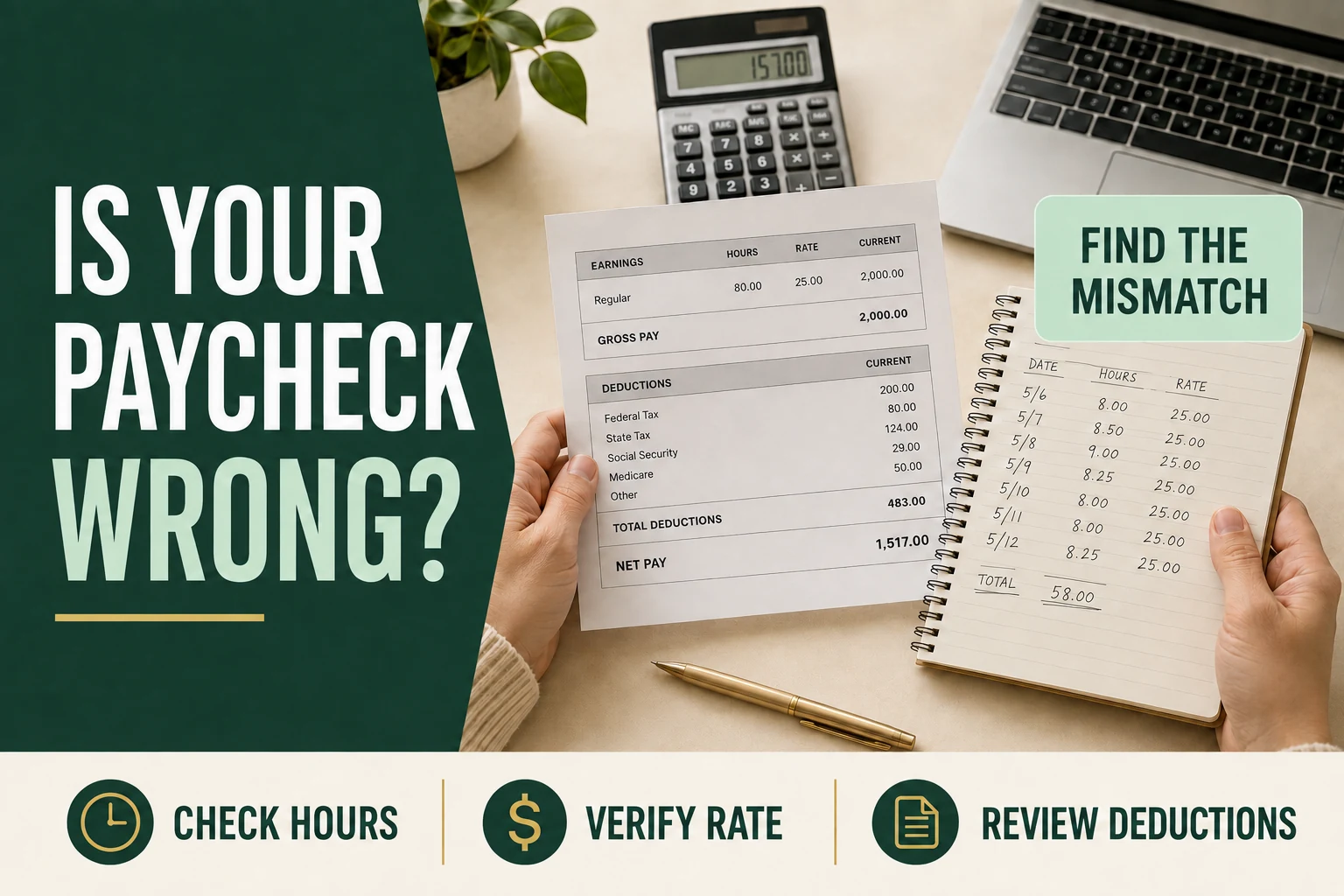
The MoneyBucket Pay & Work guide connects this check with related help for pay stubs, deductions, deposits, and payroll errors. Paycheck Accuracy Guide
How to Find Errors in Your Paycheck
A paycheck can look official and still be wrong. Use this step-by-step check to compare your hours, pay rate, overtime, extra earnings, deductions, and deposit without getting lost in payroll jargon.
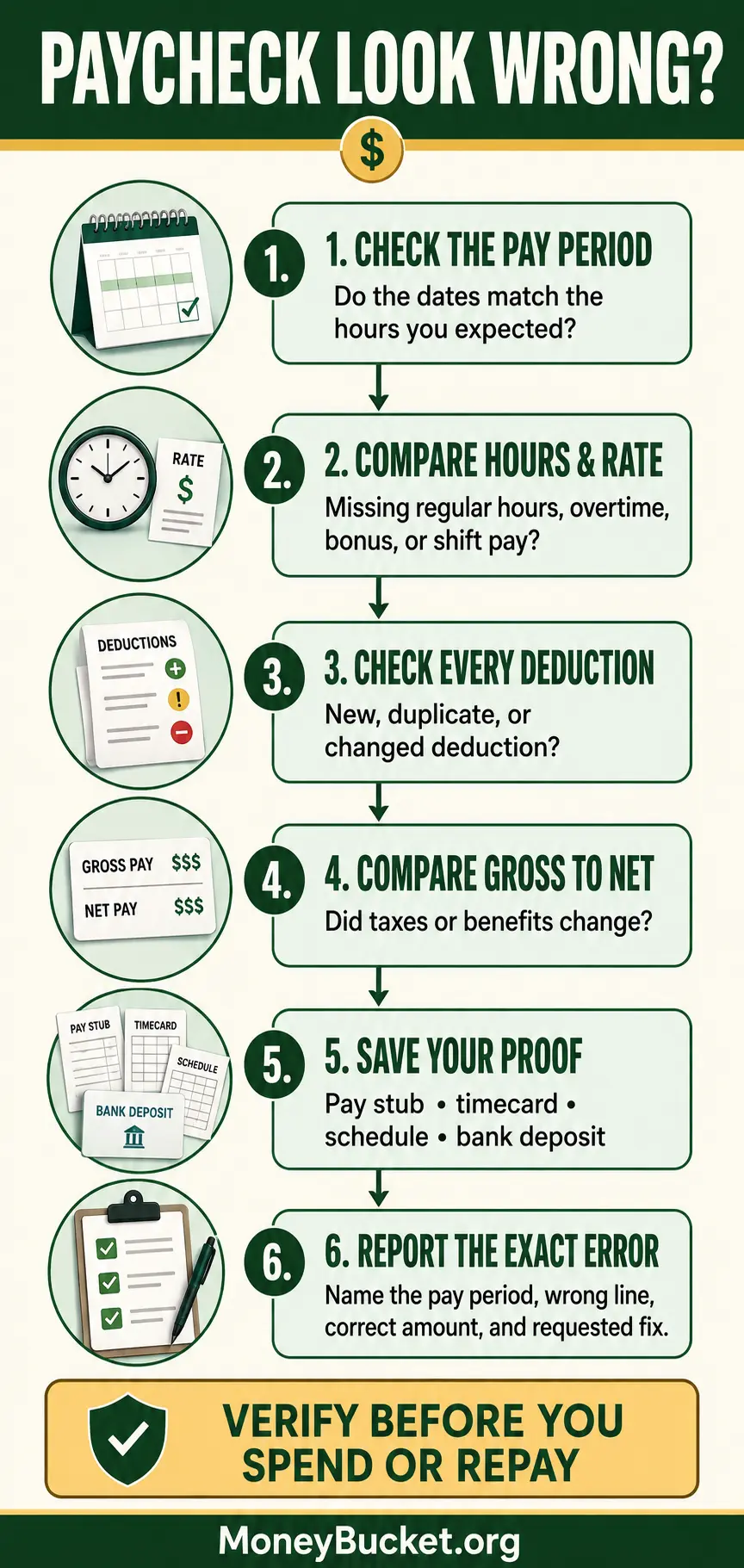
How can you tell if your paycheck is wrong?
Start with gross pay, not the bank deposit. Confirm the pay-period dates, then multiply paid hours by the correct rate and add overtime, shift differentials, commissions, tips, bonuses, paid leave, and reimbursements that belong on this check. Next, compare every deduction with your elections and the prior pay stub. One difference often explains the entire change.
Seven Signs Your Paycheck Deserves a Closer Look
Your gross pay is lower
Missing hours, the wrong rate, unpaid premium pay, or earnings placed in another pay period may be the cause.
Your hours do not match
The pay stub differs from your timecard, schedule, clock records, or approved corrections.
Your regular rate changed
The rate is lower than your offer, raise notice, union agreement, or earlier pay stub.
Overtime is absent or unusual
Overtime hours are missing, counted at an unexpected rate, or mixed into another earnings line.
A deduction appeared twice
The same benefit, insurance cost, repayment, or other amount seems to have been taken more than once.
A familiar deduction jumped
Tax withholding, insurance, retirement, or another line changed without an obvious reason.
The deposit does not match net pay
The pay statement shows one net amount, but your bank received another amount or nothing at all.
Your year-to-date totals look wrong
A total moved backward, jumped sharply, or does not reflect earlier checks from the same year.
Check Your Paycheck in This Order
This order matters. It separates an earnings mistake from a deduction change and keeps you from trying to reconstruct the whole payroll system at once.
| Check | What to compare | What may explain a mismatch |
|---|---|---|
| 1. Pay period | Beginning and ending dates on the stub | Hours worked after the cutoff may belong on the next check. |
| 2. Regular hours | Paid hours against timecards, schedules, clock records, and approved edits | A missed punch, pending correction, unpaid meal period, or omitted shift. |
| 3. Pay rate | Stub rate against your offer, raise notice, contract, or prior stub | A raise was not entered, an old rate remained active, or different work uses different rates. |
| 4. Overtime and premium pay | Weekly hours, overtime line, shift differential, holiday or weekend premium | The payroll workweek differs from the pay period, the payment is delayed, or the calculation needs correction. |
| 5. Other earnings | Tips, commissions, bonuses, paid leave, reimbursements, and piece-rate pay | An approval or reporting deadline was missed, or the payment follows another schedule. |
| 6. Deductions | Current lines against benefit elections, authorizations, tax forms, and the prior stub | A benefit began, arrears were collected, withholding changed, or a duplicate was taken. |
| 7. Net pay and deposit | Net pay against direct deposits, checks, pay cards, or split accounts | The payment was split, returned, delayed, garnished, or sent using old bank details. |
Watch: Six Quick Paycheck Checks
This 57-second visual guide shows where to look first when your pay seems wrong.
Worked Example: A Paycheck That Is $96 Short
Expected: 80 regular hours × $24 = $1,920 gross pay.
Pay stub: 76 regular hours × $24 = $1,824 gross pay.
Difference: 4 hours × $24 = $96 gross pay.
The useful question is not “Why is my deposit wrong?” It is: “My pay stub for the pay period ending August 1 lists 76 regular hours. My approved timecard lists 80. Can you check the missing four hours?” Taxes may change the final amount added to the next payment, so the $96 gross difference will not necessarily create a $96 deposit.
Want help checking the numbers?
Paycheck Proof helps you compare the figures on your pay stub and spot the line that may need a second look. Keep your stub and time records nearby.
Gather Evidence Before You Contact Payroll
Work records
- Schedule and shift changes
- Timecard, clock-in records, and edits
- Paid-leave approvals
- Tip, bonus, commission, or piece-rate records
- Messages approving extra hours or a new rate
Pay records
- The paycheck or pay stub in question
- At least one earlier pay stub
- Offer letter and raise notices
- Benefit and retirement elections
- Bank activity showing the deposit
Keep copies on a personal device or in a personal account you can access. Record the date, person, and response each time you ask about the problem.
How to Report a Possible Payroll Error
- Name the pay period and payday. This helps payroll find the correct record.
- Point to the exact line. State what the stub shows and what your record shows.
- Show your calculation. Keep it short enough to verify in seconds.
- Attach or offer evidence. Use a timecard, rate notice, approval, or prior stub.
- Ask for the correction date. Request written confirmation of what will happen next.
Use the payroll correction message template. If the issue is missing time, see how to document missing hours. For an overtime mismatch, use the overtime pay-stub check.
When the Problem Is Not Fixed
Ask for the employer’s payroll-error or wage-complaint process and keep your request in writing. Federal law sets baseline wage, overtime, and recordkeeping rules for covered workers, while states may set their own payday, pay-statement, deduction, minimum-wage, and overtime rules. Check the labor agency for the state where you work. The U.S. Department of Labor provides a directory of state labor-law resources and information about filing a Wage and Hour Division complaint.
Paycheck Error Questions
What is the most common paycheck error?
Missing hours, an old pay rate, absent premium pay, and unexpected deductions are common places to find a mismatch. The fastest check starts with the pay period, hours, and rate.
Can a paycheck be wrong even if the hourly rate is correct?
Yes. Paid hours, overtime, paid leave, tips, commissions, bonuses, reimbursements, deductions, or bank details can still be wrong.
Why does my pay stub show fewer hours than I worked?
The missing time may fall outside the pay-period cutoff, remain unapproved, result from a missed punch or edit, or reflect a payroll mistake. Compare the pay-period dates with each shift before contacting payroll.
Should I calculate the error using gross or net pay?
Use gross pay to check missing earnings. Net pay changes after taxes and deductions, so it is less useful for proving the value of missing hours or an incorrect rate.
How long should I keep pay stubs and time records?
Keep them long enough to support tax, benefit, wage, and employment questions that may arise. Retention needs vary, so check applicable federal and state guidance and your personal tax-record needs.
Official Sources
This page provides general educational information, not legal, tax, accounting, or employment advice. Rules and remedies vary by worker, employer, pay type, and state.