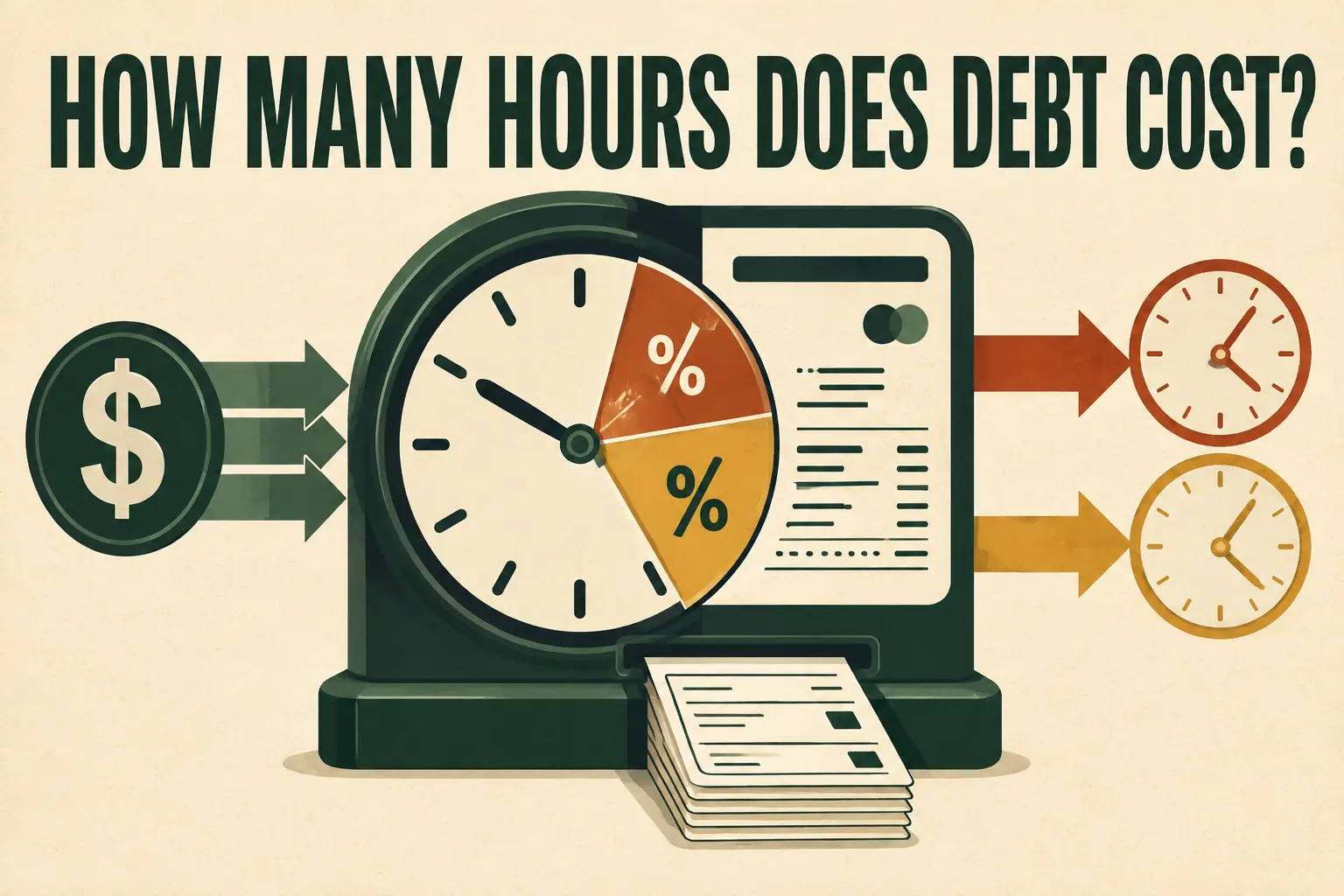
Start with the Debt Management Guide for the broader topic, then use this page for the details below. Debt costs more than dollars. It costs hours of your life. Enter your balance, APR, planned monthly payment, and hourly take-home pay below. The calculator estimates your payoff time, total interest, and the number of work hours needed to earn every dollar you will send to the debt.
Debt Work Hours Calculator
Use figures from your latest statement and pay stub. Your entries stay in this browser and are not sent to MoneyBucket.
Estimate assumes a fixed APR, one payment each month, no new charges or fees, and interest calculated monthly. Your lender may calculate interest daily or apply account rules that change the result.
What the work-hours number means
The calculator divides your estimated total repayment by your hourly take-home pay. If a debt will cost $10,000 to repay and you keep $20 from each hour worked, its time price is 500 work hours.
This is not a claim that every work hour can go toward debt. Rent, food, utilities, insurance, medicine, transportation, and other needs still claim part of each paycheck. The number gives you a new way to see the cost: not just as a balance, but as the labor needed to earn the money.
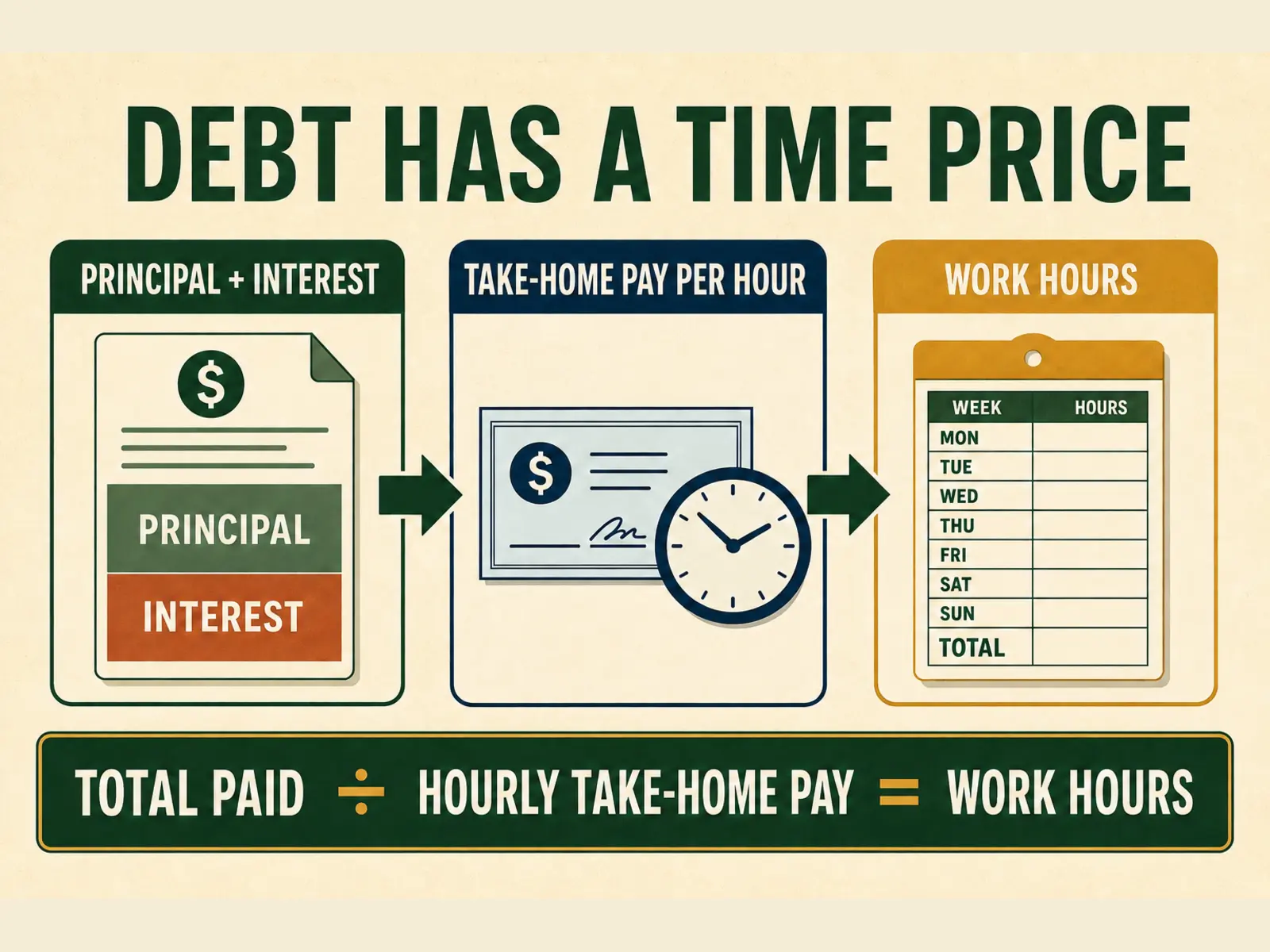
Watch: Find the time price of debt
This 53-second visual guide shows what the calculator measures, why interest creates extra work hours, and what to check when a payment is too small to reduce the balance.
Video transcript
- Debt has a time price. A balance is not only dollars. It is hours of future take-home pay.
- Enter your debt balance, APR, monthly payment, and hourly take-home pay.
- The calculator estimates total paid, interest, and months until payoff.
- Divide total paid by take-home pay per hour to find the debt’s work-hour price.
- See the labor behind principal plus the cost of borrowing.
- Interest hours show how much labor pays for the borrowing itself.
- Test a payment that is $50 larger to see potential time and interest savings.
- If the balance cannot shrink, check the statement, contact the creditor, and ask a nonprofit credit counselor for help.
How to get accurate calculator inputs
Principal hours and interest hours are not the same
Principal hours represent the work needed to repay money you borrowed. Interest hours represent the extra work needed to pay for the borrowing itself. A high APR or small monthly payment can make the interest slice much larger.
| Calculator result | What it tells you | Useful next question |
|---|---|---|
| Total work hours | Principal and estimated interest divided by hourly take-home pay | Does this debt still deserve part of my future income? |
| Interest work hours | Estimated interest divided by hourly take-home pay | Could a larger payment or lower rate reduce this number? |
| Payoff months | How long the balance may last with the entered payment | Will the payment still fit during expensive months? |
| Eight-hour workdays | Total work hours divided into eight-hour days | What would I rather buy back with those days? |
Why the minimum payment can hide the time price
Credit-card statements are required to show how long repayment may take if you make only minimum payments and add no new charges. They also show an estimated payment that would repay the current balance in three years. The Consumer Financial Protection Bureau explains that paying more each month generally means less interest over time.
A minimum payment can keep an account current, yet it may leave the balance alive for years. Compare your statement’s minimum-payment disclosure with the calculator result. If they differ, trust the statement for that account because it can apply your issuer’s rate, payment formula, fees, and balance categories.
Three ways to buy back work hours
1. Increase the repeatable monthly payment
Even a small recurring increase can reduce the number of months that interest has time to grow. The calculator automatically compares your plan with a payment that is $50 higher. Use the comparison as a test, then check whether the higher amount fits after essentials and required payments.
2. Aim extra money at the highest APR
If you have several debts, the debt avalanche method sends extra money to the highest-rate balance while required payments continue on the others. This route often cuts total interest. The debt snowball targets the smallest balance first, which can create quicker account closures and a stronger sense of progress.
3. Ask what lower-cost terms are available
If payments are becoming hard to make, contact the creditor before missing a due date when possible. Ask about a hardship plan, lower rate, fee waiver, due-date change, or structured repayment plan. Get the terms in writing and compare the full repayment cost, not only the monthly payment.
When the calculator says the debt will not shrink
If the monthly payment is equal to or smaller than the first month’s interest, the balance cannot reach zero under the calculator assumptions. That result deserves fast attention.
- Check that the balance, APR, and payment were entered correctly.
- Review the statement for fees, penalty rates, deferred interest, or separate APR buckets.
- Find the smallest payment that is safely above the monthly interest.
- Contact the creditor and ask about hardship options.
- Consider a nonprofit credit counselor if the required payments do not fit after essential expenses.
Frequently asked questions
Should I use gross pay or take-home pay?
Use take-home pay. Gross pay includes money withheld for taxes, benefits, and other deductions, so it can make the debt look cheaper in work hours than it feels in your bank account.
Can I combine all my debts in one calculation?
Run each debt separately when APRs or minimum payments differ. Add the work-hour results afterward. Combining balances under one average rate can hide the cost of the most expensive account.
Does the calculator include late fees or new purchases?
No. It assumes no new charges or fees. Add known fees to the opening balance, or use your lender’s statement disclosure for an account-level estimate.
Why is my statement payoff estimate different?
Your lender may calculate interest daily, use a changing minimum-payment formula, apply several APRs, or include fees. The calculator is a planning estimate, while the statement reflects the account terms used by the issuer.
Is paying debt always more important than saving?
Protect essential expenses and required payments first. A small emergency reserve can keep the next car repair or medical bill from returning to a credit card. Compare the debt’s APR with your cash-buffer needs and near-term risks.
Sources and further help
- Consumer Financial Protection Bureau: Credit cards
- Consumer Financial Protection Bureau: Repayment disclosure calculation rules
- Consumer Financial Protection Bureau: Debt-relief program risks
- Federal Trade Commission: How to avoid a debt-relief scam
- U.S. Department of Labor: Wage and hour recordkeeping
Educational information only. This calculator provides an estimate based on the values you enter and does not offer financial, legal, tax, or credit advice. Review your account agreement and current statement. Contact the creditor or a qualified professional for guidance tied to your circumstances.