Use the MoneyBucket Pay & Work guide for related help with paycheck totals, deductions, overtime, and payroll errors. Pay Stub Guide
How to Read a Pay Stub
Your pay stub tells the story of your paycheck: when you were paid, what you earned, what came out, and what reached you. Here is how to read every major section and spot a number that needs a second look.
How to Read a Pay Stub in 53 Seconds
Follow the highlighted pay-stub sections from the pay period through net pay. The video uses on-screen captions and light music, with no narration.
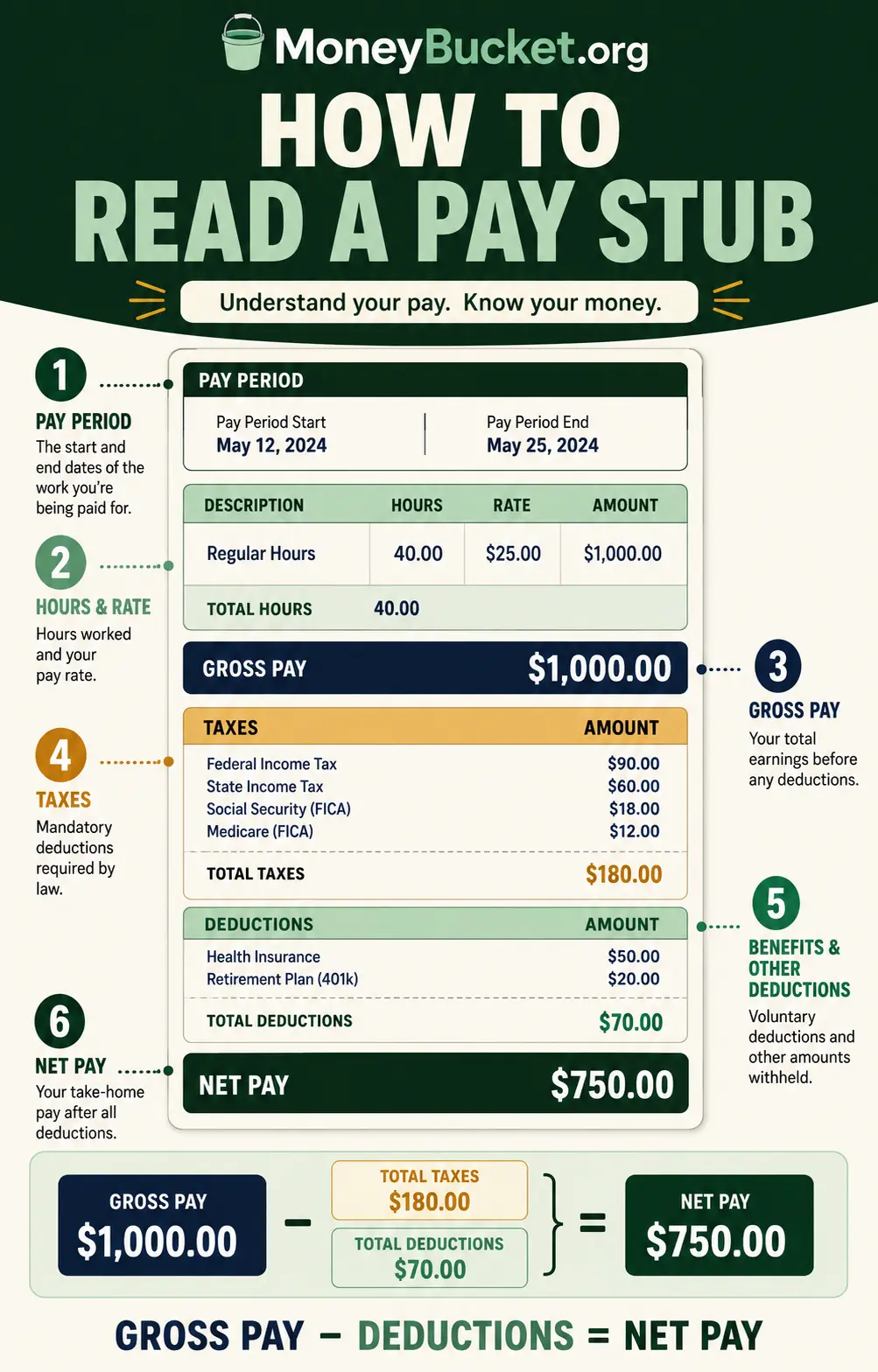
What does a pay stub show?
A pay stub usually identifies the employee and employer, pay date and pay period, hours and earnings, taxes and other deductions, net pay, and year-to-date totals. Read it in that order. Gross pay shows earnings before deductions. Net pay is the amount left after deductions, though split deposits or other payment arrangements can make the bank transaction look different.
The Five Parts of a Pay Stub
1. Pay period and pay date
The pay period tells you which work dates are included. The pay date tells you when payment was issued. Hours near a payroll cutoff may appear on the next check.
2. Earnings
Look for regular hours, rate, overtime, shift pay, paid leave, tips, commission, bonus pay, or reimbursements. Current earnings cover this check; year-to-date earnings cover the year so far.
3. Taxes
Common lines include federal income tax, Social Security, Medicare, and state or local taxes where applicable. Federal income-tax withholding depends partly on earnings and Form W-4 information.
4. Other deductions
Health insurance, retirement contributions, flexible spending, union dues, garnishments, repayments, and other authorized items may appear here. Some reduce taxable wages and some do not.
5. Net pay and payment
Net pay equals gross pay minus taxes and deductions, with payroll adjustments accounted for. Confirm whether it went to one bank account, several accounts, a pay card, or a check.
Year-to-date totals
YTD columns help you track cumulative earnings, taxes, and deductions. Compare them with the prior stub; they should usually move forward by the current amounts.
Common Pay Stub Terms Explained
| Term | What it means | What to check |
|---|---|---|
| Gross pay | Earnings before taxes and deductions | Hours, rates, overtime, and other earnings |
| Taxable wages | Pay subject to a named tax after applicable payroll treatment | Do not assume every tax uses the same wage figure |
| Federal withholding | Federal income tax withheld from pay | Earnings and current Form W-4 information |
| Social Security | Employee Social Security tax withheld from covered wages | Current and YTD amounts |
| Medicare | Employee Medicare tax withheld from covered wages | Current and YTD amounts |
| Pre-tax deduction | A deduction that may reduce wages subject to one or more taxes | Benefit election and which tax treatment applies |
| Post-tax deduction | A deduction taken after applicable taxes | Authorization, amount, and frequency |
| Net pay | Pay remaining after deductions | Payment method and deposit total |
Worked Example: Reading One Pay Stub
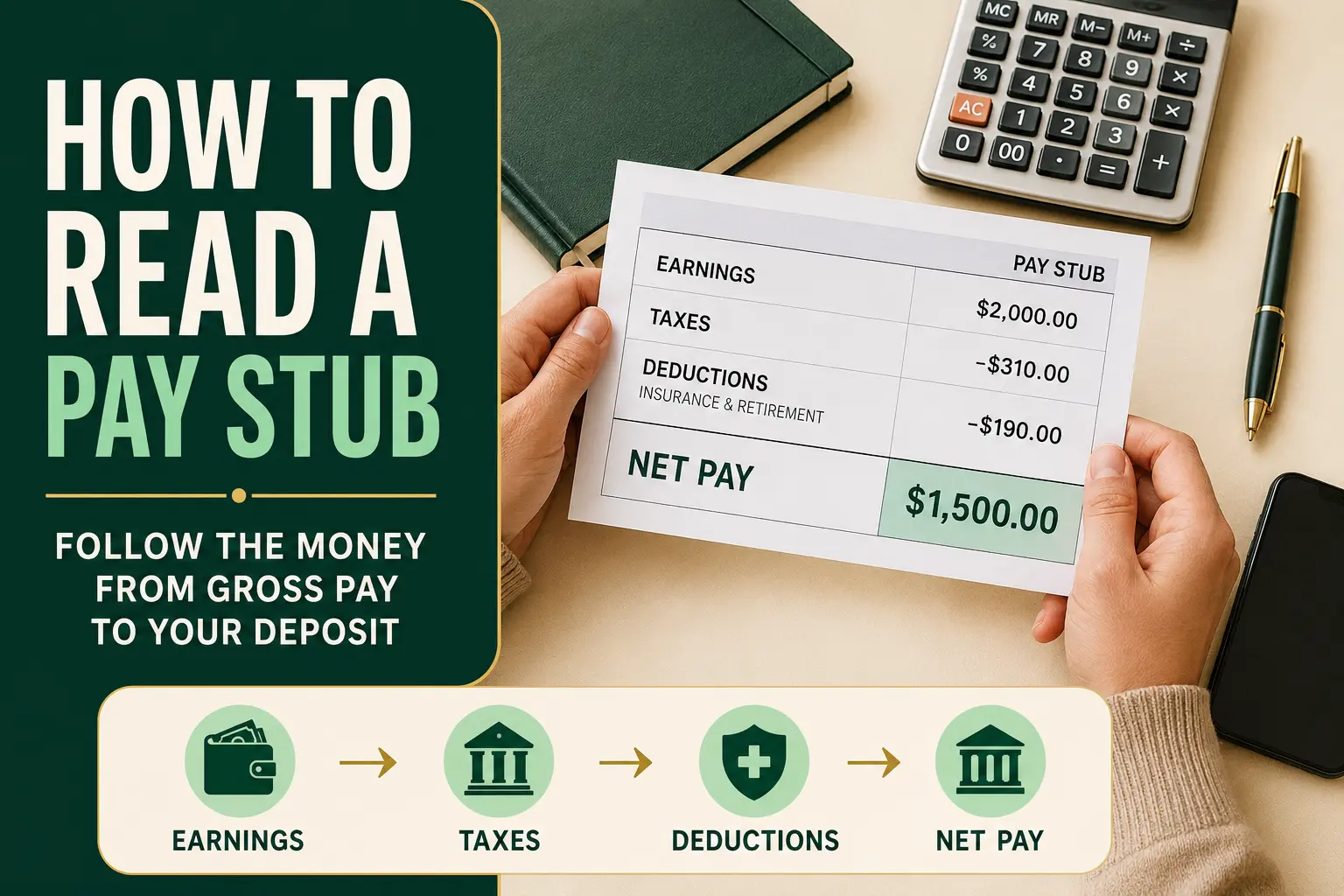
Regular earnings: 80 hours × $25 = $2,000.00
Gross pay: $2,000.00
Taxes: $310.00
Insurance and retirement: $190.00
Net pay: $2,000.00 − $310.00 − $190.00 = $1,500.00
The arithmetic reconciles, but that alone does not prove every line is correct. The reader should still confirm the hours, rate, tax setup, benefit elections, and deposit.
Want a second look at the numbers?
Paycheck Proof helps you compare the figures on your pay stub, work records, and expected pay so you can find the line worth checking.
Check a Pay Stub for Accuracy
- Confirm the person, pay period, and pay date.
- Match hours and rates to your records. Include overtime, paid leave, and extra earnings.
- Recalculate gross pay. Check each earnings line before adding them.
- Review every deduction. Compare benefit elections, Form W-4 changes, and the prior stub.
- Reconcile net pay. Gross pay minus taxes and deductions should lead to net pay after any listed adjustments.
- Compare the payment. Account for split deposits before reporting a missing amount.
- Scan YTD totals. Look for unexplained jumps, missing totals, or a figure that moved backward.
If something does not match, use the paycheck error checklist. For missing time, see missing hours on a paycheck once that guide is live. For an unfamiliar line, use the paycheck deductions guide once published.
What Your Pay Stub May Not Tell You
Labels and layouts vary by payroll provider and employer. A short code may need an employer legend, and federal law does not create one universal pay-stub design for every worker. States may require itemized wage statements or certain details. Ask payroll what an unfamiliar code means and check the labor agency for the state where you work.
Pay Stub Questions
What is the difference between gross pay and net pay?
Gross pay is earnings before taxes and deductions. Net pay is what remains after payroll deductions and listed adjustments.
Why are taxable wages lower than gross pay?
A benefit or retirement deduction may receive pre-tax treatment. Different taxes can use different wage bases, so compare the deduction details before treating the difference as a mistake.
Why does my deposit not equal net pay?
The payment may be split between accounts, divided between a deposit and pay card, reduced by an off-stub arrangement, returned by the bank, or incorrect. Check the payment section first.
What does YTD mean on a pay stub?
Year to date is the cumulative amount from the beginning of the payroll year through the current check. It may appear beside earnings, taxes, and deductions.
Is an employer required to give me a pay stub?
Pay-statement requirements vary by state and worker type. Federal law requires covered employers to keep certain wage and hour records, but state law often controls whether and how a statement must be given to an employee.
Official Sources
This page provides general educational information, not legal, tax, accounting, or employment advice. Pay-stub labels, requirements, and remedies vary by employer, worker, pay type, and state.