Emergency fund stress test
One Car Repair Away: Can You Cover a $1,200 Emergency?
A $1,200 car repair can expose a cash-flow gap fast. Compare the verified repair quote with warranty coverage, emergency savings, and cash you can safely use without missing essentials. The calculator below shows what you can cover now, the remaining gap, and how many months it could take to close or rebuild it.
The $1,200 repair test in 53 seconds
Read the video transcript
- 00:00: Run a $1,200 emergency-fund stress test.
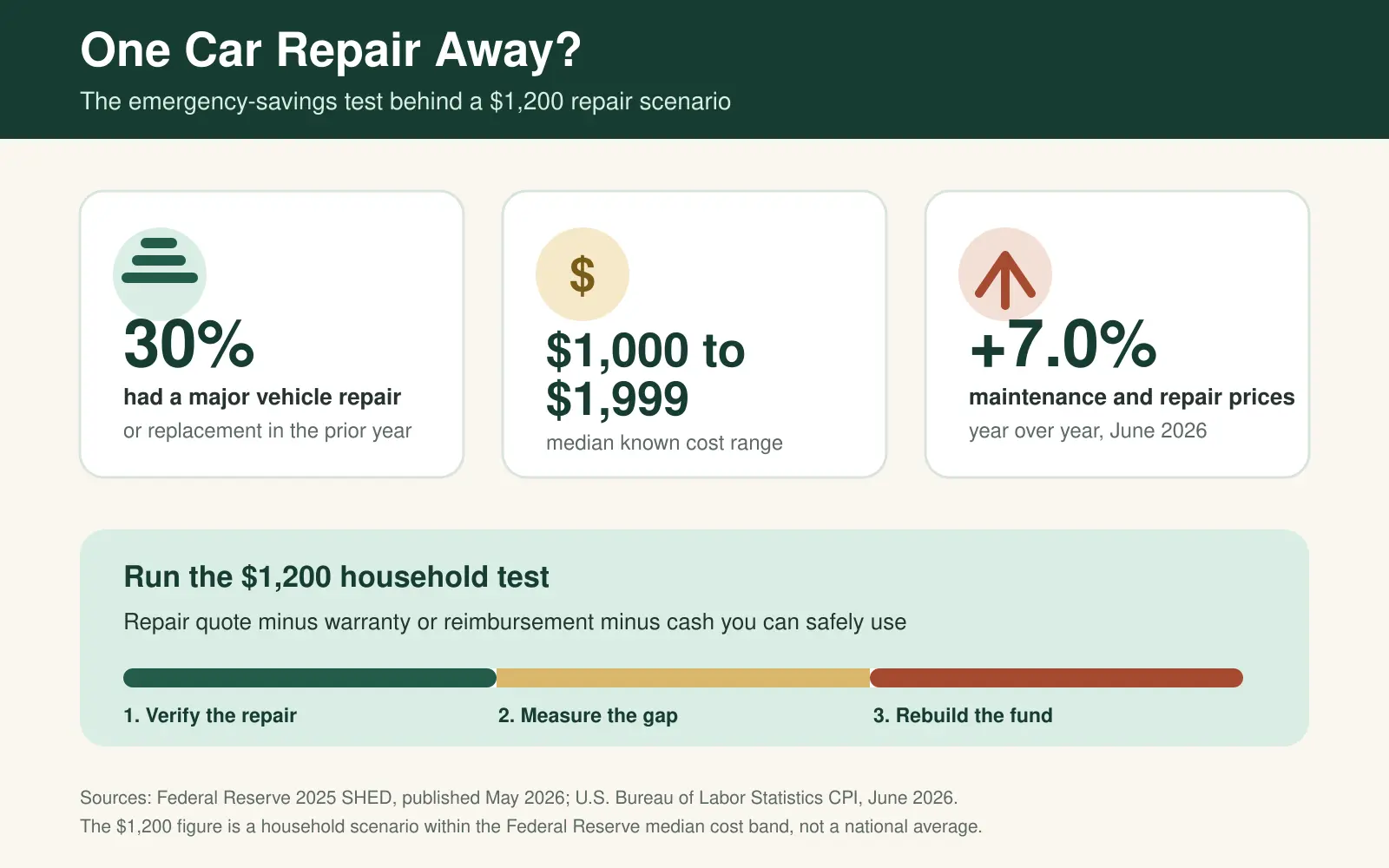
- 00:06: Thirty percent of adults had a major vehicle repair or replacement in the prior year.
- 00:13: The median known cost was $1,000 to $1,999 for that major vehicle event.
- 00:19: Maintenance and repair prices were up 7.0% over the year ending June 2026.
- 00:26: Get the diagnosis, parts, labor, and approval limit in writing.
- 00:32: $500 in savings plus $200 in safe cash leaves a $500 gap on a $1,200 quote.
- 00:39: At $150 per month, a $500 gap takes about four months to close.
- 00:45: Rebuild the reserve from $400 to $800, then to the full $1,200 milestone.
The $1,200 amount is a household scenario within the Federal Reserve median cost band, not a national average.
Why use a $1,200 repair test?
The $1,200 figure is a household scenario, not a national average. It sits inside the Federal Reserve’s reported median known-cost range of $1,000 to $1,999 for major vehicle repairs or replacements in 2025.
These figures do not predict your quote. Vehicle, labor, parts, location, warranty terms, and the urgency of the repair can change the cost. They show why a four-figure test is a useful planning checkpoint.
A repair fund and a general emergency fund can be separate
If a car is essential for work, care, school, or medical appointments, a repair reserve can sit beside a broader emergency fund. That makes ordinary maintenance easier to plan while preserving more of the general fund for job loss, housing, or medical shocks.
$1,200 car repair runway calculator
Replace every sample number with your own. Use only cash that remains after housing, food, utilities, medicine, minimum debt payments, and other essentials.
Worked $1,200 example
| Line | Sample amount | What it means |
|---|---|---|
| Written repair quote | $1,200 | Starting scenario |
| Confirmed warranty or reimbursement | $0 | Do not count unconfirmed coverage |
| Emergency savings available | $500 | Money already reserved for a real shock |
| Other safe cash | $200 | Cash left after near-term essentials |
| Amount available now | $700 | $500 + $200 |
| Remaining gap | $500 | $1,200 – $700 |
| Monthly saving capacity | $150 | A four-month path after rounding up |
Safety comes first. Ask the shop which work is needed to make the vehicle safe and legal to operate. Do not delay a safety-critical repair based only on a savings timeline.
Build the repair plan in the right order
Confirm the problem and get the estimate in writing
The FTC says a written estimate should identify the condition, parts, and anticipated labor charge. Ask the shop to contact you before exceeding an agreed amount.
Ask what is urgent
Separate safety-critical work from maintenance that can reasonably wait. If the explanation is unclear or the quote is large, ask whether a second diagnostic opinion is safe and practical.
Check existing coverage
Review the manufacturer warranty, dealer warranty, recall status, insurance policy, and any service contract. Coverage varies. A service contract is not the same as a warranty, and normal wear may be excluded.
Protect essentials before paying
Keep rent or mortgage, food, utilities, medicine, required insurance, and minimum debt payments visible. A repair solution that creates a housing or utility emergency only moves the problem.
Compare the full cost of any borrowing
Write down the amount financed, annual percentage rate, fees, monthly payment, and payoff date. Be cautious with products secured by your vehicle or paycheck. If a loan could put the car at risk, pause and compare safer options.
Set the rebuild transfer before the repair is forgotten
Schedule a small automatic transfer for the next payday or month. Rebuilding begins with the first repeatable deposit, even if the full target takes time.
Compare payment paths before choosing one
| Payment path | Potential benefit | Cost or risk to check |
|---|---|---|
| Emergency savings | No interest and fast access | Leaves a smaller buffer until rebuilt |
| Cash flow plus a shorter repair scope | May reduce borrowing | Only works if delayed items are safe to postpone |
| Written shop payment plan | May spread the cost | Confirm fees, interest, autopay terms, and consequences of a missed payment |
| Credit union or bank loan | Can have a structured payoff | Compare APR, fees, term, and total repayment |
| Credit card | Immediate access and possible consumer protections | Carrying a balance can make the repair much more expensive |
| Payday or auto-title loan | Fast approval | High cost and, for a title loan, risk to the vehicle |
Rebuild the fund after the repair
Choose the first milestone
If $1,200 feels distant, start with $400, then $800, then the full repair target.
Name the account
A label such as Car Repair Reserve makes the purpose visible and reduces accidental spending.
Use irregular money deliberately
Decide in advance what share of a refund, bonus, or extra paycheck will refill the reserve.
The Federal Reserve reported that 63% of adults would cover a hypothetical $400 emergency expense completely with cash or its equivalent in 2025. A $1,200 vehicle event is three times that test amount, which is why a car-specific milestone can be useful.
For a broader plan, use the Money Bucket emergency fund guide. If the repair competes with monthly bills, revisit the household budget guide and the cash-flow pressure test.
Frequently asked questions
Is $1,200 the average car repair cost?
No. This guide uses $1,200 as a household stress-test scenario. The Federal Reserve reported a median known-cost range of $1,000 to $1,999 for major vehicle repairs or replacements in 2025.
Should I use my emergency fund for a car repair?
A necessary, unplanned repair can fit the purpose of an emergency fund, especially when the car is needed for work, care, school, or medical access. Protect near-term essentials and make a rebuild plan before withdrawing the money.
What if I cannot cover the full repair?
Ask which work is safety-critical, get a written estimate, confirm warranty or recall coverage, and compare any payment option by APR, fees, term, and total repayment. Avoid assuming that the fastest offer is the least expensive.
How much should I keep for car repairs?
There is no universal amount. Consider the vehicle’s age, reliability, warranty, mileage, local labor costs, and how essential it is to your household. A first milestone can be based on a recent written estimate or a four-figure stress test.
What if the repair quote seems too high?
Ask for the diagnosis, parts, labor, taxes, and fees in writing. Ask whether a second opinion is safe before driving elsewhere. You can also check your state consumer protection office if you cannot resolve a repair-shop dispute.
Sources and methodology
- Federal Reserve, Economic Hardships, 2025 SHED: major unexpected expense types and median cost ranges.
- Federal Reserve, Savings and Investments, 2025 SHED: the $400 emergency-expense measure.
- U.S. Bureau of Labor Statistics, Consumer Price Index, June 2026: motor vehicle maintenance and repair price change.
- Federal Trade Commission, Auto Repair Basics: written estimates and repair authorization.
- Consumer Financial Protection Bureau, Emergency Fund Guide: defining and using emergency savings.
Method: The $1,200 scenario is inside the Federal Reserve’s $1,000 to $1,999 median known-cost range. Calculator inputs are user-provided. Months are calculated by dividing the uncovered repair gap by the monthly saving amount and rounding up to the next whole month. A result is not a quote, lending offer, or forecast.