
The MoneyBucket Pay & Work guide covers related paycheck and payroll problems. Payday Emergency Guide
Direct Deposit Missing? What to Do Now
Confirm that payday has arrived, check whether a pay stub was issued, and ask payroll whether the deposit was released. If it was, request the ACH trace number and give it to your bank or credit union so the payment can be located.
What should I do when my direct deposit is missing?
Check the official pay date and your bank balance, not only a pending-transactions screen. Then look for a pay stub. If no stub exists, contact payroll first. If payroll says the deposit was sent, ask for the payment amount, effective date, account information used, deposit status, and ACH trace number. Give that information to your bank. Save every message and fee connected to the delay.
Direct Deposit Missing? Trace Your Paycheck in 60 Seconds
Follow the payment from the official payday through payroll release, ACH trace, bank search, and documentation.
Read the video transcript
- Confirm the official payday on the employer calendar.
- Check the pay stub and available bank balance.
- If no stub exists, ask payroll whether payroll ran, time was approved, and when replacement pay will be issued.
- If a stub exists, confirm the amount, effective date, destination account’s last four digits, and payment status.
- Get the ACH trace number and ask whether the entry was returned, rejected, reversed, or changed.
- Give the bank the sender, amount, effective date, and trace number through a verified contact.
- Ask for the payment status, bank case number, and response time.
- If the destination account is unfamiliar, alert payroll and the bank, then protect payroll and email access.
- Record every name, date, answer, case number, fee, and promised replacement-payment time.
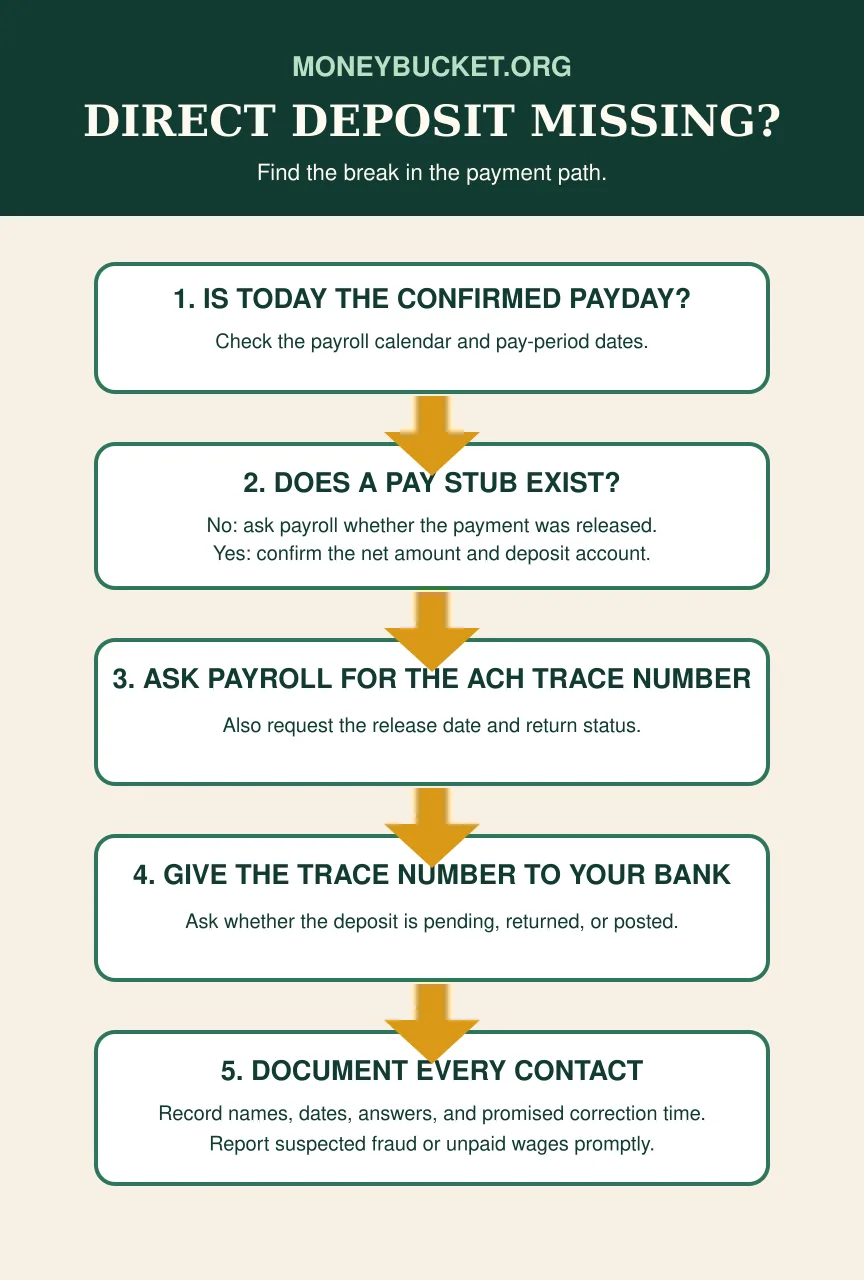
Missing Direct Deposit Decision Tree
1. Payday has not arrived
A deposit that appeared early before does not make early access the promised payday. Check your employer’s pay calendar and allow for weekends, holidays, and payroll cutoffs.
2. No pay stub was issued
Start with your manager or payroll. Ask whether payroll was processed, whether your time was approved, and when payment will be made.
3. A pay stub exists, but no deposit
Ask payroll whether the ACH credit was released, returned, reversed, or sent to different account details. Request the trace number if it was sent.
4. Payroll confirms a successful release
Contact the bank or credit union receiving the deposit. Provide the amount, effective date, sender name, and trace number. Ask whether the credit is pending, posted, rejected, or returned.
What to Ask Payroll
- Was payroll completed for this pay period?
- Was a pay stub issued, and what is the net-pay amount?
- What date was the ACH deposit released?
- What effective date or settlement date was used?
- What were the last four digits of the destination account?
- Was the deposit returned, rejected, reversed, or changed?
- What is the ACH trace number?
- If the payment failed, when and how will replacement pay be provided?
Message to payroll
My direct deposit for the pay period ending [date] has not reached my account. The scheduled pay date is [date], and my expected net pay is [$amount]. Please confirm whether the payment was released, the effective date, the last four digits of the destination account, its current status, and the ACH trace number. If it was returned or not released, please tell me when and how replacement pay will be issued.
Confirm the amount payroll says it sent
If you are paid hourly and received a pay stub, Paycheck Proof can help you compare recorded hours, base rate, overtime hours, and overtime pay before you start the trace. Deductions and net pay need a separate review.
What to Ask Your Bank or Credit Union
Direct deposits commonly travel through the Automated Clearing House, or ACH, network. An ACH trace number helps the receiving institution search for the entry, but it does not guarantee the money posted to the intended account.
- Call the number on your bank card or use the institution’s verified app.
- Say that an expected payroll ACH credit is missing.
- Provide the sender name, amount, effective date, and trace number.
- Ask whether the payment is pending, posted under another description, rejected, or returned.
- Request a case number and the expected response time.
- Write down the representative’s name and the time of the call.
If the deposit went to an account you do not recognize, alert payroll and your bank at once. Change payroll credentials through a verified channel, review recent account changes, and protect your email account.
Direct Deposit Trace Log
Use this record to keep payroll, bank, and replacement-payment details in one place.
Download the Direct Deposit Trace Log (CSV)
| Item | What to record |
|---|---|
| Employer and pay period | Employer name; pay-period start and end |
| Scheduled pay date | Date shown on the pay calendar or pay stub |
| Expected net pay | Exact amount shown on the pay stub |
| Payroll release | Date, effective date, status, and last four account digits |
| ACH trace number | Number supplied by payroll or its processor |
| Bank case | Case number, representative, date, time, and response promised |
| Returned payment | Return date and reason supplied |
| Replacement pay | Method, amount, and delivery date promised |
| Costs caused by delay | Late fees, overdraft fees, returned payments, and notices |
When the Missing Deposit Needs Urgent Action
Possible payroll fraud
Act quickly if account details changed without your approval, a payroll-change email looks suspicious, or the deposit went to an unknown account. Secure payroll and email access and report the change through verified contacts.
Wages remain unpaid
If the employer did not issue the wages or will not correct a failed payment, check your state payday rules and labor-agency process. State deadlines and remedies can be stronger than federal rules.
Keep the pay stub, time records, pay calendar, payroll messages, bank case number, and records of fees. The U.S. Department of Labor provides a directory of state labor offices. If the missing deposit leaves essential bills at risk, the emergency fund guide can help you rank immediate expenses while the payment is traced.
Common Reasons a Payroll Deposit Does Not Appear
- The scheduled pay date has not arrived.
- Time approval or payroll processing was missed.
- The routing or account number is wrong.
- The account was closed, frozen, or unable to accept the credit.
- A new direct-deposit setup is still in a pre-notification or verification period.
- The ACH entry was returned or rejected.
- The employer sent a paper check for the first or changed payment.
- The deposit posted under an unfamiliar company or payroll-processor name.
- An unauthorized person changed the payroll destination.
For broader paycheck math, use the paycheck error checklist. If the stub itself is confusing, follow the guide to reading a pay stub. Visit the Pay & Work hub for the complete paycheck-help path.
Missing Direct Deposit Questions
Can my bank find a direct deposit with a trace number?
The trace number gives the receiving bank or credit union a payment identifier it can use while searching its ACH records. Ask payroll for the number, amount, effective date, and sender name.
Should I call payroll or my bank first?
Call payroll first unless the bank already shows a pending or returned entry. Payroll can confirm whether the payment was released and supply the trace details the bank may need.
Does a pay stub prove the money was deposited?
No. A pay stub shows the employer’s wage calculation and expected payment. It does not prove that the bank received or posted the ACH credit.
Why did coworkers get paid but I did not?
Your entry may have different account details, a return, a payroll hold, a setup issue, or a fraud-related change. Ask payroll to check your individual payment status, not only the company payroll batch.
Can a direct deposit arrive later in the day?
Posting timing can vary, but a promised payday should be judged by the employer’s pay schedule and applicable law, not by earlier deposits you happened to receive in the past. Ask payroll and the bank for the effective date and status.
What if the missing pay causes fees?
Save bank statements, fee notices, late notices, and every payroll response. Ask the employer and bank in writing whether they will reimburse costs. Rights and remedies can depend on state law and the cause of the delay.
Official Sources
Source check: Reviewed October 2, 2026 by the Money Bucket Editorial Team against the CFPB, Nacha and U.S. Department of Labor sources listed above. Corrections: moneybucket.org@gmail.com.
This page provides general educational information, not legal, banking, tax, payroll, or employment advice. Deposit timing, wage-payment deadlines, account protections, and remedies depend on the facts, financial institution, employer policy, and applicable law.