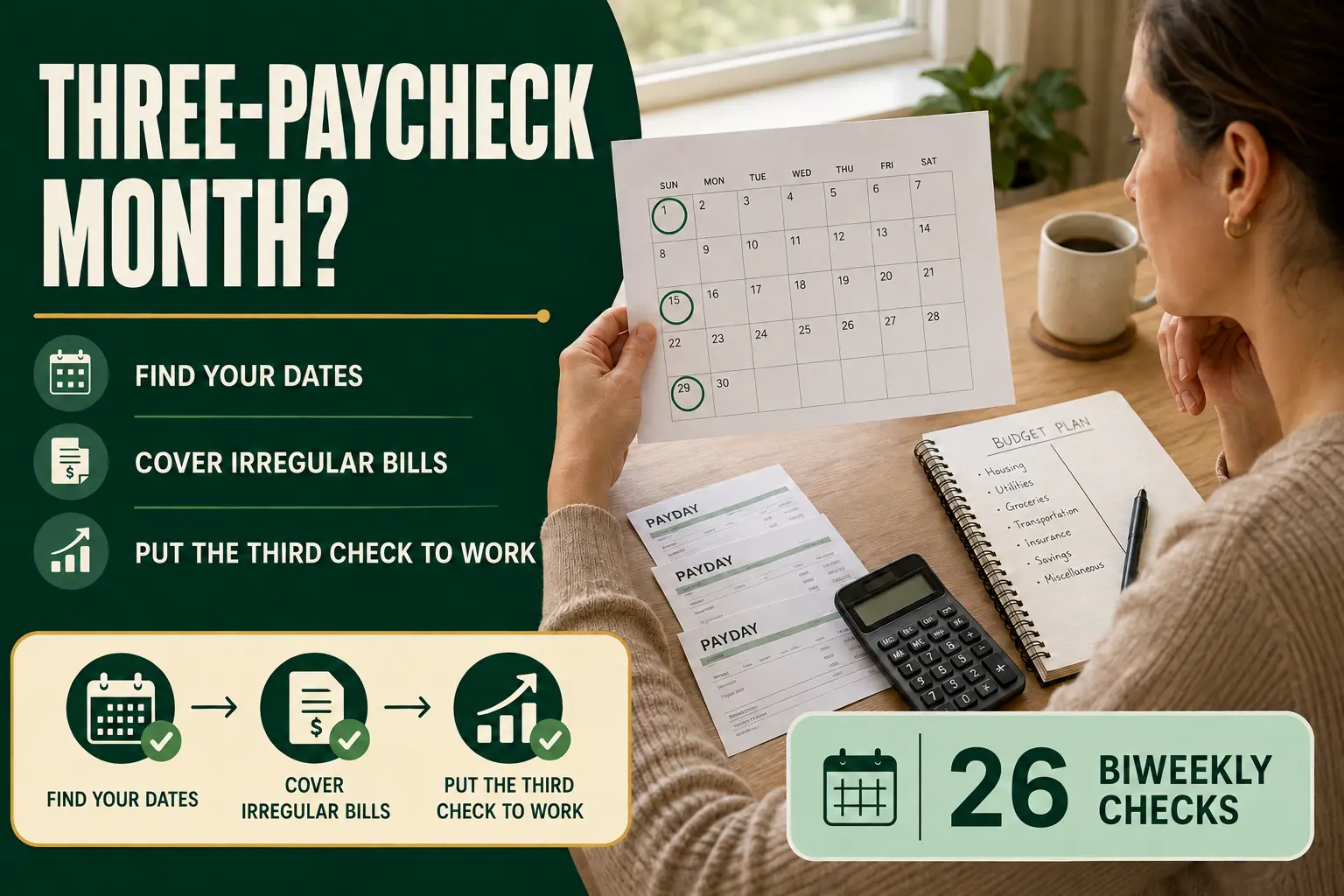
Use the MoneyBucket Pay & Work guide for related help with paycheck timing, deductions, and payroll questions. Make the Rare Check Count
Three-Paycheck Months: Find Your Dates and Make a Plan
If you are paid every two weeks, two months may bring three paychecks instead of two. Find the dates on your own payroll calendar, protect money needed for irregular bills, and give the remaining dollars a job before the deposit arrives.
Your 2026–2030 Three-Paycheck Calendar
Choose one known biweekly payday. The calendar follows that exact 14-day sequence.
For biweekly schedules only. Payroll changes, bank holidays, and early deposits can shift a displayed deposit date.
What is a three-paycheck month?
A three-paycheck month occurs when a biweekly payday sequence places three regular paydays inside one calendar month. A normal biweekly schedule has 26 pay periods, while most monthly budgets are built around two checks per month. That creates two months with a third check in many years. The dates are different for each payroll sequence, so use your employer’s calendar rather than a generic list online.
How to Find Your Three-Paycheck Months
1. Confirm that you are paid biweekly
Biweekly means every 14 days, often on the same weekday. Semimonthly usually means twice per month on set dates, such as the 15th and final business day.
2. Start with a confirmed payday
Use a recent pay stub, payroll portal, or employer calendar. Do not count the end of the pay period as the payday unless they are the same date.
3. Mark every 14 days
Continue the pattern through December. Any month containing three marked paydays is one of your three-paycheck months.
4. Check holiday shifts
A bank holiday may move a deposit earlier or later. Use the official payroll calendar when the change could place a payday in another month.
Example calendar pattern
If a worker is paid on the 1st, the next two biweekly paydays are the 15th and 29th. All three land in the same month. The next payday arrives 14 days after the 29th, in the following month.
| Pay schedule | Typical checks per year | Three-check month? |
|---|---|---|
| Weekly | 52 | Some months have five checks |
| Biweekly | 26 | Often two months have three checks |
| Semimonthly | 24 | Usually no third regular check |
| Monthly | 12 | No |
The IRS uses 26 annual pay periods for biweekly withholding calculations and 24 for semimonthly calculations. An occasional calendar alignment can create 27 biweekly paydays in a year, so confirm the employer’s calendar instead of assuming every year is identical.
Check what the third deposit will actually contain
If you are paid hourly, Paycheck Proof can help you compare expected hours, base rate, overtime hours, and overtime pay against the pay stub before you build a plan around the deposit.
A Five-Step Third-Paycheck Budget Plan
1. Reserve normal living costs
Set aside groceries, transportation, childcare, prescriptions, and any other costs that occur every week or every payday.
2. Fund irregular bills
Look ahead for insurance premiums, vehicle tags, school costs, holidays, medical visits, home repairs, and annual subscriptions.
3. Repair urgent money leaks
Catch up a past-due essential bill, cover an overdraft risk, replace a failing tire, or handle another problem that could become more expensive.
4. Strengthen the next month
Add to an emergency fund, pay high-cost debt, create a bill cushion, or pre-fund a known expense.
5. Keep a planned piece
If the essentials are covered, reserve a modest amount for something enjoyable. A plan that allows one conscious reward can be easier to keep.
Use this order before the check arrives
- Write the expected net deposit: $_____
- Subtract recurring costs until the next payday: $_____
- Subtract irregular bills due soon: $_____
- Choose one urgent repair or catch-up goal: $_____
- Split what remains among savings, debt, a future expense, and a planned treat.
Example: A $1,800 Third Paycheck
This example does not treat the whole deposit as free money. It reserves the costs that still occur during the extra pay cycle, then assigns every remaining dollar.
| Job for the money | Amount | Why it comes here |
|---|---|---|
| Groceries, fuel, and childcare | $450 | Normal costs continue |
| Car insurance due next month | $300 | Irregular bill is already known |
| Emergency savings | $500 | Builds a buffer against the next surprise |
| Credit-card principal | $400 | Reduces costly debt |
| Planned treat | $150 | Enjoyed without taking from another goal |
| Total assigned | $1,800 | Every dollar has a job |
Choose the Best Job for Your Money
| If this is happening | Consider using the check for |
|---|---|
| Essential bills are past due | Housing, utilities, food, medicine, transportation, or childcare first |
| You have no cash cushion | A starter emergency fund or one-paycheck buffer |
| A large bill is coming | A sinking fund for the known cost |
| High-interest debt is growing | A targeted principal payment after essential bills are secure |
| Income varies | A low-income-month reserve |
| Your basics are secure | Retirement, a longer-term goal, debt payoff, and a planned reward |
Three-Paycheck Month Mistakes to Avoid
- Counting a semimonthly schedule as biweekly.
- Using a generic calendar that does not match your employer’s payday sequence.
- Spending the deposit before checking the pay stub and deductions.
- Calling the whole check extra while weekly expenses still continue.
- Paying debt so aggressively that rent, food, or medicine becomes short.
- Moving money to savings while a known annual bill is about to hit a credit card.
- Waiting until payday to decide what the money should do.
If the deposit is different from what you expected, use the guide to find out why take-home pay changed. If a deposit does not arrive, follow the missing direct-deposit checklist.
Three-Paycheck Month Questions
Which months have three paychecks?
The answer depends on your first payday and the employer’s 14-day sequence. Mark every confirmed payday on a calendar. Any month with three marks is one of yours.
Does everyone get two three-paycheck months?
No. The pattern applies to many biweekly workers in a normal 26-pay-period year. A different pay frequency, job change, first check, holiday shift, or 27-pay-period year can change the result.
Why is my third paycheck smaller?
Hours, benefit deductions, retirement contributions, garnishments, taxes, or payroll rules may differ. Compare it with an earlier check using the pay-stub guide and deduction guide.
Is a three-paycheck month a good time to pay debt?
It can be, once essential bills and near-term irregular costs are covered. Keep enough cash to avoid putting the next surprise back on the card.
Should I save or invest the third paycheck?
The best order depends on near-term bills, emergency savings, debt cost, workplace benefits, and the time before you need the money. Money needed soon should not be exposed to short-term market loss.
Do taxes take more from a third paycheck?
A regular third paycheck is still a regular payroll payment. Withholding depends on taxable wages, pay frequency, Form W-4 information, and payroll calculations. Check the actual stub rather than assuming the entire deposit will match another check.
Make the Decision Before Payday
Put the three paycheck dates in your calendar now. Then list the bills and problems competing for the money. A third check can disappear in a weekend or quietly remove a financial pressure that has followed you for months. The difference is a written plan made before the deposit arrives.
Use the Pay & Work hub for the full paycheck-help series, and use the paycheck error checklist if the hours, rate, deductions, or deposit do not match.
Official Sources
This page provides general educational information, not financial, tax, payroll, investment, accounting, or legal advice. Pay frequency, deposit timing, deductions, and withholding depend on the employer’s payroll calendar and the worker’s circumstances.