
Verify Before You Repay
Employer Says You Were Overpaid? What to Do Next
Do not spend disputed money or rush to send it back. Confirm the overpayment, ask for the calculation and tax treatment in writing, check the rules where you work, and agree only to repayment terms you understand.
Do you have to repay an overpaid paycheck?
A genuine wage overpayment usually does not become yours simply because payroll made the mistake. Yet the employer still needs the correct amount, and the way it can recover the money may depend on federal law, state law, a union agreement, and company policy. Ask for written proof before paying. Keep the disputed amount separate, compare the payroll records, and do not authorize an open-ended deduction.
Overpaid Paycheck Scenarios: The Next Safe Move
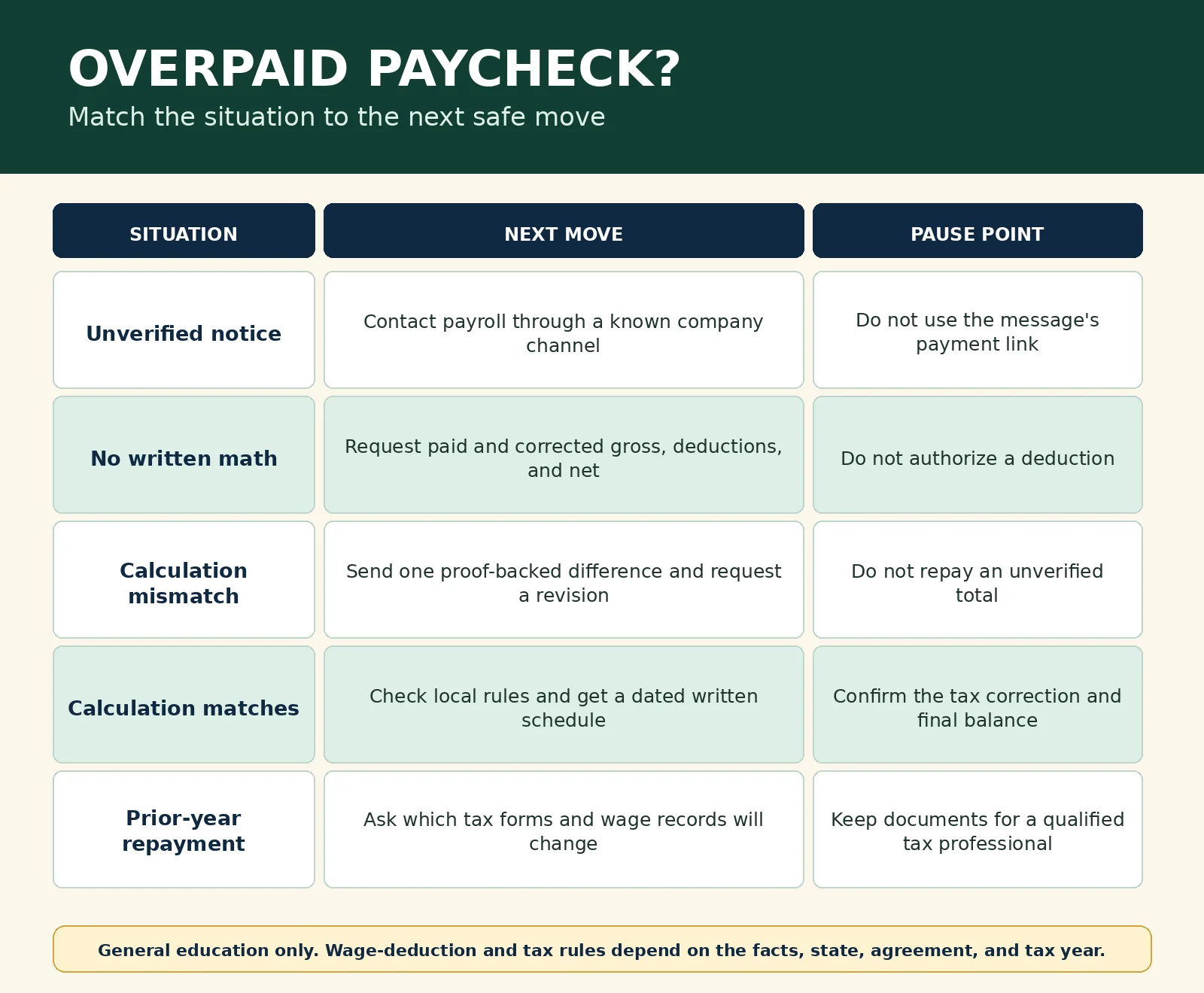
Read the scenario table
| Situation | Next move | Pause point |
|---|---|---|
| Unverified notice | Contact payroll through a known company channel. | Do not use the message’s payment link. |
| No written math | Request paid and corrected gross, deductions, and net. | Do not authorize a deduction. |
| Calculation mismatch | Send one proof-backed difference and request a revision. | Do not repay an unverified total. |
| Calculation matches | Check local rules and get a dated written schedule. | Confirm the tax correction and final balance. |
| Prior-year repayment | Ask which tax forms and wage records will change. | Keep documents for a qualified tax professional. |
Employer Says You Were Overpaid? 12 Checks in Two Minutes
Verify the notice, protect the disputed money, reconcile gross and net pay, check the recovery rules, and get written repayment and tax-correction terms.
Read the video transcript
- Verify the amount before agreeing to repay it.
- Confirm the notice through a trusted company channel.
- Leave the disputed money untouched.
- Identify the exact paycheck and payroll line involved.
- Request the paid, corrected, and difference calculations.
- Separate the $300 gross difference from the $225 extra cash received.
- Compare the calculation with your pay stub, timecard, schedule, rate, bonus, and leave records.
- Check the federal baseline, state deduction rules, and any union or contract terms.
- Get the verified total, payment schedule, and tax correction in writing.
- Ask whether the repayment is in the same tax year or a later year and which records will be corrected.
- Dispute a mismatch with one checkable fact and supporting proof.
- Save the calculation, agreement, receipts, corrected pay records, and payroll messages until the balance reaches zero.
What to Do When Your Employer Says You Were Overpaid
1. Confirm the request is real
Contact payroll through the company directory or payroll portal. Do not use a phone number or payment link supplied only in the repayment message.
2. Ask which check is wrong
Request the pay period, payday, earnings code, hours, rate, bonus, commission, leave, or deduction that created the claimed overpayment.
3. Request the full math
Ask for the correct gross pay, paid gross pay, gross difference, taxes and deductions affected, net amount received, and amount the employer wants returned.
4. Compare your records
Check the pay stub against your timecard, schedule, rate notice, bonus plan, commission statement, leave balance, and bank deposit.
5. Check the recovery rules
State rules may control notice, written consent, deduction size, timing, and minimum-pay protections. A union agreement or employment contract may add another process.
6. Get terms in writing
Confirm the amount, schedule, payment method, tax correction, corrected pay stub or W-2, and what happens if employment ends before repayment is complete.
Check the paycheck before agreeing to the claim
If you are paid hourly, Paycheck Proof can help you compare recorded hours, base rate, overtime hours, and overtime pay against the pay stub so you can identify the earnings line that needs a second look.
How to Check the Overpayment Calculation
Start with gross pay, not the amount that landed in your bank account. Gross pay shows the earnings error. Net pay reflects the taxes and deductions taken from those earnings. That is why a $300 gross overpayment does not automatically mean you received $300 extra cash.
Example: a $300 gross overpayment
| Line | Paid check | Correct check | Difference |
|---|---|---|---|
| Gross pay | $2,300 | $2,000 | $300 |
| Taxes and deductions | $575 | $500 | $75 |
| Net pay | $1,725 | $1,500 | $225 |
The worker received $225 more in take-home pay, even though gross wages were overstated by $300. The correct repayment and tax process can depend on when the wages were paid and repaid. Ask payroll to explain the requested amount rather than mailing $300 on instinct.
Red flags in an overpayment calculation
- The employer gives only a total, with no pay period or payroll lines.
- The request treats gross overpayment and extra net deposit as identical.
- Hours, rate, commissions, bonuses, tips, or approved leave do not match your records.
- The calculation includes money you already returned or a deduction already taken.
- Payroll cannot explain how taxes or benefits will be corrected.
- The repayment request comes from an unfamiliar account or asks for gift cards, cryptocurrency, cash, or a person-to-person payment.
What Records Should You Gather?
Payroll records
- The pay stub in question
- One or two earlier pay stubs
- Timecards and schedules
- Rate or promotion notice
- Bonus, commission, tip, or leave records
Repayment records
- The employer’s written calculation
- Every email and portal message
- Deduction authorization or proposed agreement
- Bank deposit confirmation
- Receipts and corrected payroll documents
Before You Agree to Payroll Deductions or a Repayment Plan
Federal wage law sets minimum-wage and overtime baselines for covered workers. Department of Labor guidance has addressed recovery of genuine wage advances or overpayments, but state rules can be more protective and may require notice or consent. Do not assume that a payroll deduction is valid merely because the underlying overpayment is real.
| Ask payroll | Why it matters |
|---|---|
| What exact amount do you claim I owe? | Prevents an unexplained or changing balance. |
| Is that amount gross or net? | Shows whether taxes and deductions were considered. |
| Which pay periods and lines created it? | Lets you match the claim to your records. |
| How will payroll taxes be corrected? | Helps prevent paying back money while incorrect wages remain on tax records. |
| Will I receive corrected pay stubs or a corrected W-2? | Creates a record of the revised wages and withholding. |
| What deduction or payment schedule is proposed? | Lets you check affordability and legal limits before signing. |
| Will fees or interest be added? | Stops surprise charges from appearing later. |
Message to Send When Payroll Claims an Overpayment
Subject: Request for overpayment calculation for pay period [dates]
Hello [Payroll or HR contact],
I received your notice stating that I was overpaid for [pay period or payday]. Before discussing repayment, please send the written calculation showing:
- the paid and corrected gross wages;
- the hours, rate, earnings code, benefit, leave, bonus, or commission involved;
- the taxes and deductions affected;
- the paid and corrected net amounts;
- the exact amount you are asking me to repay; and
- how my pay stubs, payroll tax records, and Form W-2 will be corrected.
Please also provide the proposed repayment method and schedule, along with the policy, agreement, or law the company is relying on for any payroll deduction. I am keeping the disputed funds available while I review the calculation and my records.
Thank you,
[Your name]
[Employee ID, only if normally used]
If the Calculation Is Wrong
Reply with one checkable difference at a time. Use the payroll correction message templates to identify the pay period, show what payroll used, show what your record says, and attach the proof. The missing-hours guide, overtime guide, and deduction guide can help isolate the mismatch.
Subject: Dispute of overpayment calculation for [pay period]
Hello [name], I compared the calculation with my records. The company calculation uses [hours, rate, date, or other figure], while my attached [timecard, rate notice, agreement, or statement] shows [correct figure]. This changes the claimed overpayment from [$claimed amount] to [$your calculated amount]. Please review the attached record and send a revised calculation before any deduction or payment is made.
How Taxes Can Change an Overpayment Repayment
The calendar year matters. IRS Publication 15 says employers generally handle repayments of wages received in error differently when the wages are repaid in the same year versus a later year. For current-year repayments, employers may adjust employment tax reporting for the repaid wages. Prior-year repayments can involve different limits and records.
Ask payroll for a written answer to these questions:
- Will the repayment occur in the same calendar year as the overpayment?
- Which federal income, Social Security, and Medicare tax amounts will be corrected?
- Will payroll issue corrected pay stubs or Form W-2c?
- If the repayment crosses tax years, what documentation will payroll provide for your tax preparer?
- Does the requested payment represent gross wages, net wages, or another calculated amount?
Do not rely on a generic online formula for a cross-year repayment. The correct handling depends on the dates, payroll records, type of pay, and tax facts.
What If You Cannot Afford the Proposed Repayment?
Do not ignore the notice. Confirm the amount first, then ask for smaller deductions or payments that leave room for rent, food, utilities, transportation, and medicine. A real debt does not make every recovery method acceptable. Check the wage-deduction rules where you work before authorizing a plan.
If payroll threatens an immediate deduction, refuses to explain the amount, or proposes a deduction that may cut protected wages, contact the state labor agency, your union, or an employment attorney. The Department of Labor provides a state labor-office directory. Rules and complaint routes vary by state.
Overpaid Paycheck Questions
Can an employer take the whole overpayment from my next check?
Not always. The answer can depend on federal minimum-wage and overtime rules, state deduction and notice laws, a union agreement, and the facts of the payment. Ask for the calculation and legal basis in writing before authorizing a deduction.
Should I repay the gross amount or the net amount?
Do not guess. Ask payroll to show both amounts and explain the tax correction. The right process can differ between a repayment made in the same calendar year and one made later.
What if I already spent the money?
Respond promptly, verify the total, and request an affordable written schedule. Avoid agreeing to a balance or deduction before you have checked the calculation.
Can I keep the money because the employer made the mistake?
A payroll error does not usually turn an unearned payment into a gift. You can still require proof of the amount and check whether the proposed recovery method follows the rules that apply where you work.
What if the overpayment notice looks like a scam?
Contact payroll through a trusted company channel. Do not click the message’s link or send money until the company confirms the notice, amount, and approved repayment method.
What happens if I leave the job?
Ask how the employer plans to handle the final paycheck and any remaining balance. Final-paycheck and deduction rules differ by state, so check the rules where you worked before signing an authorization.
Keep the Full Paycheck Trail
Save the original pay stub, corrected pay stub, employer calculation, repayment agreement, payment receipts, and corrected tax forms. Then use the pay-stub guide to check the next check. The paycheck error checklist and Pay & Work hub connect the rest of the paycheck-help series.
Official Sources
This page provides general educational information, not legal, tax, payroll, accounting, or employment advice. Repayment duties, wage-deduction limits, tax treatment, notices, deadlines, and remedies depend on the facts and the law where the employee works.