
Self-employment is not just a higher hourly-rate question. The right question is not, “Can I earn more per hour?” It is, “What remains after every hour and cost needed to earn that money?” A $60 client rate can produce less usable income than a lower employee wage when only part of the workday is billable.
Self-employment pros and cons side by side
| Possible advantage | The matching cost or risk | Evidence to check |
|---|---|---|
| Control over clients and projects | Sales, proposals, scope disputes, and client concentration become your responsibility. | How many qualified prospects exist, and what share of revenue would the largest client control? |
| Control over schedule | Deadlines, client time zones, peak seasons, and service needs can still control the calendar. | Which hours are truly flexible, and which are fixed by the work? |
| Ability to set a rate | A quoted rate is not the same as real hourly pay after unpaid time and costs. | Billable hours, unpaid hours, collection rate, business costs, benefits, and reserve needs. |
| More income paths | Revenue can be uneven and may depend on a small number of clients. | Signed work, repeat demand, pipeline value, payment terms, and cash runway. |
| Business-expense deductions may apply | A deduction is not a reimbursement, and personal costs do not become deductible because a business exists. | Ordinary and necessary business purpose, receipt, date, amount, and current tax rules. |
| Choice of retirement plan | The owner must open, fund, and maintain the plan, and employee-plan rules can apply after hiring. | Plan type, earned income, contribution rules, fees, filing duties, and employee coverage. |
| Ability to build an asset | A business may have little sale value when every dollar depends on the owner’s personal labor. | Recurring clients, documented process, transferable contracts, margins, and owner dependence. |
The strongest reasons to choose self-employment
You can choose the offer
An owner can focus on a service, customer group, price model, or work method that an employer may not support. That control has value when customers will pay for the offer.
You can spread income across clients
Several healthy client relationships can reduce dependence on one employer. A single dominant client can recreate the same dependence without employee protections.
You can keep the upside from better systems
If a process cuts delivery time without lowering quality, the owner may keep more margin. A fixed hourly model may still cap that benefit.
You can build a business record
Documented revenue, client retention, operating process, and brand assets can become more valuable than a string of one-time gigs.
You can select a retirement route
IRS guidance lists retirement options for eligible self-employed people, including SEP, SIMPLE, and qualified plans. A one-participant 401(k) is another route for an eligible owner with no employees other than a spouse. Rules differ by plan and can change after hiring.
You can test before leaving a job
Some people can validate an offer with limited work outside job hours, subject to employment agreements, licensing rules, and conflicts. A paid test provides better evidence than a business name or logo.
The costs that make a high rate misleading
Employees are commonly paid for work time while the employer handles sales, payroll, equipment, administration, and part of the benefit package. A self-employed worker may perform all of those jobs before sending one invoice.
- Unpaid sales time: networking, calls, estimates, proposals, follow-up, and lost bids.
- Unpaid delivery support: planning, email, revision control, scheduling, travel, and file management.
- Business costs: software, equipment, supplies, licenses, insurance, payment fees, bookkeeping, and professional help.
- Benefit replacement: health coverage, disability coverage, retirement funding, training, and paid time away from work.
- Payment risk: slow invoices, disputed work, refunds, chargebacks, client failure, and gaps between projects.
- Tax cash flow: recordkeeping, self-employment tax, income tax, estimated payments, and state or local duties.
Calculate the real hourly amount
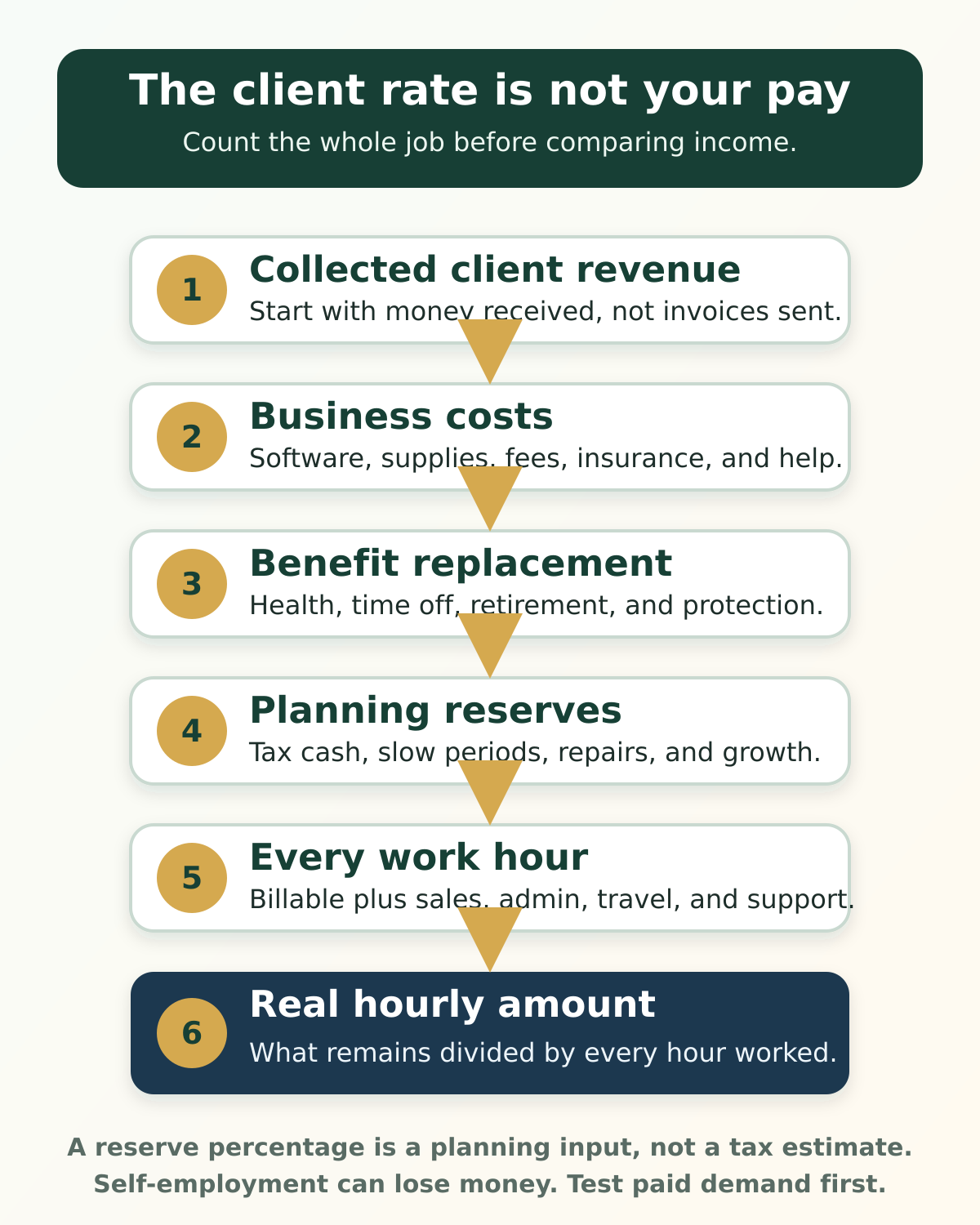
Start with collected revenue, not invoices sent. Subtract business costs and chosen reserves. Divide what remains by billable and unpaid work hours. Keep the tax reserve labeled as a planning input rather than a tax calculation.
| Fictional input | Amount | Why it matters |
|---|---|---|
| Client rate | $60 per billable hour | The number shown in the contract. |
| Billable time | 20 hours a week for 46 weeks | Produces $55,200 of annual collected revenue if every billed dollar is collected. |
| Unpaid work | 10 hours a week for 46 weeks | Total work time becomes 1,380 hours, not 920. |
| Business and benefit costs | $13,200 a year | Leaves $42,000 before personal taxes and other reserves. |
| Planning reserve | 25% of the $42,000 remainder | Moves $10,500 aside. This is an entered planning choice, not a tax estimate. |
| Amount after costs and reserve | $31,500, or about $22.83 per total work hour | The same $60 client rate looks different after the whole workload is counted. |
This example does not compare after-tax employee and self-employed pay. It shows why the client rate cannot be treated as personal hourly pay. Use current tax forms or qualified tax help for an actual tax estimate.
Self-Employment Rate Reality Check
Compare a client rate with collected revenue, unpaid work, business costs, benefit replacement, and a planning reserve. Then estimate the billed rate needed to reach a chosen pre-tax pay target.
Private by design: entries stay in this browser. This page does not send or save them.
Your rate reality check
| Line | Amount | Reading |
|---|
Self-employed is not the same as independent contractor
| Term | What it describes | Key warning |
|---|---|---|
| Self-employed | A broad tax and business description for someone who operates a trade, business, profession, or eligible income activity for themselves. | Business structure, licensing, insurance, tax, and local duties can still apply. |
| Independent contractor | A worker relationship analyzed under the law that applies to the work. A contractor is generally in business for themselves. | A contract label or Form 1099 does not settle legal status by itself. |
| Employee | A worker relationship that can bring wage, overtime, payroll-tax, unemployment, workers’ compensation, leave, or benefit rights under applicable law. | Tests can differ by federal statute and state. One relationship can receive different treatment under different laws. |
The U.S. Department of Labor warns that misclassification can deny workers minimum-wage, overtime, and other protections. On February 26, 2026, the Department proposed replacing its 2024 federal rule and states that the proposal is not final. Other federal laws and state laws can use different tests. Check the current rule and the law that applies to the work before accepting a label.
Tax and recordkeeping duties
The IRS states that a self-employed person generally files an annual return and may need estimated tax payments during the year. Self-employment tax helps fund Social Security and Medicare. Income tax, state tax, sales tax, payroll duties, licenses, and filing rules depend on the activity and location.
- Record income when received. Reconcile client payments, platform payouts, processing fees, refunds, and deposited amounts.
- Keep business-cost proof. Save receipts, invoices, mileage records, contracts, and the business purpose for each cost.
- Separate planning cash. Move tax and business reserves away from spending money. The reserve percentage is a cash-flow choice, not proof of the final bill.
- Check estimated-payment rules. Review the IRS estimated tax guidance when withholding will not cover enough tax. Use current forms and due dates.
- Review business structure and local duties. The Small Business Administration launch guide covers structure, registration, tax IDs, licenses, banking, and insurance. Location and activity can add other duties.
- Reconcile before filing. Match records to bank, payment-platform, and information-return totals. Resolve differences rather than forcing them to match.
MoneyBucket’s Self-Employment Tax Paycheck guide can help plan a reserve and pay-period view. It does not replace a filed return or professional tax work.
Health coverage, time off, and retirement
Self-employment does not mean that benefits are impossible. It means the owner usually has to find, pay for, and manage them. HealthCare.gov says a self-employed person with no employees can use the individual Marketplace. Eligibility and costs depend on household facts and current rules.
Health coverage
Compare premiums, deductibles, networks, prescriptions, subsidies, enrollment dates, and the cost of losing an employer contribution.
Paid time away
Build nonworking weeks into the rate and cash plan. A week without billing can still include software, insurance, and other fixed costs.
Disability and liability risk
Ask what happens if you cannot work or a client claims loss. Coverage needs depend on the service, contracts, property, and state rules.
Retirement
Compare an IRA, SEP, SIMPLE plan, and one-participant 401(k) when eligible. Employee coverage, earned-income calculations, deadlines, costs, and filing duties can change the fit.
Eight questions before leaving a job
- Is there paid demand? Name the customer, problem, offer, price, and proof that someone will buy.
- What is the real rate? Count every billable and unpaid hour, cost, benefit replacement, reserve, and expected payment gap.
- How concentrated is the revenue? Record the share tied to the largest client and what happens if that client leaves.
- Can cash survive the payment terms? A profitable invoice cannot pay a bill before the client pays it.
- Which duties move to you? List sales, contracts, delivery, support, bookkeeping, tax, insurance, technology, and compliance.
- Which protections are being replaced? Price health coverage, paid time, retirement contribution, disability coverage, and any other employer support you use.
- Is the worker label lawful? Review control, economic dependence, opportunity for profit or loss, investment, permanence, skill, and state rules with current guidance.
- What is the stop rule? Set a date, cash floor, client target, and loss limit that would trigger a pause, price change, or return to employment.
A 30-day self-employment test
Week 1: Define one offer
State the buyer, problem, deliverable, price, boundary, timeline, and proof you can do the work.
Week 2: Find ten likely buyers
Use direct contacts, local groups, referrals, past colleagues, or a focused marketplace. Record replies and objections.
Week 3: Seek one paid test
Use a written scope, payment schedule, change rule, ownership term, and cancellation term. Do not rely on a verbal promise.
Week 4: Review the evidence
Compare revenue, costs, paid hours, unpaid hours, collection timing, stress, repeat interest, and what would need to change.
Warning signs the offer is not ready
- The price was copied from another freelancer without a cost or time calculation.
- One client controls nearly all expected revenue and also controls how, when, and where the work is done.
- The plan depends on every available hour being billable.
- Taxes, health coverage, insurance, paid time, or late payment are missing from the cash plan.
- The business requires a large purchase before any customer has agreed to pay.
- The contract has no scope, payment date, revision boundary, ownership term, or cancellation rule.
- The only sales claim is that income is unlimited.
Read the seven-number checklist
Before choosing self-employment, check seven numbers. Start with collected client revenue. Subtract business costs and the price of replacing benefits. Count billable hours and unpaid sales, admin, travel, and support time. Plan for slow or unpaid invoices. Move a chosen tax reserve away from spending cash, but do not treat that percentage as your tax bill. Divide what remains by every hour worked. Then test client demand before leaving stable pay. Self-employment can offer control, but the rate is real only after the whole job is counted.
Frequently asked questions
What are the biggest advantages of self-employment?
Possible advantages include control over the offer, client mix, schedule, work method, price model, and business direction. Those benefits depend on customer demand, contract terms, and the owner’s ability to handle business duties.
What are the biggest disadvantages of self-employment?
Common costs include uneven revenue, unpaid work, business expenses, benefit replacement, tax administration, collection risk, legal duties, client concentration, and no automatic paid leave.
How much more should a self-employed person charge?
There is no universal markup. Calculate the billed rate needed to cover pay goals, unpaid time, business costs, benefit replacement, slow periods, collection risk, and reserves. Market demand and the value of the work still limit the price.
Is self-employed income the same as profit?
No. Revenue is money collected from customers. Profit is what remains after allowable business costs. Personal spending, tax payments, and owner withdrawals are tracked separately based on the business and tax setup.
Does self-employment mean I am an independent contractor?
Not always. Self-employment is a broad tax and business description. Independent-contractor status is analyzed within a worker relationship under the law that applies. A label or tax form alone does not decide status.
Do self-employed people get tax deductions?
Qualifying ordinary and necessary business costs may reduce taxable business income under current rules. A deduction is not a reimbursement, and mixed personal-business costs require careful records and allocation.
Can a self-employed person get health insurance and retirement benefits?
Yes. Eligible people can buy health coverage, including through the individual Marketplace, and may use retirement accounts or plans allowed for self-employed people. Costs, eligibility, deadlines, employee rules, and tax treatment differ.
Should I quit my job before finding clients?
A paid demand test and cash-flow plan can reduce the risk of leaving stable pay for an untested offer. Employment agreements, conflicts, licenses, and time limits should be checked before testing work outside a job.
Related MoneyBucket guides
What People Do for MoneyCompare employee work, contract work, business income, and asset income.
Tracking ExpensesBuild a record of spending, fees, and recurring costs.
Self-Employment Tax PaycheckTurn irregular client income into a tax and cash-flow check.
Independent Contractor GuideReview one client relationship, contract terms, and worker status.
Pay & WorkCheck employee pay, overtime, payroll, and work-income records.