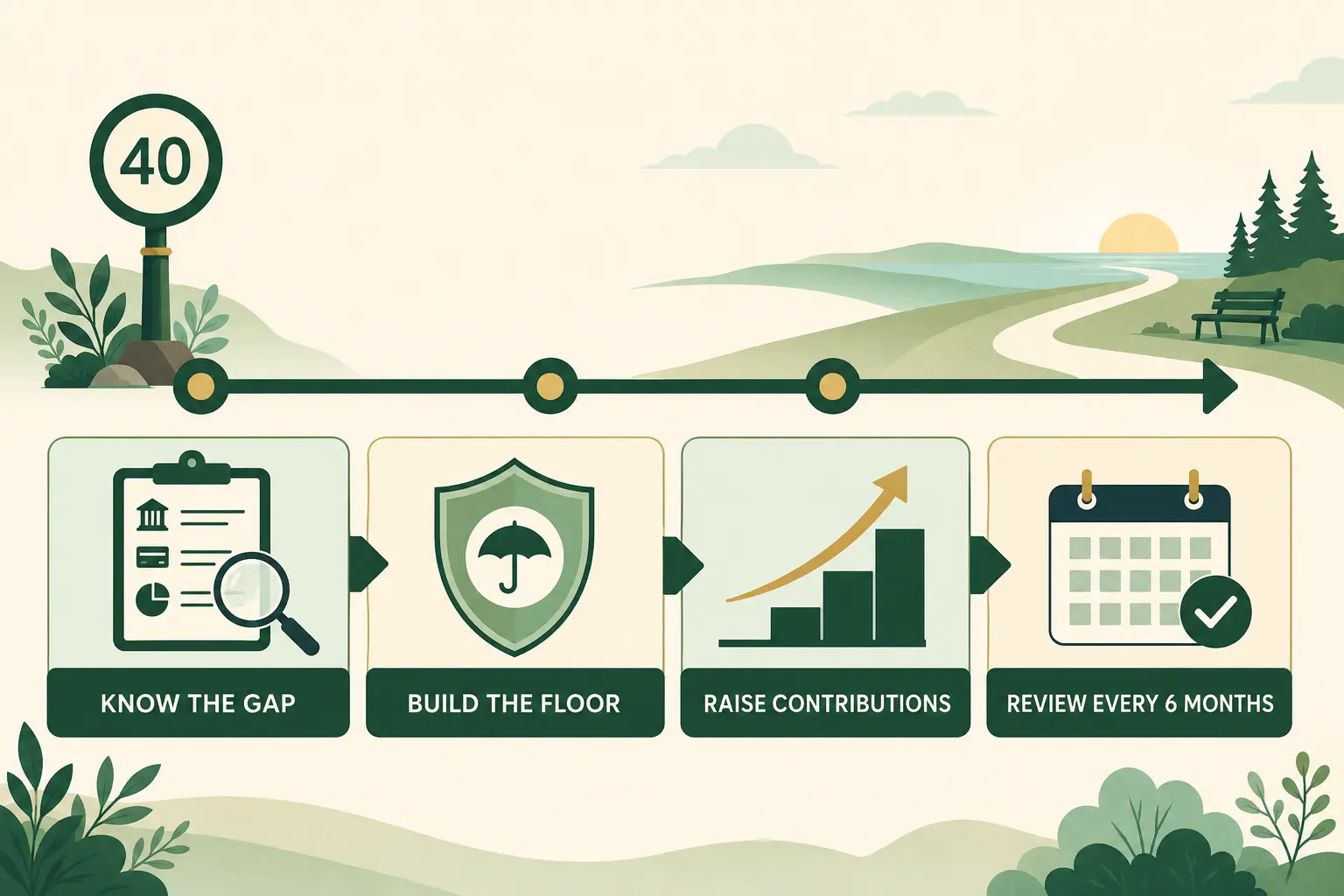
If you are 40 with little or no retirement savings, start with the Saving and Investing guide and build a plan from your actual cash flow instead of a generic age benchmark. You still have meaningful time to save, but the next decisions matter more than a motivational slogan.
What should you do first at 40 with no retirement savings?
Do not try to catch up to someone else’s number overnight. Start by improving the amount you can reliably save, using the accounts available to you, controlling high-cost debt, and giving future contributions time to work.
Create a one-page inventory with:
Retirement and investment accounts
List workplace plans, IRAs, old 401(k) or 403(b) accounts, pensions, cash savings, and taxable investment accounts.
Debt and fixed obligations
List high-interest debt, mortgage or rent, vehicle payments, insurance, and other large monthly commitments.
Monthly cash flow
Record take-home pay, essential spending, flexible spending, and the current retirement contribution.
Future income clues
Check pension records and your personal Social Security earnings record and benefit estimate.
The Social Security Administration’s benefit estimate page explains that a personal account can show estimates based on earnings and claiming age. You can adjust expected future income to see how it affects the retirement estimate.
Why should you protect emergency cash before chasing returns?
Without emergency cash, a car repair, home expense, or medical bill can push you back to a credit card or retirement-plan loan. Build a starter reserve while continuing any contribution needed to capture an employer match you would otherwise lose, when the budget allows.
If high-interest debt is consuming the budget, create a repayment plan alongside retirement saving. Investing does not automatically beat the guaranteed cost of expensive borrowing.
How should you use a workplace retirement plan?
Start with the plan you actually have. Confirm the employer match, vesting rules, investment menu, fees, and your current contribution rate.
For 2026, the employee elective-deferral limit for most 401(k), 403(b), governmental 457 plans, and the federal Thrift Savings Plan is $24,500. At age 40, the age-50 catch-up limit does not apply. A plan can impose lower limits, and other rules may apply.
The current limit comes from the IRS 2026 retirement-plan limits.
Can an IRA help at age 40?
For 2026, the IRA contribution limit is $7,500. Eligibility to deduct a traditional IRA contribution or contribute directly to a Roth IRA can depend on income, filing status, and workplace-plan coverage.
Do not choose Roth or traditional from an age-only rule. Compare current and expected future tax circumstances, account access, employer benefits, and the rest of the retirement plan. A qualified tax adviser can review how current rules apply to your return.
How can you raise the savings rate without using a rigid rule?
A benchmark such as save 15% does not know your income, pension, assets, debt, retirement age, or expected spending. Use a step-up plan:
- Capture the full employer match when affordable.
- Increase the contribution by 1 percentage point after a raise.
- Redirect a paid-off loan payment to retirement saving.
- Send part of bonuses or side income to the retirement account.
- Review the contribution rate every six months.
The best savings rate is meaningfully higher than today’s rate and sustainable enough to continue.
How should a 40-year-old choose investments?
Age alone does not set the right stock, bond, or cash mix. The decision depends on when the money will be needed, the ability and willingness to tolerate losses, other income sources, concentration risk, and fees.
Investor.gov’s asset-allocation guide ties portfolio choices to time horizon and risk tolerance and explains diversification across and within asset classes.
Favor a diversified approach you can understand and maintain. Do not try to repair a late start with concentrated stocks, crypto, leverage, speculative property, or another position that can create a large loss.
How do you estimate what retirement may cost?
Start with current annual spending. Then mark the categories that could change:
| Category | What to review | Common uncertainty |
|---|---|---|
| Housing | Rent or mortgage, taxes, insurance, maintenance, and planned moves. | A paid-off mortgage does not remove taxes, insurance, or repair costs. |
| Health care | Insurance, premiums, out-of-pocket costs, and long-term care planning. | Coverage, health, and prices can change. |
| Transportation | Vehicles, transit, fuel, maintenance, and reduced commuting. | Replacement timing and mobility needs vary. |
| Taxes | Expected account withdrawals, pension income, Social Security, and filing rules. | Future law and personal income mix are uncertain. |
| Lifestyle and family | Travel, hobbies, care for relatives, and other chosen spending. | Goals and family needs can change. |
Subtract dependable income, such as an estimated Social Security benefit or pension, from expected spending. The remaining gap may need to come from savings. Do not turn it into one guaranteed nest-egg number using a single withdrawal-rate rule.
Why do future earnings matter as much as current savings?
At 40, future earnings and benefits can be powerful planning levers. A higher wage, better employer contribution, or longer period of steady work can increase the amount available to save.
Review whether your skills support a higher-paying role, whether retirement benefits differ across employers, whether side income is profitable after taxes and expenses, and whether available benefits such as an HSA or workplace plan fit your circumstances.
Which fixed costs deserve the closest review?
Housing, vehicles, insurance, and debt often matter more than tiny daily purchases. Look for one or two structural changes that can create recurring room without making life unworkable.
A housing change is not automatically the answer. Compare transaction costs, commute, taxes, maintenance, insurance, and quality-of-life effects before moving or downsizing.
What can you finish in a 90-day retirement reset?
1Days 1 to 30
Inventory accounts and debt. Check the Social Security estimate. Confirm the workplace match and contribution. Build or protect starter emergency cash.
2Days 31 to 60
Raise the retirement contribution if the budget supports it. Choose a debt target. Review fees and diversification. Find old plans or pensions.
3Days 61 to 90
Automate the contribution. Direct the next raise or windfall. Estimate spending and dependable income. Set a six-month review date.
Retirement saving at 40 FAQ
Is 40 too late to start retirement saving?
No. Starting at 40 leaves years for future contributions and investment growth, but the plan depends on income, spending, retirement age, Social Security, pensions, and investment results. Start with the largest sustainable improvement you can make now.
How much should a 40-year-old contribute?
There is no universal percentage that works for everyone. Use the retirement-income gap, current budget, and available accounts to set a contribution, then increase it over time when possible.
Should I pay off debt or invest for retirement?
Often you need to do both in a deliberate order. Capture valuable employer benefits when practical, protect emergency cash, and compare the guaranteed cost of high-interest debt with the risk and time horizon of investing.
What is the 401(k) contribution limit in 2026?
The employee elective-deferral limit for most 401(k), 403(b), governmental 457 plans, and the TSP is $24,500 in 2026. A plan can impose lower limits, and other rules may apply.
Continue your retirement plan
Build an Emergency FundSet a starter target and grow a cash reserve without abandoning every other goal.
Manage DebtPrioritize balances by cost, risk, minimum payments, and available cash.
Primary sources
- IRS: 2026 401(k) and IRA contribution limits
- Social Security Administration: Get a Benefits Estimate
- Social Security Administration: My Social Security Account
- Investor.gov: Asset Allocation and Diversification
Educational information: This guide does not promise a retirement outcome or recommend an account, tax choice, contribution, or investment. Rules and personal circumstances can change.