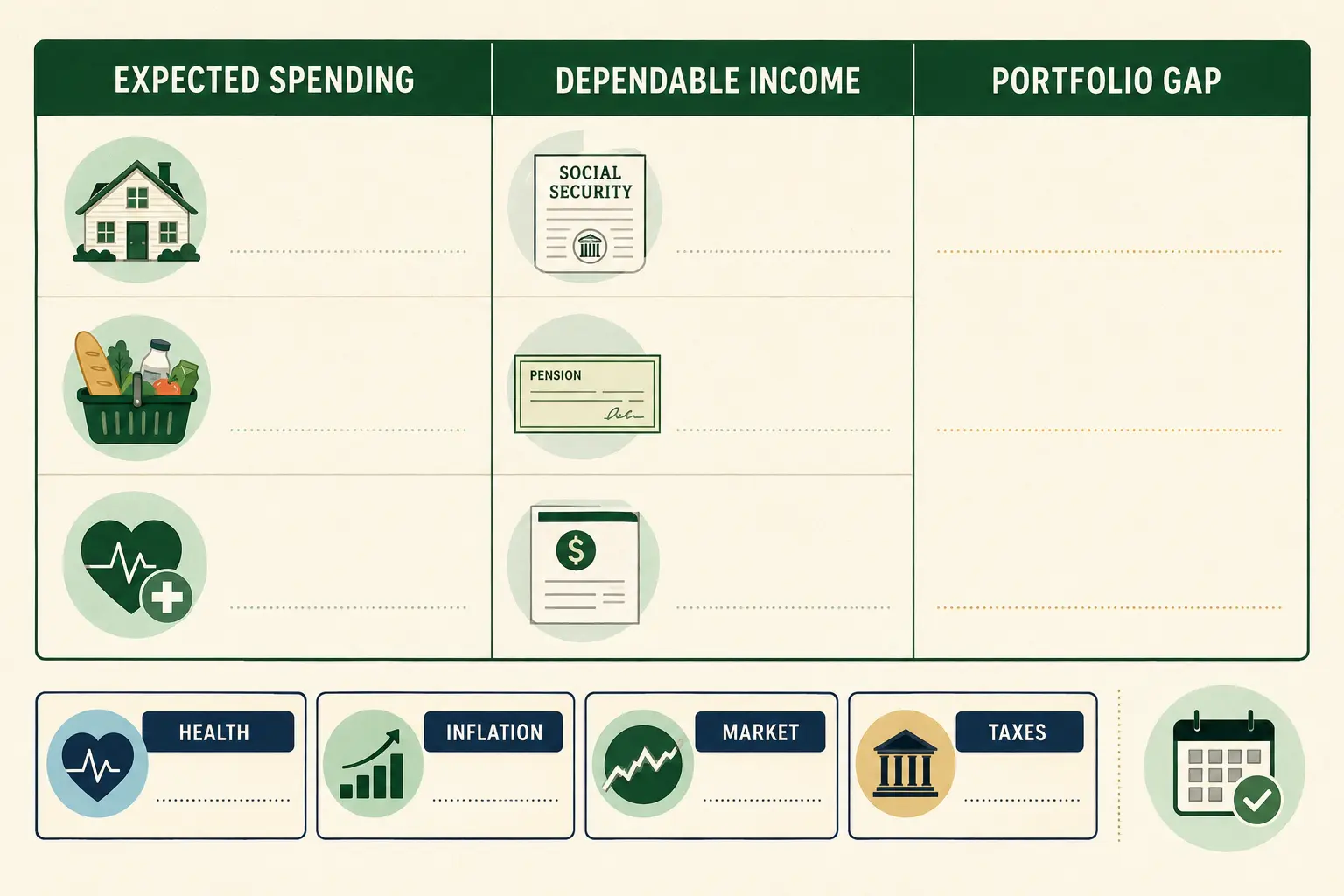
Retirement planning starts with the life you expect to fund, not a magic savings multiple. Use the MoneyBucket Retirement Planning guide as the parent plan, then estimate spending, dependable income, and the annual amount your savings may need to supply.
How much money do you need for retirement?
No one amount works for every household. The answer depends on spending, retirement age, Social Security, pension terms, account taxes, investment returns, health coverage, housing, family support, and how long retirement lasts.
A useful estimate has three parts:
1Expected spending
What the household may spend during retirement, including irregular costs and taxes.
2Dependable income
Social Security, pensions, and other income that does not require selling investments each month.
3Portfolio gap
The annual amount that savings and investments may need to provide after dependable income.
The gap is the starting point for planning. It is not a promise that a fixed multiple will fund every future year.
How do you build a current spending baseline?
Use the last 12 months of bank, card, and payment records when possible. A budget based only on memory often misses annual premiums, repairs, gifts, travel, taxes, and other irregular bills.
| Category | Include now | Question for retirement |
|---|---|---|
| Housing | Rent or mortgage, property tax, insurance, utilities, maintenance, association fees. | Will the home, loan, location, or maintenance burden change? |
| Food and household | Groceries, dining, household goods, and personal care. | Which costs are tied to work and which are part of daily life? |
| Transportation | Vehicle payments, fuel, transit, insurance, repairs, and replacement saving. | Will commuting fall while vehicle age or travel changes? |
| Health | Premiums, deductibles, copays, prescriptions, dental, vision, and other care. | What coverage applies before and after Medicare eligibility? |
| Taxes | Income, payroll, property, and other recurring taxes. | How will the future income and account mix change taxable income? |
| Lifestyle and family | Travel, hobbies, gifts, care for relatives, and charitable giving. | Which items are essential, flexible, or likely to grow? |
Convert irregular bills into annual amounts. If the roof may need replacement once during retirement, do not hide that cost because it does not appear in last month’s spending.
Which expenses may change after work ends?
Some costs may fall: commuting, work clothing, payroll taxes on wages after work ends, and the retirement contributions themselves. Other costs may rise or appear for the first time: health coverage before Medicare, travel, home changes, family support, long-term care, and taxes on withdrawals.
Build at least two spending plans:
- A core plan for housing, food, health, transportation, taxes, and other needs.
- A full plan that adds travel, hobbies, gifts, and other chosen spending.
This split shows which expenses could be reduced during a poor market period and which would be hard to change.
How do you estimate dependable retirement income?
List income that does not depend on selling portfolio holdings. Common entries include Social Security, a traditional pension, and certain annuity or ongoing work income. Review payment timing, survivor terms, cost-of-living terms, and taxes for each source.
Use a personal Social Security benefit estimate, not a generic average. The Social Security Administration lets an account holder compare estimates at different claiming ages and adjust expected future earnings. Check the earnings record for missing or incorrect years as part of the review.
If a pension offers a lump sum or monthly payment choice, do not place either amount in the worksheet until the election, survivor coverage, inflation protection, plan strength, and tax treatment have been reviewed.
How do you calculate the portfolio gap?
Subtract expected dependable income from expected spending for the same year and in the same dollar terms. If spending is shown in today’s dollars, income should be shown in today’s dollars too.
| Illustrative item | Annual amount | Meaning |
|---|---|---|
| Expected retirement spending | $72,000 | Core and chosen spending, including taxes and irregular costs. |
| Social Security and pension | $38,000 | Estimated dependable income for the same year. |
| First-year portfolio gap | $34,000 | The amount savings may need to supply before any other income. |
This example is arithmetic, not a recommended retirement budget. The $34,000 gap must still be tested for tax treatment, inflation, retirement length, investment risk, and changes in income.
Should you multiply annual retirement spending by 25?
A 25-times rule turns a first-year withdrawal into a target based on a 4% starting withdrawal assumption. It can be a rough comparison tool, but it is not a guarantee and it is not a substitute for a household plan.
The result can change when retirement begins earlier, fees are high, taxes are ignored, the portfolio mix differs, Social Security starts later, spending is flexible, or returns arrive in a harmful order. Use several withdrawal assumptions or a year-by-year model and treat the outcome as a range.
Why should you test more than one retirement age?
Run the worksheet for at least three dates: the preferred retirement date, one or two years earlier, and one or two years later. A date change affects working and saving years, the period investments must support, health coverage, pension terms, and Social Security estimates.
The result is not always linear. One more year of work can add contributions, delay withdrawals, shorten the funding period, and change pension or Social Security amounts at the same time.
How do you plan health coverage before and after 65?
The U.S. Department of Labor retirement guide warns early retirees to plan for health coverage before Medicare eligibility and notes that private employers generally are not required to provide retiree health benefits.
Possible bridge routes can include an employer retiree plan, a spouse’s plan, COBRA, or Marketplace coverage. Eligibility, price, subsidy, provider network, and timing vary. HealthCare.gov explains that losing job-based coverage can open a Marketplace enrollment period.
Medicare eligibility commonly begins around age 65, but automatic enrollment and sign-up timing depend on benefit and work status. Medicare says the first sign-up window generally lasts seven months, from three months before the month a person turns 65 through three months after it. Active-employment coverage, COBRA, HSA contributions, disability, and other facts can change the timing analysis. Check the official Medicare enrollment guidance before ending other coverage.
Which downside cases belong in the plan?
Longer retirement
Test more than one lifespan. A plan that ends at one exact age hides the cost of living longer.
Higher inflation
Raise recurring expenses and check whether dependable income has matching cost-of-living terms.
Early market loss
Model weaker returns during the first several withdrawal years, when selling assets can do more damage.
Large health or home cost
Add a major outlay and decide which reserve, insurance, or spending change would absorb it.
Lower work income
Remove planned part-time income or shorten the period it is expected to last.
Tax change
Test the after-tax cash produced by withdrawals from traditional, Roth, and taxable accounts.
Investor.gov identifies sequence-of-returns risk as a retirement planning concern. A poor return early in retirement can hurt more than the same return later when withdrawals force more shares to be sold.
How do taxes change the number?
A $50,000 withdrawal does not always create $50,000 of spendable cash. Traditional retirement-plan withdrawals are generally taxable, qualified Roth withdrawals can receive different treatment, and sales in taxable accounts can create gains or losses. Social Security benefits can also be taxable depending on other income.
Estimate spending after tax, then map which accounts may supply it. A tax professional can review account sequencing, required distributions, Roth conversions, Medicare premium effects, and state taxes.
What should a retirement-needs worksheet include?
- Current annual spending
- Expected core retirement spending
- Expected full retirement spending
- Personal Social Security estimate at each tested claiming age
- Pension and other dependable income
- First-year portfolio gap
- Retirement dates tested
- Health coverage before and after Medicare eligibility
- Market, inflation, longevity, health, and tax cases
- Target range and next review date
Keep the assumptions beside the answer. A bare target without its retirement date, spending level, income, and tax assumptions is hard to maintain.
How often should you recalculate retirement needs?
Review the plan at least once a year and after a major change in work, health, housing, family, pension terms, debt, investment balances, or retirement timing. The Labor Department also recommends an annual review.
An annual review does not require rebuilding every forecast. Update the inputs, compare the new gap with the prior estimate, and record the next action. That action might be raising contributions, changing the retirement date, reducing a planned expense, checking an insurance option, or getting professional review.
Retirement needs FAQ
Should I multiply annual retirement spending by 25?
A 25-times rule is a rough shortcut based on a 4% starting withdrawal assumption, not a guarantee. Retirement length, taxes, fees, portfolio mix, return order, dependable income, and spending flexibility can change the result.
How do I estimate Social Security income?
Use a personal my Social Security account to review the earnings record and compare benefit estimates at different claiming ages. You can also adjust expected future earnings in the estimate.
What if I want to retire before 65?
Add health coverage before Medicare as its own budget line. Employer retiree coverage, a spouse’s plan, COBRA, Marketplace coverage, and other routes have different costs, networks, eligibility rules, and deadlines.
What is a retirement portfolio gap?
It is the expected annual retirement spending that remains after subtracting Social Security, pensions, and other dependable income. Savings and investments may need to supply that amount.
How often should I recalculate retirement needs?
Review the plan at least annually and after a major change in work, health, housing, family, debt, pension terms, account balances, or retirement timing.
Continue the retirement plan
Social Security GuideReview the earnings record, claiming dates, benefit estimates, and income role.
Starting Retirement Saving LateFocus limited time on contribution capacity, account choices, debt, and retirement timing.
Primary sources
- Social Security Administration: Get a Benefits Estimate
- Social Security Administration: Benefit Calculators
- U.S. Department of Labor: Preparing for Retirement
- Medicare: When Coverage Starts
- HealthCare.gov: Coverage After Losing Job-Based Insurance
- Investor.gov: Sequence-of-Returns Risk
Educational information: This guide does not promise a retirement outcome or recommend a withdrawal rate, account, tax choice, insurance option, or investment. Rules, markets, and personal circumstances can change.