Feeling broke is a signal, not a character flaw. The MoneyBucket Budgeting guide covers the wider planning system. You may have a real monthly deficit, enough income with badly timed bills, money already assigned to future costs, or too little cash in checking to absorb a rough week. The right fix depends on which pressure is real.
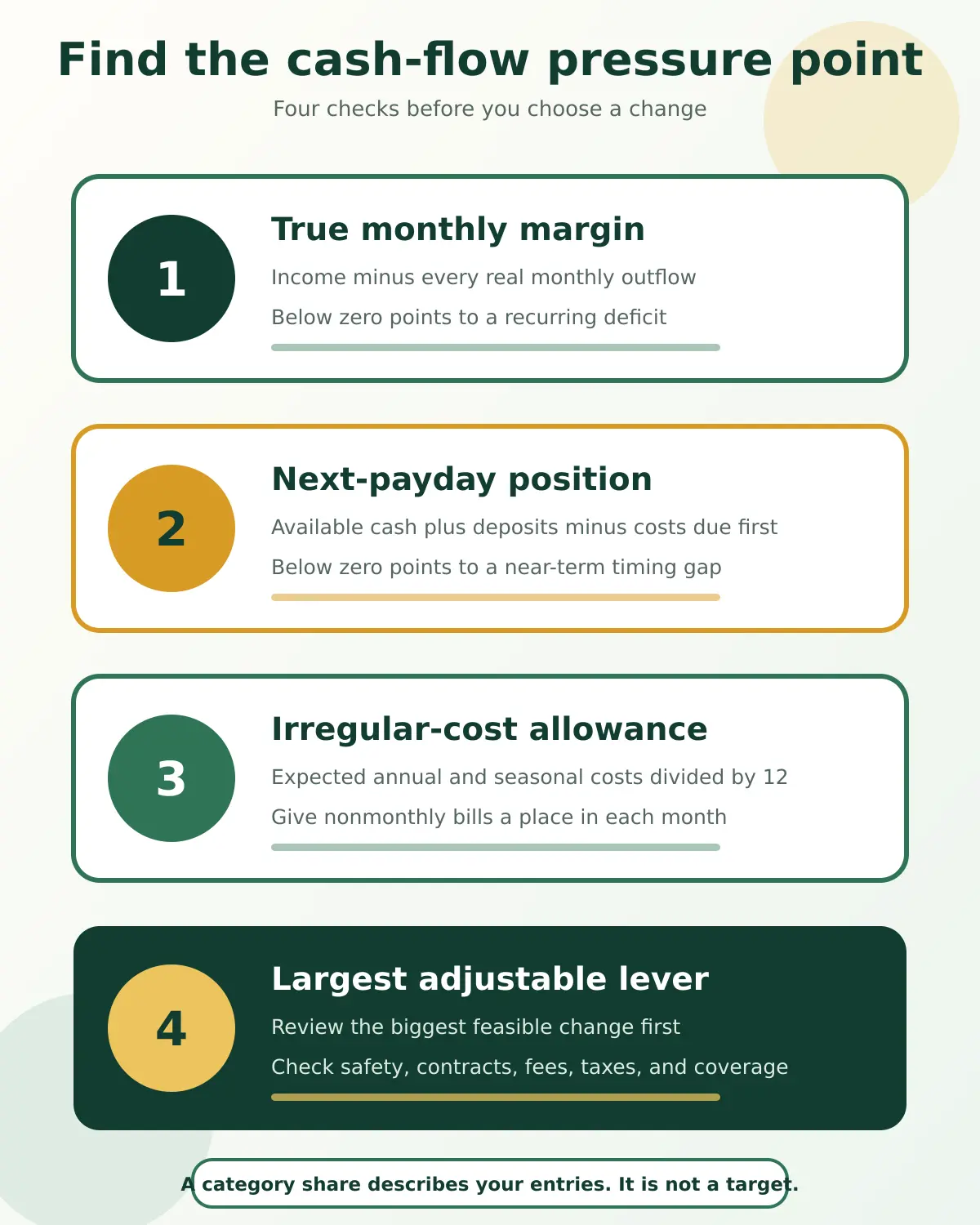
Start with two questions: Does a normal month end above or below zero after every real cost? Will the cash available before your next payday cover everything due before then? A person can pass one test and fail the other.
Are you short of money or short of visibility?
The Consumer Financial Protection Bureau describes financial well-being through four parts: control over day-to-day and month-to-month finances, capacity to absorb a shock, progress toward goals, and freedom to make choices. Income and net worth do not capture all four. A household can earn more and still feel pressure when most cash is committed, account balances swing sharply, or no reliable plan shows what is safe to spend.
| What you notice | Likely pressure | First check |
|---|---|---|
| Every month ends short | Recurring outflow may exceed take-home income | Calculate the true monthly margin |
| The month works, but one week is painful | Paydays and due dates may not line up | Calculate the next-payday cash position |
| Checking looks healthy, then drops suddenly | Annual and seasonal costs may be missing from the plan | Convert irregular costs to a monthly amount |
| Income rose, but free cash did not | Fixed costs, debt, essentials, or automatic transfers may have risen too | Compare the latest 90 days with the prior period |
| Money exists, but you cannot use it | Funds may be reserved, restricted, illiquid, or controlled by someone else | Separate available cash from every other balance |
Why do I feel broke when I have money?
A bank balance is not the same as spendable cash. Part of it may already belong to rent, taxes, insurance, a card payment, or a bill due next week. Savings may be held for a goal or emergency. Investments and retirement accounts may be costly or impractical to access. A low checking buffer can also make every purchase feel risky even when total assets are positive.
Unclear numbers can create pressure too. If you do not know what is due, when income arrives, or which costs recur outside the current month, the safest response may feel like “do not spend anything.” A written cash-flow view can replace that uncertainty with a number. It cannot remove a true shortfall, but it can show whether the shortfall is monthly, temporary, or tied to one category.
Nine reasons money may feel tight
1. Essential outflow exceeds take-home income
This is a true monthly deficit. Add housing, utilities, food, medicine, transport, insurance, required debt payments, taxes not withheld, and recurring care costs. If those needs already exceed reliable take-home income, canceling a few subscriptions will not close the whole gap.
Protect immediate needs and look for the largest feasible change. That may mean assistance, a hardship plan, a housing or transport change when safe, added reliable income, or help from a qualified counselor. Do not hide a structural gap behind a savings challenge.
2. Paydays and bill dates do not line up
A month can be positive overall while checking falls below zero before the next deposit. Map every due date and expected deposit on one calendar. Ask a provider whether it offers a due-date change, a split payment, or a hardship option. Get the terms in writing and confirm when a change starts. Moving a due date does not reduce the amount owed.
3. Fixed costs leave little room
Rent or mortgage, utilities, insurance, transport, childcare, phone, and required subscriptions can consume most pay before flexible spending begins. There is no single safe fixed-cost percentage for every household. Location, family size, health, work needs, and income stability all matter.
Review one large contract at a time. Compare the full cost of a change, including deposits, moving costs, deductibles, commute time, cancellation fees, and loss of coverage. A lower monthly bill is not a win if it creates a larger risk.
4. Debt minimums and interest absorb the margin
Minimum payments may keep accounts current while leaving little room for food, repairs, or savings. List each balance, rate, minimum, status, and due date. Protect current obligations before sending extra money to one debt. If minimums no longer fit, contact the creditor early and ask about hardship terms.
A new consolidation loan does not fix the gap unless its total cost, payment, fees, term, and collateral risk improve the plan. Use MoneyBucket’s debt reduction guide for payoff choices.
5. Irregular expenses are treated as surprises
Car repairs, school costs, annual insurance, medical bills, gifts, travel, home upkeep, and professional fees may not arrive monthly, but they still belong in the plan. Review at least several months of transactions. Look back a full year when costs are seasonal.
Add the expected annual total and divide by 12. Put that monthly amount in the cash-flow calculation. The estimate will not predict every bill. It gives irregular costs a place before they hit checking.
6. Variable essentials rose or fluctuate
Groceries, fuel, utilities, medicine, and care costs can move sharply. Compare quantities and unit prices when possible. A higher grocery total may come from price changes, a larger household, dietary needs, or more meals at home rather than waste.
Use a realistic recent average, not an aspirational limit. Then test changes that preserve nutrition, health, work access, and safety. A budget that depends on an impossible essentials number will fail on paper before the month begins.
7. Automatic savings or investing is too aggressive for current cash flow
Saving is valuable, but an automatic transfer that forces overdrafts or new card debt may be set too high for the current month. Include every transfer in the cash-flow view. A temporary reduction can protect bills while you repair a deficit or build a small checking buffer.
Review tax effects, employer matching, vesting, withdrawal rules, and lost benefits before changing a workplace plan. Do not cash out a retirement account based only on this page.
8. Small recurring or low-friction spending drifts
Subscriptions, app purchases, delivery fees, tips, convenience purchases, and repeated small charges can add up. The point is not to label every small pleasure a mistake. It is to test whether the total matches what you meant to spend.
Scan 90 days, group repeated merchants, and flag charges you did not expect. Cancel only what you no longer value. For purchases you want to keep, choose a monthly amount that fits after needs, minimums, irregular costs, and planned savings.
9. Shared-money rules reduce access or visibility
Joint finances can feel tight when one person pays most shared bills, account access is unequal, or no one knows which money is reserved. Use a shared bill list, clear contribution dates, and access that both people understand when it is safe to do so.
Financial control can be abuse. If someone blocks your account access, takes income, hides documents, forces debt, monitors purchases, or threatens you over money, focus on safety rather than a joint budget meeting. Use a safer device if your activity may be watched. The National Domestic Violence Hotline offers live advocates and safety-planning resources. Clear browser history only if doing so will not put you at greater risk.
Run the two cash-flow tests
Test 1: Your true monthly margin
Review the latest 90 days of checking and credit-card activity. Use a longer period for seasonal income or costs. Record what actually happened rather than what you hoped would happen.
True monthly margin = reliable take-home income − fixed bills − essential variable spending − required debt minimums − monthly share of irregular costs − savings and investing transfers − flexible spending.
A negative result means the month is structurally short under the numbers entered. A positive result means the month may work overall, but timing can still cause stress. A result near zero means even a small error or price change can create a shortfall.
Test 2: Your next-payday cash position
Use only cash that is available in checking now and deposits expected before the next payday. Do not count a credit limit, retirement balance, unconfirmed deposit, or money reserved for a bill that is not in the due list.
Next-payday cash position = available checking cash + deposits before the next payday − bills and essentials due before that payday.
A negative result is a near-term timing gap. Check due dates, stop nonessential automatic transfers that have not posted, contact providers before missing payments, and avoid overdraft fees. A positive result shows how much cash remains for that period, not how much is safe for the whole month.
Cash-Flow Pressure Finder
Test whether the entered pressure comes from a monthly deficit, the period before your next payday, or both. Category shares describe the numbers you enter. They are not spending targets.
Private by design: entries stay in this browser tab. Nothing is sent to MoneyBucket or saved after the page closes.
1. Build an as-is month
2. Check the period before your next payday
Your entered cash-flow picture
| Monthly outflow category | Amount | Share of entered outflow | Visual share |
|---|
The largest category is a place to review, not an automatic cut. Check contracts, safety, coverage, fees, taxes, and household needs first.
Monthly margin = reliable income minus all entered monthly outflow. Next-payday position = available checking cash plus deposits before the next payday minus bills and essentials due first. Runway = liquid emergency savings divided by the entered essential monthly floor. Results are estimates, not a bill order or personal advice.
If bills are due now, use a 15-minute triage
- Write the cash available today and confirmed deposits before the next payday.
- List bills and essentials due before that payday, including food, medicine, transport, and care needs.
- Mark any payment tied to housing, utilities, insurance, taxes, work access, or a court order.
- Check the consequence, grace period, fee, and shutoff or cancellation risk for each item. Do not guess.
- Contact the provider before the due date when possible. Ask about a due-date change, fee waiver, payment plan, or hardship option.
- Pause a discretionary transfer only after checking penalties, tax effects, employer benefits, and account rules.
- Document every call, name, date, amount, confirmation number, and promise.
There is no safe universal bill order. The cost of missing a payment depends on the contract, service, law, timing, and household needs. The CFPB’s Behind on bills booklet includes tools for prioritizing bills and tracking income and spending.
If the gap threatens food, housing, utilities, or health needs, check USAGov’s financial-hardship resources and local 211 referrals. Eligibility, availability, deadlines, and wait times vary. Do not pay a company that promises a government grant for personal bills.
A one-week cash-flow reset
- Day 1: Download or review 90 days of checking and card activity.
- Day 2: Mark reliable income, fixed bills, essentials, debt minimums, irregular costs, transfers, and flexible spending.
- Day 3: Calculate the true monthly margin with current numbers.
- Day 4: Put each deposit and due date on a calendar, then calculate the next-payday position.
- Day 5: Pick one pressure point with a change you can verify.
- Day 6: Make the change, record its start date, and keep written terms.
- Day 7: Recalculate. Keep the change only if it improves cash flow without creating a larger cost or safety risk.
One change is easier to measure than a full spending overhaul. If the deficit remains after realistic cuts, name it plainly. The next step is an income, assistance, contract, housing, transport, debt, or care-cost decision, not harsher self-criticism.
Frequently asked questions
Why do I feel broke even when I make good money?
Income may be heavily committed to fixed costs, debt, taxes, care, savings goals, or irregular bills. A thin checking buffer or poor bill timing can also create low-balance days. Calculate both the true monthly margin and the next-payday cash position.
How do I know whether I have a spending problem or an income problem?
Use 90 days of actual transactions. If essential costs and required payments exceed reliable take-home income, the gap is structural. If needs fit but flexible spending exceeds the remaining margin, that category may be the first adjustable lever. Many households have both pressures.
What should I pay first when I cannot cover every bill?
There is no universal order. Check which payments protect housing, utilities, food, medicine, transport, insurance, taxes, care, and court obligations, then verify the consequence of missing each payment. Contact providers early and use the CFPB bill-prioritizing tools.
How much should I keep in checking?
Keep enough for bills and essentials due before the next deposit, plus a buffer that reflects timing and account risk. The right amount depends on income frequency, automatic payments, overdraft rules, bill variability, and available savings. There is no fixed percentage that fits everyone.
Should I stop saving while paying debt?
Not automatically. Compare interest, missed-payment risk, liquid cash needs, employer matching, taxes, and withdrawal rules. A temporary transfer change may help when saving causes overdrafts or new debt, but check workplace-plan effects before acting.
Why do irregular expenses keep ruining my budget?
They may be absent from the monthly plan. Review a full year when possible, total predictable annual and seasonal costs, divide by 12, and include that amount each month. Keep a separate record for large costs whose timing is uncertain.
Can changing bill due dates help?
It can reduce a timing gap when providers allow it. Ask whether the change affects the current cycle, creates a longer first cycle, changes interest or fees, or requires a split payment. Confirm the new date and start month in writing.
What if someone else controls access to my money?
Blocked account access, forced debt, hidden documents, taken income, or purchase monitoring can be financial abuse. If it is safe, use a device the other person cannot monitor and contact the National Domestic Violence Hotline for safety planning. Do not confront the person solely because a budget guide tells you to.
Educational use only: This page and calculator do not provide personal financial, legal, tax, debt, housing, benefits, safety, or mental-health advice. Income, contracts, laws, benefit rules, household needs, and account terms differ. Verify current terms with the provider, government source, advocate, or qualified professional before acting.