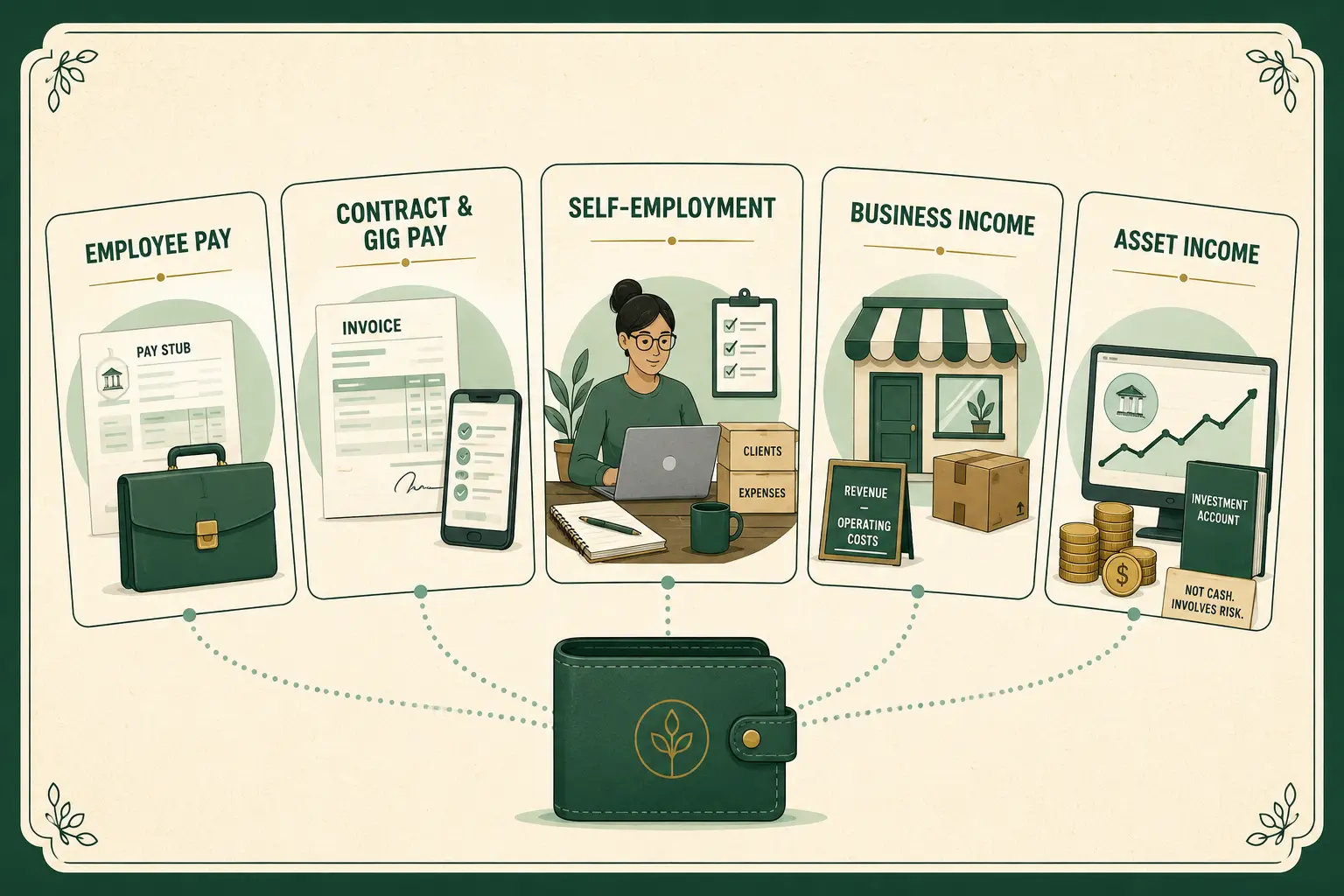
Start with the Earning Money guide for the broader topic, then use this page for the details below. People earn money in five main ways: employee pay, contract or gig pay, self-employment, business income, and income from assets. Most households use one primary route and may add a second route for extra income or long-term growth.
How Do People Make Money?
Every paycheck, invoice, sale, distribution, and interest payment fits into a broader income model. The label matters because it affects how predictable the money is, who pays work-related costs, which benefits may be included, and how taxes are handled.
| Income route | What creates the income | Main advantage | Main tradeoff |
|---|---|---|---|
| Employee pay | Time and work performed for an employer | More predictable pay and possible benefits | Less control over schedule, duties, and pay structure |
| Contract and gig pay | A project, delivery, task, or client agreement | Flexible work and multiple clients | Variable demand, expenses, and tax responsibility |
| Self-employment | A service sold directly to customers | Control over pricing and client choice | You find the work and cover operating costs |
| Business income | Products, services, systems, or employees producing revenue | Potential to earn beyond one person’s billable hours | Capital, cash-flow pressure, and operating risk |
| Asset income | Interest, dividends, rent, royalties, or gains from owned assets | Money is not tied only to hours worked | Requires money or property and may involve loss |
1. Employee Pay
Employees exchange labor for wages or a salary. Pay may be hourly, salaried, commission-based, or a mixture. Some jobs include health insurance, retirement contributions, paid leave, training, or other benefits. Those benefits have value even though they do not appear as cash in every paycheck.
Employee work is often the strongest starting point when steady cash flow matters most. It can also build experience, references, and skills that later support a raise, a better job, or independent work. If you are paid hourly, verify that your regular and overtime hours match your records with Paycheck Proof.
2. Contract and Gig Pay
Contractors and gig workers are paid for a project, task, delivery, shift, or defined result. Examples include freelance writing, design, repair work, rideshare driving, delivery services, consulting, seasonal labor, and short-term technical work.
Gross pay is not take-home pay. Vehicle costs, platform fees, supplies, insurance, unpaid administrative time, and taxes can sharply reduce the amount kept. The IRS says gig income is taxable even when it is part-time, temporary, paid in cash, or not shown on an information form.
3. Self-Employment
A self-employed person sells a skill or service directly and runs the work as a business. A cleaner with recurring clients, a photographer, a bookkeeper, a tutor, and a solo consultant may all fit this route.
The appeal is control: you can choose services, customers, prices, and working methods. The cost is that marketing, bookkeeping, scheduling, equipment, insurance, customer service, and slow-paying clients become part of the job. The IRS generally requires self-employed people to file an annual return and may require estimated tax payments during the year.
Before relying on self-employment income, calculate the rate needed after expenses and unpaid time. A $40 client payment is not a $40 wage when the job needs travel, supplies, payment fees, and an hour of administrative work.
4. Business Income
A business earns revenue by selling products or services. Profit is what remains after operating costs. A business can be a one-person shop, but the model becomes different from simple self-employment when products, repeatable systems, employees, licensing, or equipment allow revenue to grow beyond one person’s working hours.
Revenue can look impressive while cash flow is weak. Inventory, advertising, refunds, rent, software, taxes, payroll, and debt payments may arrive before customer money does. A useful first test is simple: can the business produce a repeat sale at a price that covers the full cost of delivering it?
For a smaller, lower-cost starting point, compare the ideas in the earning extra money guide before taking on a lease, inventory loan, or large equipment bill.
5. Asset Income
Assets can produce interest, dividends, rent, royalties, or gains when sold. Examples include savings accounts, bonds, stocks, investment funds, rental property, and intellectual property. This route uses owned money or property rather than labor alone.
Asset income is sometimes called passive income, but that phrase can hide the real work and risk. A rental property needs management and repairs. A portfolio can fall in value. A business royalty may shrink. Interest rates can change. No investment return is guaranteed merely because the income is not tied to a shift.
Start with the investing guide and the guide to managing investment risk before choosing a product.
Which Way of Earning Money Fits You?
You need predictable cash flow
Put employee roles first. Compare total compensation, schedule, commute, stability, and room for advancement rather than salary alone.
You need flexible extra income
Test one contract or gig route with low startup cost. Track every expense and calculate net hourly pay after unpaid time.
You have a marketable service
Try self-employment with one clear offer for one type of customer. Confirm demand before buying equipment or subscriptions.
You have a repeatable offer
A business may fit when customers buy repeatedly and revenue can cover delivery, overhead, taxes, and a margin for mistakes.
You have money you will not need soon
Asset income may support long-term goals. Match the asset to the goal, time horizon, liquidity need, and loss capacity.
You want more than one income stream
Build in sequence. Protect the primary income first, test a second route cheaply, then expand only after the numbers work.
A Simple Income Route Test
- Name the goal. Do you need dependable monthly income, extra cash, more control, or long-term growth?
- Count the true cost. Include tools, travel, fees, insurance, taxes, unpaid time, and money tied up in the route.
- Measure net pay. Divide what you keep by every hour required, not only the hours a customer sees.
- Check the downside. Ask what happens if demand falls, a client pays late, an asset loses value, or you cannot work.
- Run a small test. Use one client, one product, one shift, or a modest contribution before making a large commitment.
Can You Use More Than One Income Type?
Yes. An employee may freelance on weekends, a self-employed worker may own investments, and a business owner may keep cash in an interest-bearing account. Multiple income sources can reduce dependence on one payer, but each new source adds records, deadlines, and risk.
The safer pattern is one strong base plus one measured test. Five half-built income streams can produce less money and more stress than one solid job and one profitable side service.
Frequently Asked Questions
What do most people do for money?
Most people earn money by working for an employer, working for clients, selling products or services, or owning assets that pay interest, dividends, rent, royalties, or gains. Many households combine two or more of these routes.
What is the difference between a job and self-employment?
An employee works within an employer relationship and may receive wage withholding and benefits. A self-employed person serves customers directly, pays business expenses, keeps records, and is generally responsible for estimated taxes and self-employment tax.
Is gig work the same as self-employment?
Gig income is often treated as self-employment income for federal tax purposes, but worker status depends on the facts. A company cannot settle the issue only by calling someone a contractor.
Is investment income passive income?
Some investment income needs little daily labor, but it still requires capital and carries risk. Rental property, royalties, and business ownership may also require active management.
What is the best way to earn more money?
The best route is the one that improves net income without taking on costs or risks you cannot carry. For many people, the first gains come from improving employee pay, adding one low-cost service, or building skills that raise future earning power.