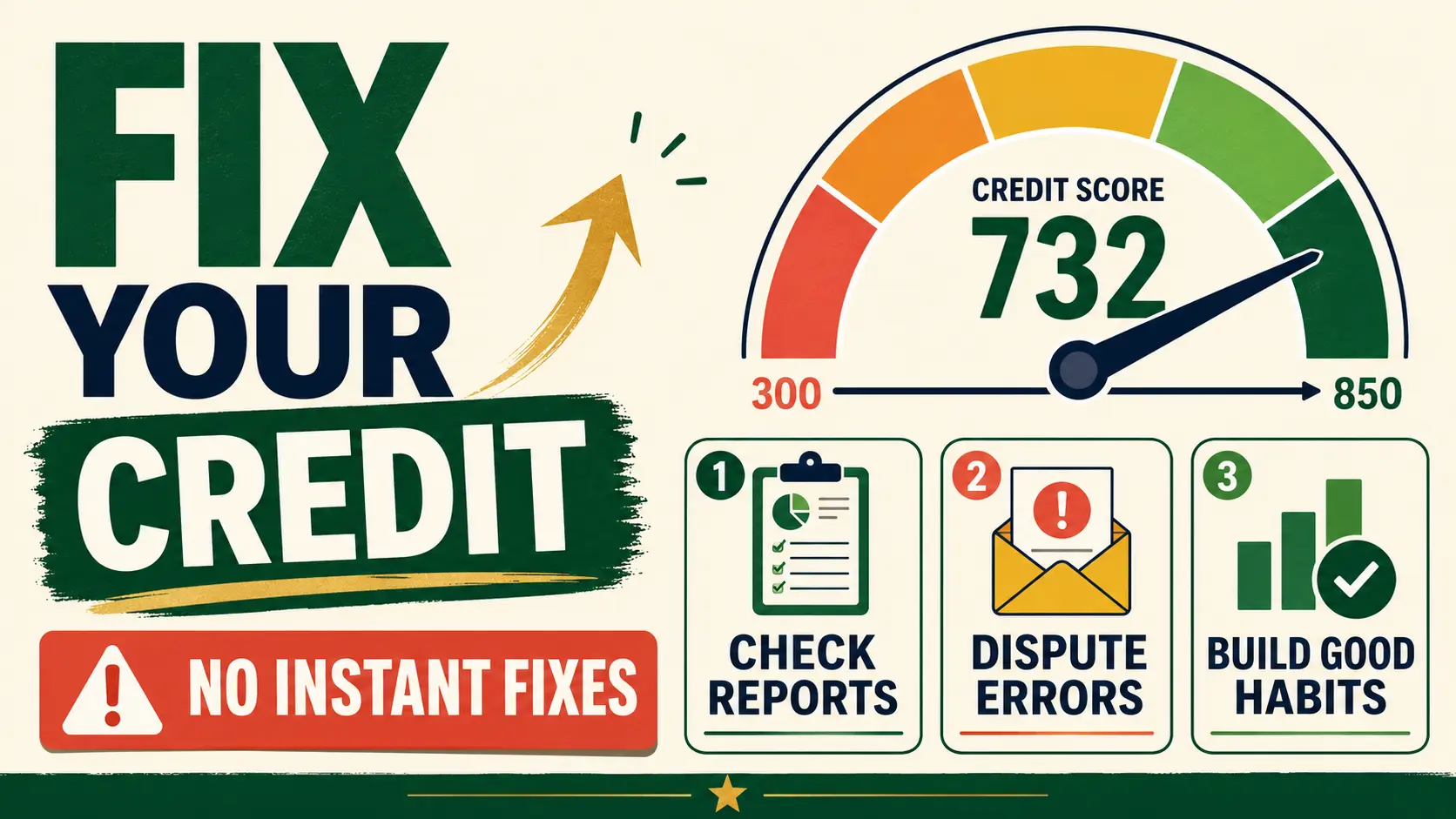
The Good Credit guide connects this page with related MoneyBucket guidance. Credit repair means correcting inaccurate credit-report information and rebuilding healthy payment habits. You can dispute errors yourself for free. No company can legally erase accurate negative information or promise a certain score increase.
Start Here: Your Credit Repair Checklist
- Get all three credit reports from AnnualCreditReport.com.
- Mark information that is inaccurate, incomplete, duplicated, outdated, or not yours.
- Gather statements, letters, receipts, identity-theft reports, and other proof.
- Dispute each error with both the credit bureau and the company that supplied the information.
- Track deadlines, save every response, and check the corrected report.
- Protect future progress with on-time payments and lower card balances.
What Credit Repair Can and Cannot Do
| Credit repair can | Credit repair cannot |
|---|---|
| Correct accounts that do not belong to you | Erase accurate late payments on demand |
| Fix wrong balances, limits, dates, or payment status | Create a guaranteed score increase |
| Remove duplicate accounts or debts listed after they should have aged off | Give you a new legal credit identity |
| Add missing context through a consumer statement after an unresolved bureau dispute | Make unpaid debt disappear |
Accurate negative information usually remains until the legal reporting period ends. Paying a debt may change its balance or status, but it does not automatically delete the account.
Choose the right correction route
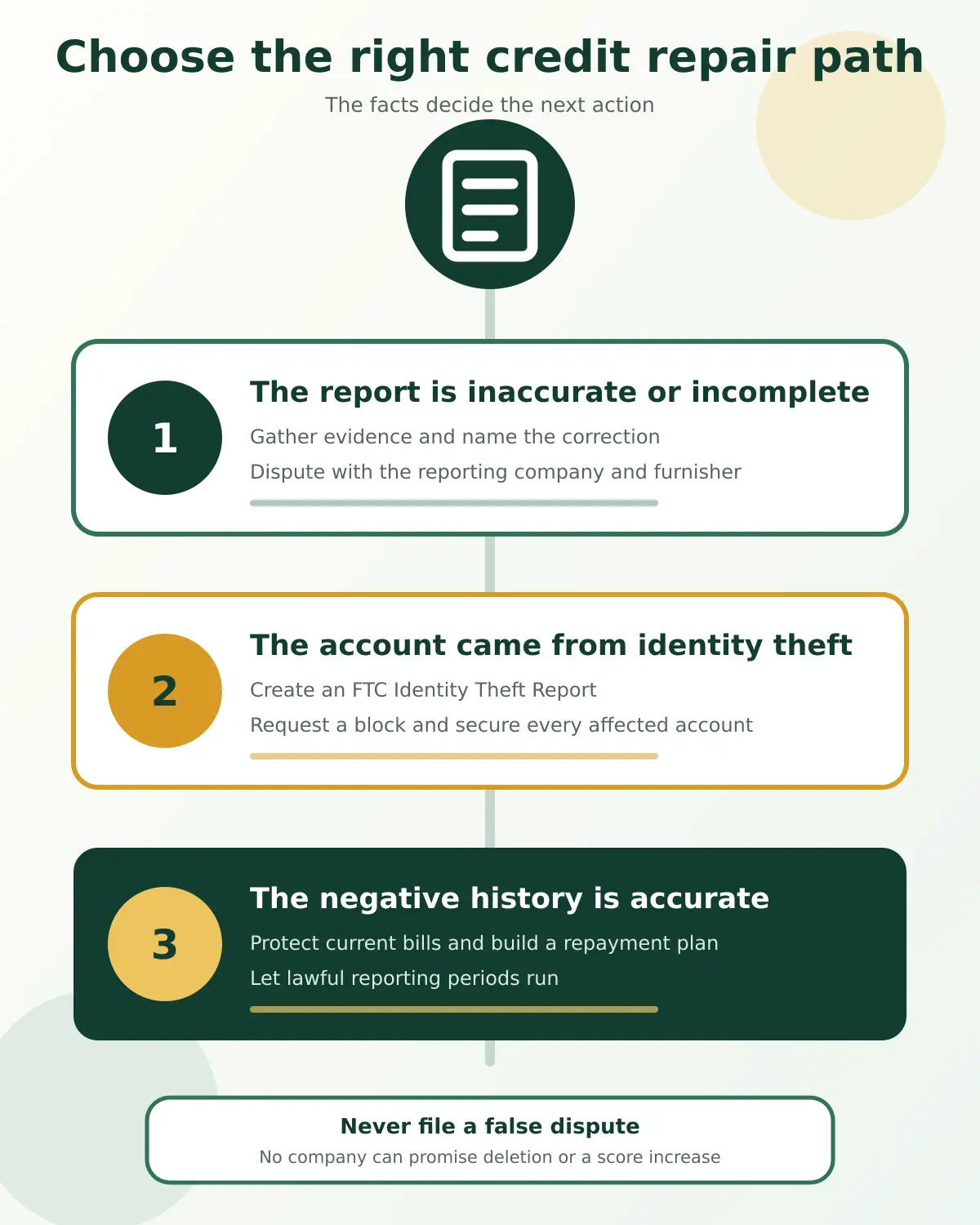
The facts decide the route. A credit-report accuracy dispute, an identity-theft block, a credit-card billing dispute, and a debt-validation request solve different problems.
| Problem | Start here | Key boundary |
|---|---|---|
| Inaccurate or incomplete report data | Dispute the item with the reporting company and the furnisher. Name the error, requested correction, and supporting records. | A dispute does not guarantee deletion. Verified accurate data may remain. |
| Identity theft or account not yours | Use IdentityTheft.gov, secure affected accounts, and follow the block, fraud-alert, or freeze steps that fit the case. | Do not file an identity-theft report for an account you opened or used. |
| Credit-card billing error | Contact the issuer promptly. CFPB billing-error guidance explains the separate written-notice timing and records to keep. | A billing dispute is not the same as correcting how an account appears on a credit report. |
| Debt-collection question | Read the validation notice and use its stated deadline. CFPB debt-collection guidance explains verification and recordkeeping. | A credit-report dispute alone does not settle the debt or replace a validation request. |
| Accurate negative history | Protect current bills, bring accounts current when possible, reduce debt, and build a repayment plan that fits the budget. | Do not dispute information solely because it is negative. |
Step 1: Check All Three Credit Reports
Your reports can differ because lenders may not report to every bureau. Review Equifax, Experian, and TransUnion separately.
Look for these common credit report errors
- Names, addresses, or accounts connected to another person
- Accounts opened through identity theft
- Closed accounts shown as open
- Payments incorrectly marked late
- The same debt reported more than once
- Wrong balances, credit limits, dates, or account status
- Old negative items that should no longer appear
Save a copy of each report before filing a dispute. Highlight the entry and note why it is wrong.
Step 2: Dispute Errors With Both Parties
The Consumer Financial Protection Bureau says to dispute inaccurate information with the credit reporting company and the business that supplied it. A furnisher may be a bank, card issuer, lender, landlord, or debt collector.
Build a clear dispute packet
- Your name, current address, and report confirmation number
- The account name and number, with only the digits needed to identify it
- A plain statement explaining what is wrong
- The correction or deletion you are requesting
- Copies of supporting records, never irreplaceable originals
- A marked copy of the report showing the disputed entry
Online disputes are fast, while mail gives you a paper trail. Keep screenshots, delivery records, case numbers, and every response. The CFPB also provides free sample dispute letters.
How Long Does a Credit Dispute Take?
A credit bureau generally has 30 days to investigate after receiving your dispute. Some cases may take up to 45 days. The bureau generally has five business days after completing the investigation to send the result. A corrected report may take more time to reach a credit-scoring service or lender.
If the result is wrong or incomplete, send a follow-up with stronger proof. You can ask the bureau to add a brief statement to your file after an unresolved bureau dispute. You may also file a complaint with the CFPB.
Separate the clocks: The credit score change timeline shows why an investigation result, a corrected report, and a newly calculated score may appear on different dates.
Credit Report Dispute Organizer
Create an item-by-item record for credit-report errors, identity-theft entries, accurate negative history, and collection questions. The organizer provides planning dates, not legal deadlines or proof that an item should be changed.
Private by design: entries stay in this browser tab. Nothing is sent to MoneyBucket or stored after the page closes.
Protect your identity: Use only the last four account digits. Do not enter a Social Security number, full account number, password, PIN, date of birth, or copies of identity documents.
Add one report item
Your private review queue
| Report item | Route | Requested action and evidence | Planning dates | Next record | Remove |
|---|---|---|---|---|---|
| No items added. | |||||
The organizer does not submit a dispute, contact a company, interpret law, decide whether information is accurate, or change a credit report. A 30-day or 45-day date shown here is a calendar check only. Company procedures and legal timing can differ.
What to Do After the Errors Are Fixed
Make every minimum payment on time
Payment history is a major scoring factor. Set automatic minimum payments where your cash flow allows, then make extra payments separately. If a due date does not match your pay schedule, ask the issuer whether it can be moved.
Lower reported credit card balances
Credit utilization compares reported card balances with credit limits. Lower balances can help, but 30% is not a magic cliff. Lower is generally better for scoring, as long as you do not drain emergency savings or miss essential bills. Paying before the statement closes may reduce the balance that gets reported.
Keep useful older accounts open with care
An older account may support credit age and available credit. Closing it can still be the right choice when it has a costly fee, creates fraud risk, or makes overspending harder to control. Never keep an unsafe or expensive account only for a score.
Apply for new credit only when it serves a real need
Do not take out a loan simply to add variety to your credit report. New applications can create hard inquiries and new debt. Compare the cost, repayment plan, and purpose before applying.
Treat authorized-user status as a shared risk
Being added to a well-managed account may help some credit files, but results vary by scoring model and issuer reporting. A high balance or missed payment may hurt. Both people should understand the rules before sharing an account connection.
Can Experian Boost or Similar Tools Help?
Some optional services add eligible bill-payment data to one credit report or scoring model. They may help certain people with thin credit files, but they do not affect every bureau, lender, or score. Read the privacy terms, linked-account permissions, and cancellation steps. Treat any score change as a possible side effect, not a promise.
Credit Repair Scams to Avoid
Walk away if a company:
- Demands payment before providing the promised service
- Promises to remove all negative information or guarantees a score
- Tells you to dispute accurate information
- Asks you to file a false identity-theft report
- Sells a credit privacy number or directs you to use an EIN as a new identity
- Tells you not to contact the bureaus yourself
- Hides your cancellation rights or will not provide a written contract
The Federal Trade Commission warns that anything a credit repair company can legally do for you, you can also do yourself at little or no cost.
Credit Repair Timeline: What Progress May Look Like
| Time | Useful action |
|---|---|
| Day 1 | Pull all reports, freeze files if identity theft is suspected, and list errors. |
| Week 1 | Send focused disputes with evidence to each bureau and furnisher. |
| Days 30 to 45 | Review investigation results and corrected reports. |
| Next 3 to 12 months | Build a clean payment record, reduce balances, and avoid costly new debt. |
Your score may move sooner, later, or not at all after a correction. The result depends on what changed, the rest of your report, the scoring model, and when account data updates.
When Professional Help May Be Worth It
You may want help when identity theft affects many accounts, a bureau keeps verifying an error without addressing strong proof, debt collection involves legal papers, or your finances need a broader repayment plan. Start with a nonprofit credit counselor, consumer-law attorney, or legal-aid group. Check credentials, fees, complaints, and the written scope before signing.
Credit counseling and credit repair are not the same. A counselor may help with budgeting and debt repayment. A repair company mainly challenges report information and cannot lawfully promise deletion of accurate items.
Frequently Asked Questions
Can I repair my credit for free?
Yes. You can get your reports, dispute errors, contact furnishers, and build better payment habits without hiring a credit repair company.
Does paying collections remove them?
Payment usually updates the balance or status. Deletion depends on the accuracy of the account, the collector’s policy, the reporting period, and any written agreement. Get settlement terms in writing before paying.
Should I dispute every negative item?
No. Dispute information that is inaccurate, incomplete, duplicated, outdated, or not yours. Filing false disputes can waste time and expose you to scams.
How fast can a credit score improve?
There is no dependable schedule or guaranteed number of points. Error corrections may appear after an investigation and data update. Rebuilding from accurate late payments or high balances often takes months of steady progress.
Will checking my own credit hurt my score?
No. Checking your own report or score is a soft inquiry and does not lower your score.