The MoneyBucket Debt Management hub treats every loan as a claim on future income. A car loan may help you buy transportation, but the vehicle secures the debt and can be repossessed after default under the contract and applicable law. Compare the full transaction before discussing the monthly payment.
A dealer, bank, credit union or finance company may offer the loan. A personal loan could also be used for a vehicle, but it is a different credit product with different pricing and collateral terms. Read the contract instead of assuming every vehicle purchase is financed the same way.
How should you compare car loans?
Compare offers for the same vehicle price, down payment and add-ons, then check APR, amount financed, loan term, finance charge and total of payments. Get at least one offer outside the dealership. Keep the trade-in and optional products visible as separate numbers. Read the completed Truth in Lending disclosures and the full contract before signing.
1. Set a vehicle budget before setting a loan payment
The payment is only one part of the cost. Start with the amount your current budget can carry after housing, food, healthcare, insurance, debt payments, savings and irregular bills.
Add the vehicle costs that arrive outside the loan:
- Insurance premium and deductible
- Fuel or charging
- Registration, inspection and property tax where applicable
- Routine maintenance, tires and repairs
- Parking, tolls and permits
Get an insurance quote for the vehicle before agreeing to buy it. Use the MoneyBucket budgeting guide to test the complete transportation cost against actual take-home income.
2. Obtain financing offers before entering the dealership
Apply with banks, credit unions or other lenders you can verify. An outside offer gives you a price to compare with dealer-arranged financing. It also lets you discuss the vehicle price without using payment size to hide a longer term or a larger amount financed.
Ask each lender for the same requested loan amount and term when possible. Record:
- APR and interest rate
- Fixed or variable rate
- Amount financed
- Number and amount of payments
- Finance charge and total of payments
- Required down payment
- Application, origination or documentation fees
- Prepayment penalty, late fee and payment method rules
3. Compare APR with APR, not APR with interest rate
The interest rate is the price charged for borrowing the principal. The annual percentage rate, or APR, includes the interest rate and certain loan fees. CFPB explains that the federal Truth in Lending Act requires the APR to be disclosed before the borrower becomes legally obligated.
A loan can show a lower interest rate and a higher APR when loan fees increase its cost. Use APR to compare the borrowing price, then use the finance charge and total of payments to see the dollar effect over the full term.
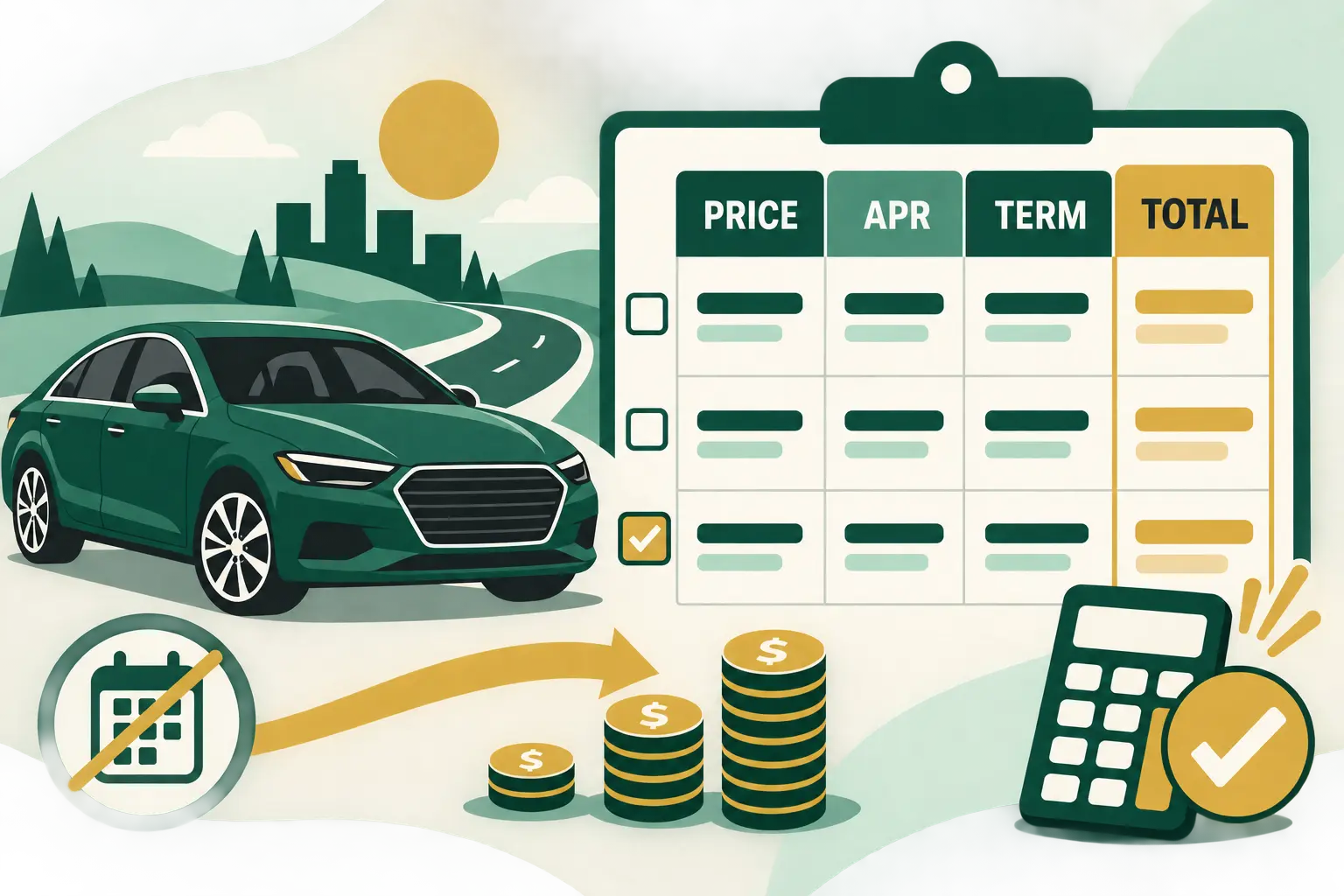
4. Put every offer into the same comparison table
| Term to copy | Offer A | Offer B | Why it matters |
|---|---|---|---|
| Vehicle cash price | _____ | _____ | Use the same negotiated vehicle price before judging the loans. |
| Down payment and trade-in credit | _____ | _____ | These reduce what must be financed, unless trade-in debt is added back. |
| Optional add-ons | _____ | _____ | Financed products raise the principal and may also add interest. |
| Amount financed | _____ | _____ | This is the amount borrowed after the transaction is assembled. |
| APR | _____ | _____ | This reflects the interest rate plus certain loan fees. |
| Loan term and payment count | _____ | _____ | A longer term can lower the payment while raising total interest. |
| Finance charge | _____ | _____ | This shows interest and certain fees across the scheduled loan. |
| Total of payments | _____ | _____ | This is the sum of scheduled payments if made as agreed. |
| Total sale price | _____ | _____ | This includes the down payment in the credit purchase total. |
The CFPB warns that a longer term may reduce the monthly payment while increasing total interest and the chance of owing more than the vehicle is worth. Compare the shortest term your complete budget can safely carry, not the shortest term available in the market.
If you want to translate a payment into hours of take-home work, use the MoneyBucket debt work-hours calculator.
5. Know how dealer-arranged financing works
With dealer-arranged financing, the dealer sends the application to one or more lenders. The lender may quote the dealer a buy rate. CFPB says the contract rate offered to the buyer may be higher to compensate the dealer.
The dealer offer can still beat an outside offer. Test it instead of assuming it is cheaper or more expensive. Keep the vehicle price, trade-in value, financing and add-ons as separate negotiations so a change in one number does not hide a cost in another.
Ask:
- Which company will own or service the loan?
- Is the rate fixed or variable?
- Is the offer final before the vehicle leaves the lot?
- Which fees are part of the APR?
- What changed from the outside offer and why?
6. Treat every F&I add-on as a separate purchase
The dealership finance and insurance office may offer an extended service contract, GAP coverage, credit insurance, debt cancellation, tire or wheel protection, theft products or prepaid maintenance.
Do not accept a product because it is presented as part of the payment. For each one, ask for the cash price, financed price, coverage, exclusions, claim process, cancellation terms, refund method and whether the lender requires it. CFPB states that buyers generally are not required to purchase optional add-ons to obtain dealer financing.
7. Calculate negative equity before trading a vehicle
Negative equity means the loan payoff is greater than the vehicle’s trade-in value. If the payoff is $18,000 and the trade-in credit is $15,000, the gap is $3,000.
A dealer may offer to include that unpaid balance in the new financing. It does not disappear. It raises the new amount financed and can put the next loan underwater on day one. CFPB’s negative-equity guidance says rolling the balance into the new loan makes that loan more expensive.
Get the current payoff directly from the lender and a written trade-in figure. Compare the new amount financed with and without the old balance before deciding whether to trade, sell, pay down or keep the vehicle.
8. Keep auto-loan applications inside a focused shopping period
Credit-scoring models may treat several inquiries for the same loan type as one when they occur in a shopping window. CFPB says those auto-loan inquiries will generally count as a single inquiry when made within 14 to 45 days of each other.
The exact treatment can depend on the score model and timing. Prepare documents first, then make comparable auto-loan applications close together. Asking about rates is not the same as authorizing an application. Confirm whether the lender will make a hard inquiry before applying.
Check your credit reports for errors before the shopping period. The MoneyBucket credit guide explains report checks, disputes and score factors without promising a fixed score increase.
9. Compare the final contract with the offer before signing
CFPB says Truth in Lending disclosures must include the APR, finance charge, amount financed, total of payments and total sale price. They should be complete before you sign. Ask to review them early and take the forms away to compare if needed.
- The buyer and co-signer names are correct.
- The vehicle identification number matches the vehicle.
- The negotiated cash price and trade-in credit are correct.
- The prior-loan payoff and any negative equity are shown correctly.
- Declined add-ons are absent.
- The APR, rate type, amount financed, term and payment count match the offer.
- The finance charge, total of payments and total sale price are filled in.
- Late fees, prepayment terms, arbitration terms and default terms have been read.
- No field is blank and you receive a complete copy.
Do not sign a blank or partly completed form. Do not rely on a verbal promise that a number will be fixed later.
10. Contact the lender early if the payment no longer fits
Call the lender or servicer as soon as you expect trouble. CFPB lists possible options such as a payment plan, due-date change or forbearance, but availability and cost depend on the lender, contract and circumstances.
Ask how the change affects interest, payment count, final due date, credit reporting, fees and repossession status. Get the agreement in writing. Keep payment records and the names, dates and reference numbers from every call.
If the issue is not resolved, CFPB explains where to submit complaints about auto lenders, servicers and dealers. State rights and repossession procedures vary, so get qualified legal help when a vehicle is at immediate risk.
Car-loan questions
What is the best way to compare car loans?
Use written offers for the same vehicle price, down payment, requested amount and term. Compare APR, amount financed, loan term, monthly payment, finance charge, total of payments, total sale price, fees, add-ons and prepayment terms.
Is APR the same as the interest rate?
No. The interest rate is the price charged for borrowing the principal. APR includes the interest rate and certain loan fees, which makes it a broader borrowing-cost measure.
Should I choose the lowest monthly payment?
Not by itself. A longer term can lower the payment while increasing total interest and the risk of negative equity. Check the complete vehicle budget, APR, term, amount financed, finance charge and total of payments.
Do I have to finance through the dealership?
No. You can seek offers directly from banks, credit unions and other lenders. Dealer-arranged financing may be useful, but compare its contract rate and fees with outside offers.
Are dealer add-ons required for a car loan?
Many F&I products are optional. Ask the lender to identify any stated requirement in writing, price each product separately and remove declined products from the contract. Review coverage, exclusions and cancellation terms before buying.
What should I do if I cannot make the car payment?
Contact the lender or servicer as soon as possible and ask about available options. Get any agreement in writing and ask how it affects interest, fees, credit reporting, the final due date and repossession status.
Build the comparison before choosing the car
Write down the vehicle price, outside offer, trade-in payoff and ownership costs before the dealership visit. Add every product and financing term to the same sheet.
Sources and further reading
- Consumer Financial Protection Bureau: Auto Loans
- CFPB: How Much Can I Afford to Borrow for a Car?
- CFPB: How Do I Compare Auto Loan Offers?
- CFPB: Interest Rate and APR
- CFPB: Finance and Insurance Department
- CFPB: Trading a Car with an Unpaid Loan
- CFPB: Auto-Loan Shopping and Credit Inquiries
- CFPB: Finalizing a Car or Auto Loan
- CFPB: Trouble Making Car Payments
MoneyBucket provides general educational information, not individualized financial, tax or legal advice. Loan offers, insurance costs, add-on terms, credit-score treatment and state laws vary. Read the complete contract and consider qualified financial or legal help for your circumstances.