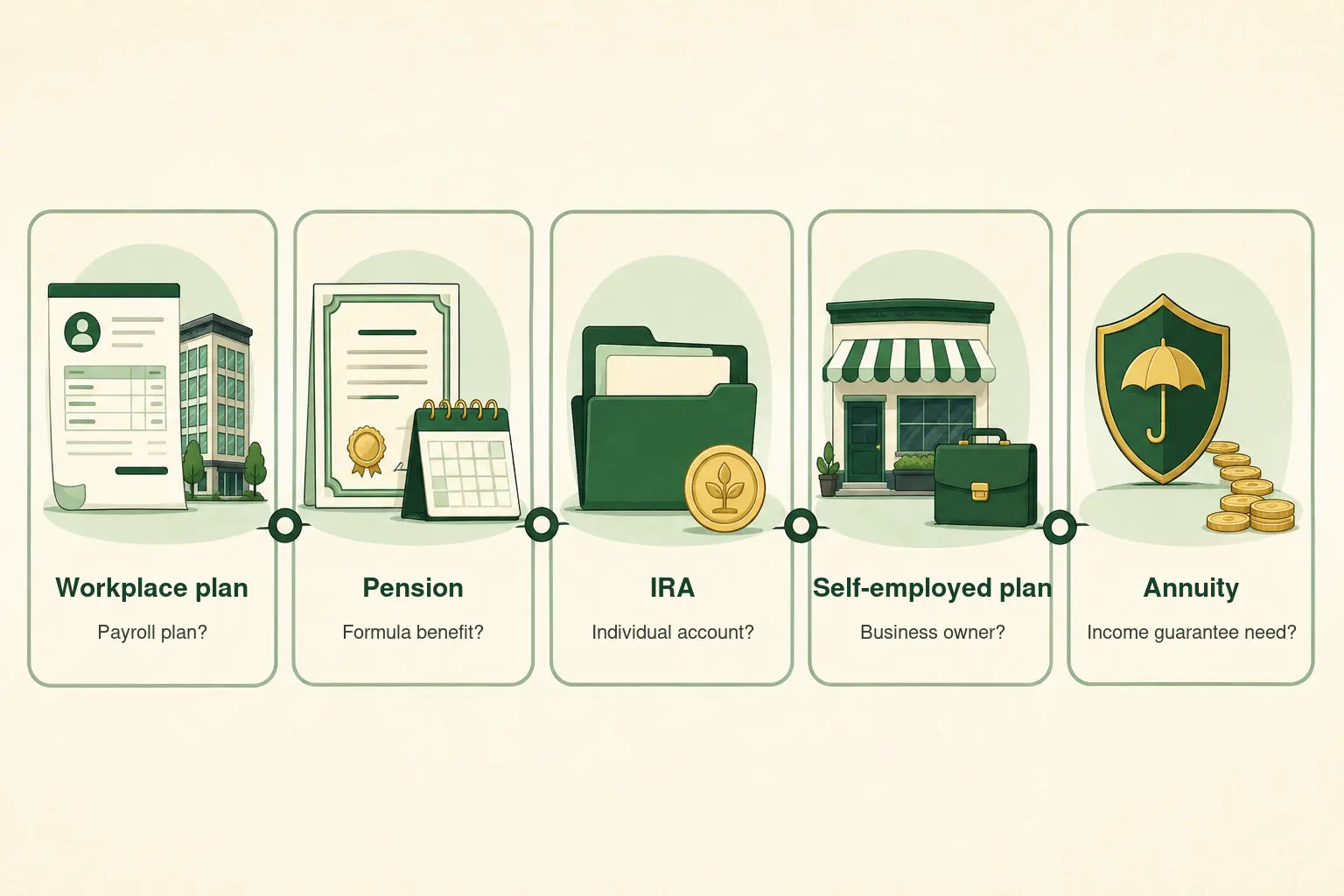
Begin with the Retirement Planning Guide before comparing accounts. A retirement plan is not one product. Workplace plans, pensions, IRAs, and self-employed plans differ in who contributes, how taxes work, when money vests, which investments are available, what fees apply, and how withdrawals are treated.
What are the two main workplace plan structures?
Defined-benefit plans
A defined-benefit plan, often called a pension, promises a retirement benefit based on a formula. The formula may use pay, years of service, age, or other plan terms. The employer generally bears the investment risk needed to fund the promised benefit.
Read the summary plan description for the benefit formula, vesting rules, early-retirement reductions, survivor options, and what happens if you leave before retirement. Check whether the plan is covered by the Pension Benefit Guaranty Corporation.
Defined-contribution plans
A defined-contribution plan gives each participant an individual account. Its eventual value depends on contributions, investment gains or losses, fees, withdrawals, and plan rules. Common examples include 401(k), 403(b), governmental 457(b), and the federal Thrift Savings Plan.
An employer contribution can be valuable, but eligibility and vesting matter. Some employer money can be forfeited if you leave before it vests. Your own salary deferrals are always yours.
How do 401(k), 403(b), 457(b), and TSP limits work in 2026?
The basic employee elective-deferral limit is $24,500 for 2026. A plan may set a lower limit or restrict contributions under its terms.
- The general age-50 catch-up limit is $8,000.
- Eligible participants ages 60 through 63 can use a higher $11,250 catch-up limit.
- For 2026, a participant whose 2025 wages from the plan sponsor exceeded $150,000 may have to make catch-up contributions on a Roth basis. Ask the plan administrator how the rule applies.
401(k)
A 401(k) is common in private-sector employment. A plan may allow traditional salary deferrals, Roth contributions, or both. Investment menus, fees, employer contributions, loans, and hardship rules vary.
403(b)
A 403(b) may be offered by public schools and certain tax-exempt organizations. It uses the same basic 2026 employee deferral limit. Some qualifying long-service employees may have access to a separate 15-year-service catch-up. Check the plan and IRS rules before counting on it.
Governmental 457(b)
A governmental 457(b) uses the same general 2026 deferral limit but has different distribution and catch-up rules. Some participants near normal retirement age may qualify for a special 457 catch-up instead of the age-50 catch-up.
Thrift Savings Plan
The federal Thrift Savings Plan serves eligible federal employees and members of the uniformed services. Its employee deferral and catch-up limits generally track the figures above. Agency contributions depend on the worker’s retirement system and service rules.
How do traditional and Roth IRAs differ?
An IRA is an individual retirement account, not an employer plan. For 2026, the combined contribution limit across traditional and Roth IRAs is $7,500. A person age 50 or older can contribute another $1,100, for a combined limit of $8,600, subject to compensation and eligibility rules.
Traditional IRA
A traditional IRA contribution is not automatically deductible. It may be fully deductible, partly deductible, or nondeductible based on income, filing status, and workplace-plan coverage. Growth is generally tax-deferred. Distribution taxes depend partly on deductible contributions, nondeductible basis, and rollover amounts.
Roth IRA
Roth IRA contributions are made with after-tax dollars and are not deductible. Income can restrict eligibility to contribute. Qualified distributions can be tax-free, but not every withdrawal is automatically tax-free. Ordering rules, five-year requirements, age, and the reason for a distribution can matter. See MoneyBucket’s Roth IRA guide for a focused explanation.
Which retirement plans can self-employed people and small businesses use?
The better fit depends on business type, employees, compensation, contribution goals, and administration. Compare the numbers using actual compensation and employee facts, not the headline maximum alone. MoneyBucket’s self-employment guide covers related planning issues.
SEP IRA
A SEP generally uses employer contributions. For 2026, the maximum contribution is the lesser of 25% of compensation or $72,000, with a separate calculation for self-employed owners. A regular SEP does not permit employee elective deferrals or catch-up contributions.
SIMPLE IRA
The general 2026 employee salary-reduction limit is $17,000. The general age-50 catch-up is $4,000, and the age-60-through-63 catch-up is $5,250. Some applicable SIMPLE plans may use an $18,100 regular limit. The employer’s plan notice should state which limit and contribution formula apply.
One-participant 401(k)
A one-participant 401(k), often called a Solo 401(k), can let an eligible owner contribute in employee and employer roles, subject to compensation, plan terms, and federal limits. A business with eligible common-law employees generally cannot keep treating the plan as a one-participant plan.
Where do annuities fit?
An annuity is an insurance contract. It can be used for retirement income and can sometimes be held inside a retirement account. Buying one inside an IRA does not add tax deferral beyond the IRA’s existing tax treatment.
Fixed and variable annuities can carry different guarantees, investment risk, surrender charges, contract adjustments, fees, income options, and insurer-credit risk. Variable annuities are securities as well as insurance products. Review mortality and expense charges, administrative fees, investment expenses, surrender periods, rider costs, liquidity limits, and insurer strength.
How do the main retirement options compare?
| Option | Often fits | Check before contributing |
|---|---|---|
| Workplace defined-contribution plan | Payroll saving and possible employer contributions | Vesting, fees, investment menu, withdrawal rules |
| Pension | Formula-based employer retirement income | Benefit formula, vesting, survivor choices, early-retirement reductions |
| Traditional IRA | Individual tax-deferred saving | Deduction eligibility, basis tracking, distribution taxes, RMD rules |
| Roth IRA | After-tax contributions with potential tax-free qualified withdrawals | Income eligibility, five-year rules, withdrawal ordering |
| SEP IRA | Self-employed people and small businesses using employer contributions | Employee coverage, compensation formula, no employee deferral |
| SIMPLE IRA | Qualifying small employers offering salary reductions | Employer formula, participant eligibility, plan’s current limit |
| One-participant 401(k) | Eligible owner-only businesses | Employee status, compensation, setup, filing duties |
| Annuity | A defined insurance or income need | Fees, surrender limits, insurer strength, contract terms |
Which account should you fund first?
- Read your workplace plan. Check eligibility, employer contributions, vesting, fees, and investment choices.
- Choose the tax treatment. Compare current deductions, Roth treatment, future withdrawals, and tax diversification.
- Match the account to your work status. Business owners should compare SEP, SIMPLE, and one-participant 401(k) rules using real compensation and employee data.
- Protect near-term cash needs. Early distributions can trigger taxes, penalties, restrictions, or paperwork. Estimate your target with the retirement-needs guide.
- Compare total costs. Review plan fees, fund expense ratios, advisory charges, insurance costs, and surrender charges.
- Set the investment mix separately. The three-bucket strategy can help organize money by time horizon.
Retirement plan FAQs
What is the 401(k) contribution limit for 2026?
The employee elective-deferral limit is $24,500. The general age-50 catch-up is $8,000. Eligible participants ages 60 through 63 can use the higher $11,250 catch-up, subject to plan rules.
What is the IRA contribution limit for 2026?
The combined traditional and Roth IRA contribution limit is $7,500. The age-50 catch-up is $1,100, making the combined limit $8,600 for an eligible person age 50 or older.
Are traditional IRA contributions always tax deductible?
No. Deductibility can depend on income, filing status, and whether the taxpayer or spouse is covered by a workplace retirement plan.
Are Roth IRA withdrawals always tax free?
No. Qualified distributions can be tax-free, but Roth IRA ordering and qualification rules matter. Contributions and earnings are not treated the same way.
Is an annuity a retirement plan?
An annuity is an insurance contract. It can support retirement income and may be held inside a retirement account, but it is not the same category as a 401(k), pension, or IRA.
Should I always contribute enough to get an employer match?
An employer contribution can be valuable. First check eligibility, vesting, the required employee contribution, fees, and your ability to cover essential bills and high-cost debt.
- IRS: 2026 retirement contribution limits
- IRS: catch-up contribution rules
- IRS: SEP contribution limits
- IRS: SIMPLE IRA rules
- U.S. Department of Labor: types of retirement plans
- Investor.gov: annuities
Tax rules and plan terms can affect the result. Check plan documents and consult a qualified tax or financial professional when a choice could affect your taxes or retirement income.