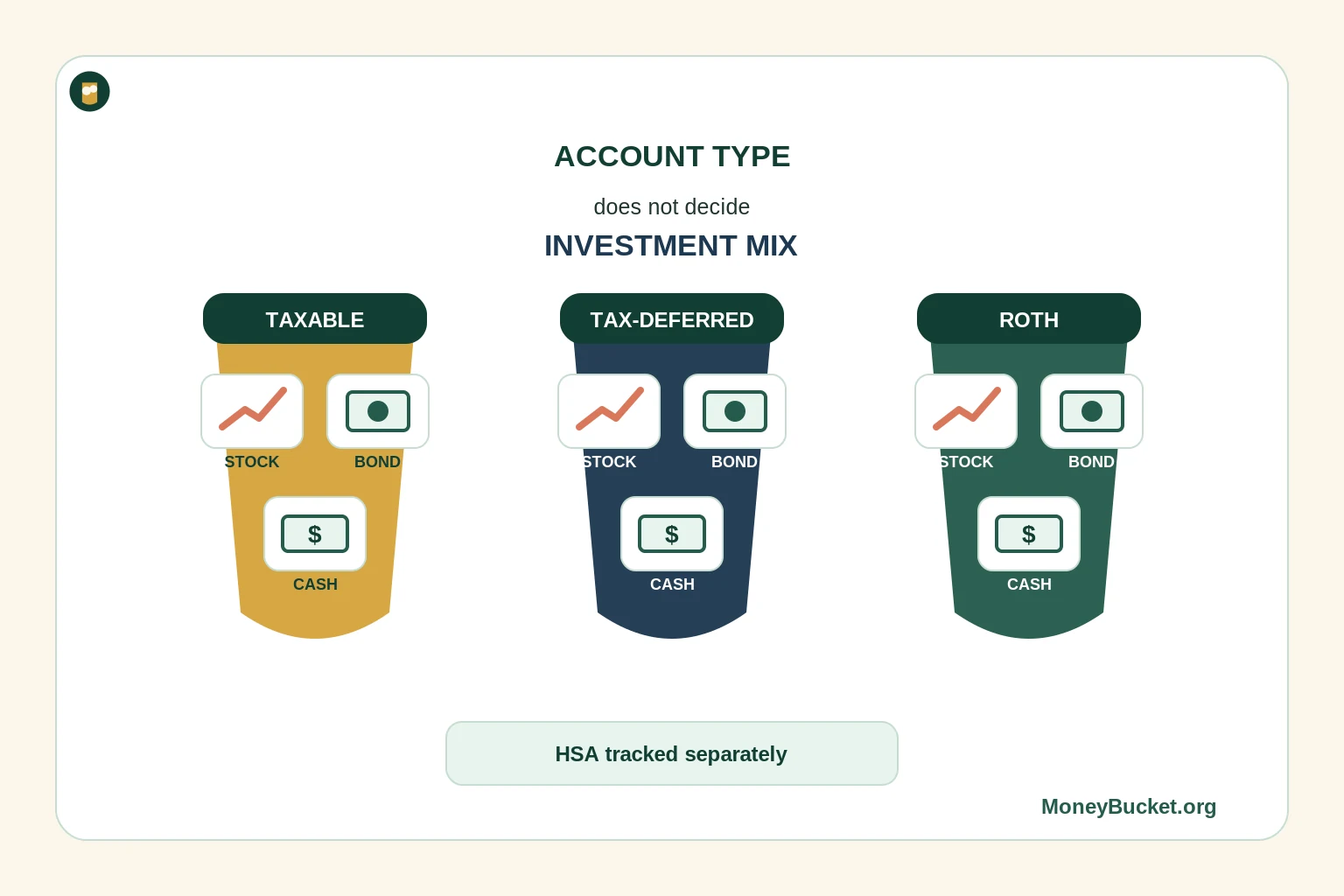
The Saving, Investing & Wealth hub covers the broader job of building reserves and investing for long-term goals. The three-bucket strategy focuses on a narrower choice: how money may be spread across taxable, tax-deferred, and Roth accounts with different federal tax treatment.
What the three buckets mean
Taxable or flexible accounts
Regular bank and brokerage accounts do not use a retirement-account tax shelter. Interest, dividends, distributions, and sales can affect the current tax return. Access is generally more flexible than a retirement account, but investment losses and tax consequences still matter.
Tax-deferred accounts
Traditional workplace plans and traditional IRAs can delay federal income tax on some money while it remains in the account. Previously untaxed amounts are generally taxable when distributed. A traditional IRA contribution may be deductible, partly deductible, or nondeductible depending on the taxpayer’s facts.
Roth accounts
Roth contributions are made with money that does not receive a current federal income-tax deduction. Qualified Roth distributions can be tax-free. Nonqualified distributions follow account rules and can include taxable amounts.
| Question | Taxable | Tax-deferred | Roth |
|---|---|---|---|
| Contribution tax treatment | Money generally enters after income tax | Workplace contribution may be pre-tax; IRA deduction can vary | Money generally enters after income tax |
| Tax while money remains | Interest, dividends, distributions, and realized gains can create tax | Tax generally waits while covered money remains in the account | Tax generally waits while money remains in the account |
| Withdrawal | Selling can create gains or losses | Previously untaxed distributions are generally taxable; other rules can apply | Qualified distributions can be tax-free; nonqualified distributions follow Roth rules |
| Owner RMDs | Not a retirement-plan RMD account | Traditional IRAs and many retirement plan accounts generally have RMD rules | Current IRS guidance says Roth IRAs and designated Roth accounts in 401(k) and 403(b) plans do not require owner RMDs while the owner is alive; beneficiary rules still apply |
| Can it hold stocks, bonds, and cash? | Yes, subject to the provider and account | Yes, subject to plan or account choices | Yes, subject to plan or account choices |
Taxable does not mean taxed twice
A taxable brokerage contribution usually comes from money that has already passed through income tax. The ongoing tax issue is what happens after the money enters the account. Interest, dividends, capital-gain distributions, and investment sales can create current tax consequences. Basis, holding period, losses, and the type of income matter.
Review the IRS guide to investment income and expenses for federal rules tied to interest, dividends, and capital gains.
Tax-deferred does not mean tax-free
A traditional workplace contribution may reduce current taxable income when made pre-tax. A traditional IRA deduction depends on income, filing status, and participation in workplace plans. When previously untaxed amounts leave a traditional account, they are generally included in taxable income.
Traditional accounts can also be subject to required minimum distribution rules. The current IRS RMD guidance explains which accounts are covered and when distributions generally begin.
Roth means qualified distributions can be tax-free
The word qualified matters. Roth IRA and designated Roth workplace-account rules are not identical. A distribution can fail the qualified-distribution tests, and a nonqualified distribution can include taxable earnings or other consequences.
Current IRS guidance also says Roth IRAs and designated Roth accounts in 401(k) and 403(b) plans do not require distributions from the original owner while that person is alive. Beneficiaries can still face distribution rules.
There is no universal three-bucket percentage
A neat one-third split is not a financial rule. The useful mix depends on workplace-plan terms, current cash needs, tax facts, income, expected withdrawal years, available accounts, debt, emergency reserves, fees, and investment risk.
Age alone does not decide the split. A person with a generous workplace match and little liquid savings has a different starting point from a household approaching retirement with most assets in a traditional plan.
Build the account mix in six steps
- Protect near-term bills. Keep enough accessible cash for upcoming expenses and emergencies before treating retirement accounts as a substitute for liquid reserves.
- Read the workplace plan. Record match terms, vesting, fees, investment choices, Roth availability, and withdrawal rules.
- Set the investment mix. Choose stocks, bonds, cash, and other holdings based on goals, time horizon, risk tolerance, and capacity for loss.
- Choose account locations. Decide where the selected investments will sit after considering taxes, access, plan quality, and costs.
- Automate a repeatable amount. A contribution you can sustain is more useful than a rigid percentage copied from another household.
- Review the whole household map. Check balances, fees, beneficiaries, asset allocation, tax treatment, and expected withdrawal years after major changes and at regular intervals.
Account tax treatment is not asset allocation
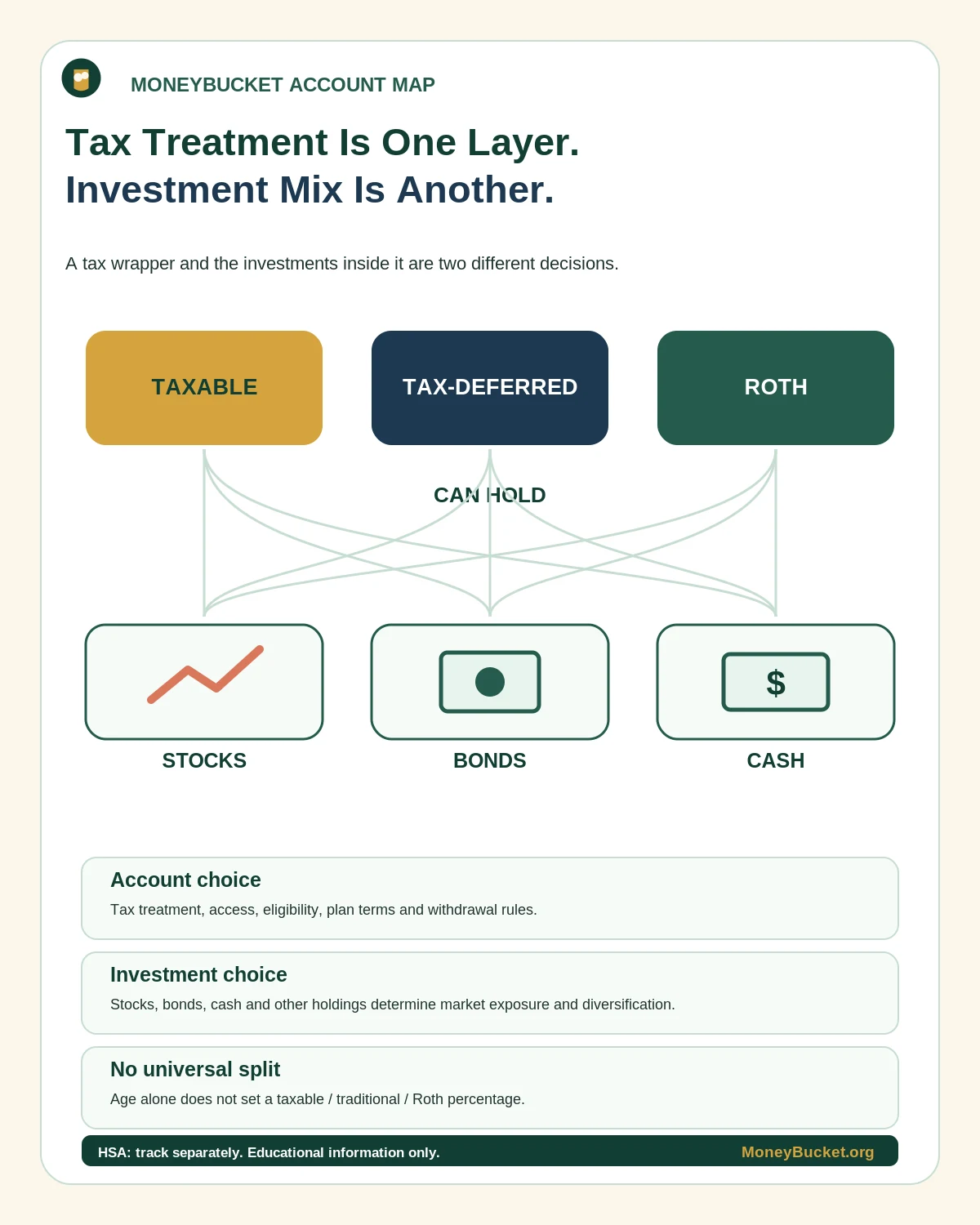
Investor.gov describes asset allocation and diversification as investment-risk choices. Those choices remain separate from the tax wrapper. The same broad stock fund can sit in a taxable account, traditional retirement account, or Roth account. Owning all three wrappers does not fix a concentrated investment portfolio.
Read the SEC’s asset allocation and diversification guide when choosing the investments that sit inside the accounts.
Keep an HSA separate
A health savings account has its own eligibility and medical-expense rules. It should not be relabeled as a Roth bucket. Investor.gov describes an HSA as a tax-advantaged account that can be used for qualified medical expenses and, when available, may also hold investments.
Review the Investor.gov HSA overview plus current IRS HSA rules.
Use the Three-Bucket Tax Mix Inventory
The private browser-only tool packaged with this page lets a reader list current taxable, tax-deferred, Roth, and HSA balances plus planned monthly contributions. Its job is to show the account mix, not to recommend a percentage or forecast returns.
Three-Bucket Tax Mix Inventory
List current balances and planned monthly contributions across taxable, tax-deferred, Roth, and HSA accounts.
Current balances
Planned monthly contributions
Common three-bucket mistakes
- Calling taxable, traditional, and Roth accounts asset classes.
- Using one percentage for every household.
- Assuming a Roth account makes every distribution tax-free.
- Assuming a traditional contribution always creates the same deduction.
- Ignoring workplace match, fees, vesting, and plan quality.
- Treating a taxable account as a tax failure rather than a flexible account with its own costs and uses.
- Counting an HSA as a Roth account.
- Ignoring current RMD rules and beneficiary rules.
- Rebalancing each account without checking the household portfolio.
3-Bucket Strategy FAQ
What are the three buckets?
They are taxable or flexible accounts, tax-deferred accounts, and Roth accounts. The labels describe account tax treatment, not the investments inside the accounts.
Is the three-bucket strategy the same as stocks, bonds, and cash?
No. Stocks, bonds, and cash are holdings or asset classes. Each account bucket can hold its own investment mix.
What percentage should go in each bucket?
There is no universal split. Workplace-plan terms, taxes, cash needs, available accounts, goals, time horizon, fees, and risk capacity all affect the choice.
Is every Roth withdrawal tax-free?
No. Qualified Roth distributions can be tax-free. Nonqualified distributions follow rules that depend on the account type and facts.
Do Roth accounts have required minimum distributions?
Current IRS guidance says Roth IRAs and designated Roth accounts in 401(k) and 403(b) plans do not require distributions from the original owner while the owner is alive. Beneficiaries can still be subject to distribution rules.
Does a taxable account have a retirement-plan early-withdrawal penalty?
A regular taxable brokerage account does not use the retirement-plan age-based additional tax. Selling can still create capital gains or losses, and investments can lose value.
Does using all three buckets reduce investment risk?
Not by itself. Investment risk depends on the holdings, diversification, fees, time horizon, and market results. Three account tax treatments do not fix a concentrated portfolio.
Where does an HSA fit?
Keep it separate. An HSA has distinct eligibility, contribution, medical-expense, investment, and distribution rules.
Retirement PlanningConnect account balances with spending, Social Security, taxes, and withdrawal years.
Investment RiskReview diversification, concentration, and risk controls separately from account tax treatment.