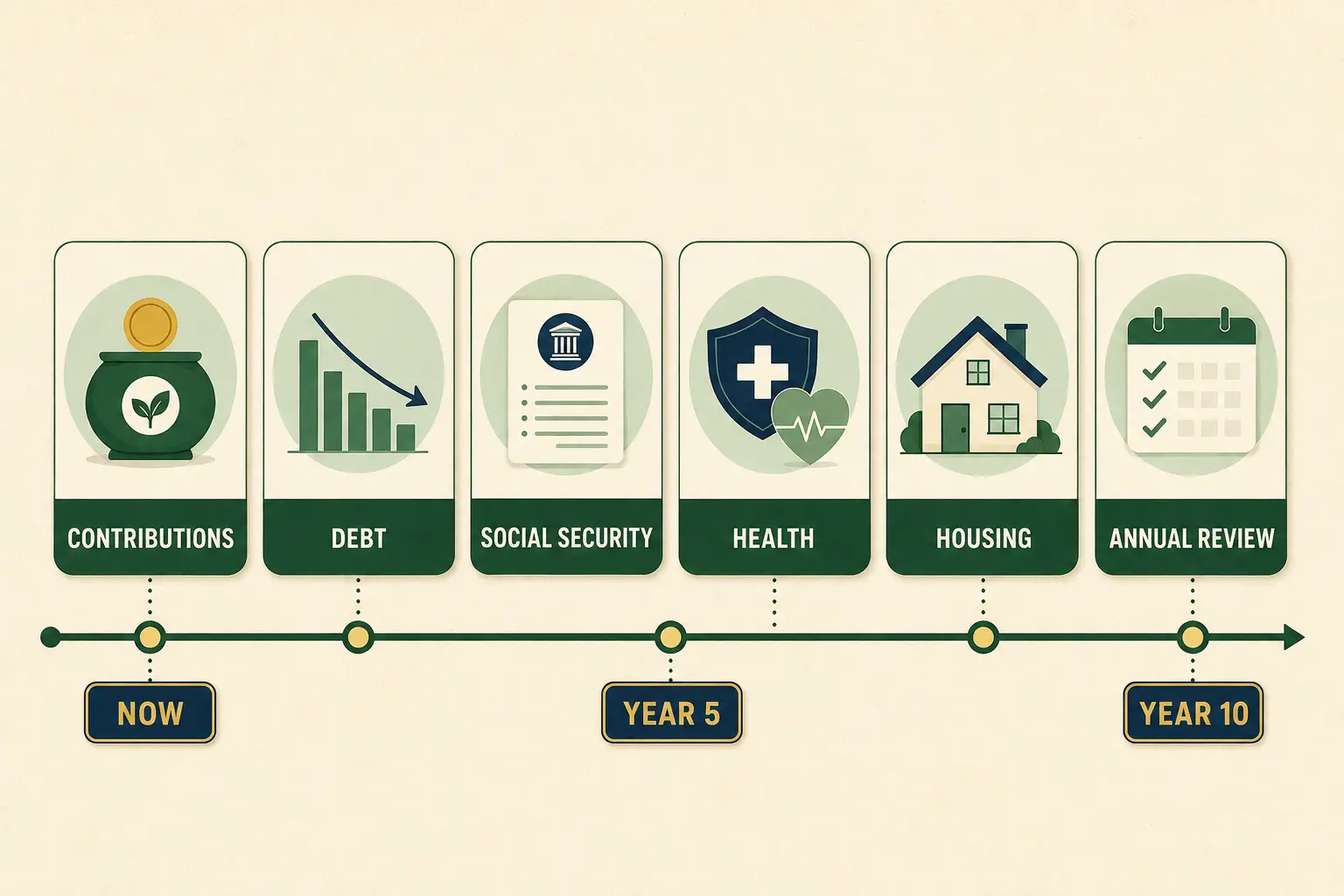
Building wealth in your 50s is less about finding a hot asset and more about using the next decade deliberately. Start with MoneyBucket Saving and Investing, then coordinate retirement contributions, debt, cash reserves, investment risk, Social Security, health coverage, and housing around the life you expect to fund.
Is it too late to build wealth in your 50s?
No. Your remaining working years, savings capacity, income, debt, Social Security, pensions, housing, health costs, and investment results still matter. The useful comparison is not your balance against someone else’s age benchmark. It is your plan this year against the plan you can have after one focused year.
Your 50s may include peak earning years, but they can also include tuition, caregiving, health changes, or a job transition. Build the plan from the cash flow you control rather than assuming every household has an uninterrupted decade of rising income.
What belongs in a midlife financial snapshot?
Put the main numbers on one page before choosing tactics:
Assets by account type
Cash, workplace plans, IRAs, taxable investments, pensions, business interests, and usable home equity.
Debts and interest rates
Credit cards, personal loans, student debt, vehicle loans, mortgage, and any variable-rate balances.
Reliable monthly income
Net pay, stable business income, pension income, and other income likely to continue.
Essential and flexible spending
Separate required bills from costs that could change during a job loss or poor market period.
Retirement saving
Current contribution rate, employer match, account fees, and the amount added over the last year.
Emergency reserves
Cash assigned to income gaps, repairs, deductibles, and other near-term shocks.
Calculate net worth, but do not let that one number hide liquidity or concentration. A household may have high net worth and very little cash available outside a home or business.
How can age-50 catch-up contributions help in 2026?
For 2026, the employee elective-deferral limit for most 401(k), 403(b), governmental 457 plans, and the federal Thrift Savings Plan is $24,500. The general catch-up limit for an eligible participant age 50 or older is $8,000. A higher $11,250 catch-up can apply in a year the participant turns 60, 61, 62, or 63.
The 2026 contribution limit for a traditional or Roth IRA is $7,500, plus an age-50 catch-up of $1,100. Deductibility and Roth IRA eligibility can depend on income, filing status, and workplace-plan coverage.
Beginning in 2026, certain plan participants whose prior-year FICA wages from the employer sponsoring the plan exceeded $150,000 must make catch-up contributions on a Roth basis. The plan and wage record matter. Confirm the rule with the plan administrator and tax professional.
The limits and Roth catch-up rule come from the IRS 2026 retirement limits and IRS catch-up guidance.
How can you raise savings without relying on willpower?
Choose the trigger before the money appears. When a raise begins or a car loan, tuition payment, or other recurring cost ends, assign part of that cash to retirement saving, debt reduction, or the emergency fund.
- Raise the workplace-plan contribution by one percentage point after a pay increase.
- Direct part of a bonus or profitable side income to a retirement account.
- Move a finished loan payment to the next chosen goal.
- Set a calendar reminder to review the contribution twice a year.
- Check that the full available employer match is captured when the budget allows.
Automation is useful only when the cash flow can support it. Keep enough checking and reserve cash to avoid replacing a contribution increase with new high-cost debt.
Which debts should you reduce before retirement?
Prioritize debt by interest cost, required payment, rate risk, collateral risk, tax treatment, and the pressure it puts on future cash flow. High-cost revolving debt often deserves early attention because it can compound against the household and weaken the ability to save.
A mortgage does not always have to be eliminated before retirement. Compare its rate, payment, remaining term, taxes, liquidity needs, housing plan, and the cost of using cash that would otherwise stay available or invested.
How should you review investment risk and fees?
List each account’s holdings, not just its balance. Funds in different accounts can own the same companies and create more concentration than the account names suggest.
| Review item | What to check | Why it matters |
|---|---|---|
| Employer stock | Total value across retirement, brokerage, and compensation plans. | Income and investments can depend on the same company. |
| Individual stocks and sectors | Largest positions and overlapping fund holdings. | A few holdings can drive a large part of the result. |
| Illiquid holdings | Private investments, property, restrictions, and selling costs. | Money may not be available when needed. |
| Investment fees | Expense ratios, advisory fees, plan charges, loads, and insurance costs. | Fees reduce the return kept by the investor. |
| Cash | Purpose, rate, insurance, and near-term use. | Unassigned cash can lose purchasing power, while too little cash can force sales. |
Investor.gov links asset allocation to time horizon and risk tolerance and explains diversification across and within asset classes. The Labor Department notes that fees affect retirement investment returns and income.
Do not try to repair a late start with concentrated stocks, leverage, or another position that could create a large loss near retirement.
Why should you check the Social Security record now?
A personal my Social Security estimate is based on the earnings record and lets you compare benefit estimates at different claiming ages. Review the record for missing or incorrect years and see how assumed future earnings affect the estimate.
Record the estimate for more than one claiming age. Do not treat the highest monthly number as automatically best. Health, work, household benefits, taxes, cash needs, and the rest of the retirement plan affect the choice.
How should you plan the health-care transition?
Estimate employer coverage through the planned retirement date, coverage before Medicare if work ends early, Medicare timing, premiums, deductibles, prescriptions, dental and vision costs, and other out-of-pocket expenses.
The U.S. Department of Labor retirement guide tells early retirees to plan health coverage before Medicare and notes that private employers generally are not required to provide retiree health benefits.
Medicare eligibility commonly begins around age 65, but enrollment timing can change with work status, current coverage, disability, Social Security benefits, and HSA contributions. Check the official Medicare sign-up and coverage rules before ending an employer plan.
Should you downsize your home in your 50s?
Only after comparing the full cost and lifestyle effect. A smaller home can lower some costs, but selling, buying, moving, repairs, taxes, insurance, association fees, and a new location can offset the difference.
| Factor | Stay | Move or downsize |
|---|---|---|
| Monthly cost | Mortgage or rent, tax, insurance, utilities, and maintenance. | New payment, tax, insurance, utilities, association fees, and maintenance. |
| One-time cost | Repairs or accessibility changes. | Selling, buying, moving, repairs, furnishing, and financing costs. |
| Work and support | Commute, local services, family, and care network. | New commute, services, family distance, and care access. |
| Future use | Space, stairs, upkeep, and ability to age in place. | Layout, location, upkeep, and expected length of stay. |
Housing is both a financial decision and a life decision. Use numbers from real properties and real transaction estimates.
When do tax tactics need professional review?
Roth conversions and tax-loss harvesting can affect taxable income, capital gains, Medicare premiums, credits, deductions, account balances, and future taxes. The right answer depends on the tax return and multi-year plan.
Do not convert an account or sell an investment merely because the tactic appears on a midlife checklist. Ask a tax professional to model the current-year and later effects, including state tax and the source of cash used to pay tax.
Which protection documents should you review?
Check beneficiary designations, powers of attorney, health-care documents, life insurance, disability coverage while still working, long-term-care planning when relevant, and estate documents with the right professionals. Confirm that account beneficiaries and ownership still match the plan after marriage, divorce, death, or another family change.
Insurance and estate rules can depend on state law, policy terms, employment, and family facts. Use qualified legal, tax, and insurance help for decisions, not a generic checklist alone.
What are useful one-year and 10-year checkpoints?
One-year checkpoint
Contribution increase completed; chosen debt target reduced; emergency reserve maintained; concentration and fees reviewed; Social Security record checked; health and housing assumptions recorded.
10-year checkpoint
Retirement-date range set; expected spending estimated; dependable income listed; health coverage mapped; housing plan tested; portfolio withdrawal and tax plan reviewed.
Review the one-year items every year. Rebuild the 10-year view when work, health, housing, family, or markets change the assumptions.
Building wealth in your 50s FAQ
Is it too late to build wealth in your 50s?
No. Remaining working years, savings rate, income, debt, Social Security, pensions, housing, and investment results all matter. Focus on the decisions you can improve now rather than comparing yourself with an age benchmark.
Should I max out my 401(k) in my 50s?
The legal maximum is not an individual recommendation. Set the contribution from the budget, debt, emergency reserve, tax situation, employer match, and broader retirement plan.
Should I downsize my home in my 50s?
Only after comparing monthly costs, selling and moving costs, repairs, taxes, insurance, accessibility, work plans, and the effect on the support network. A smaller home does not always lower total housing cost.
Should I take more investment risk to catch up?
No strategy can guarantee a higher return. Taking more risk can create larger losses close to retirement. Use a diversified allocation matched to the time horizon and ability to withstand loss.
What are the 2026 age-50 catch-up limits?
The general catch-up limit for most 401(k), 403(b), governmental 457 plans, and the TSP is $8,000 in 2026. The IRA catch-up limit is $1,100. Plan terms, compensation, income, and tax rules can affect use.
Continue the plan
Savings by AgeUse age benchmarks as context while planning from your income, spending, debt, and goals.
Emergency FundSet a starter cash target and a reserve policy for income gaps and large bills.
Primary sources
- IRS: 2026 Retirement Contribution Limits
- IRS: Catch-Up Contributions
- Social Security Administration: Get a Benefits Estimate
- U.S. Department of Labor: Preparing for Retirement
- U.S. Department of Labor: Understanding Retirement Plan Fees
- Medicare: When Coverage Starts
- Investor.gov: Asset Allocation and Diversification
Educational information: This guide does not promise a wealth or retirement outcome or recommend a contribution, tax tactic, insurance option, housing move, withdrawal, or investment. Rules and personal circumstances can change.