Is the U.S. Dollar Losing Its Reserve Currency Status?
Start with the Guide to Saving and Investing for the broader topic, then use this page for the details below. The U.S. dollar’s share of allocated global foreign-exchange reserves has declined, but that is not the same as the dollar suddenly losing its central role. It still leads by a wide margin and remains deeply embedded in trade, banking, debt, payments, and funding. For most households, the useful response is not panic. It is a stronger cash buffer, broad investment diversification, controlled debt, and fewer bets on one dramatic currency prediction.
What Is a Reserve Currency?
A reserve currency is held by central banks and monetary authorities as part of their foreign-exchange reserves. Countries may use those reserves to support their own currency, settle international obligations, or provide liquidity during financial stress.
Reserve status is only one part of the dollar’s international role. A currency can also be widely used to price trade, issue debt, make cross-border payments, fund banks, and store private wealth. Looking only at central-bank reserves misses much of the picture.
Is the Dollar’s Reserve Share Declining?
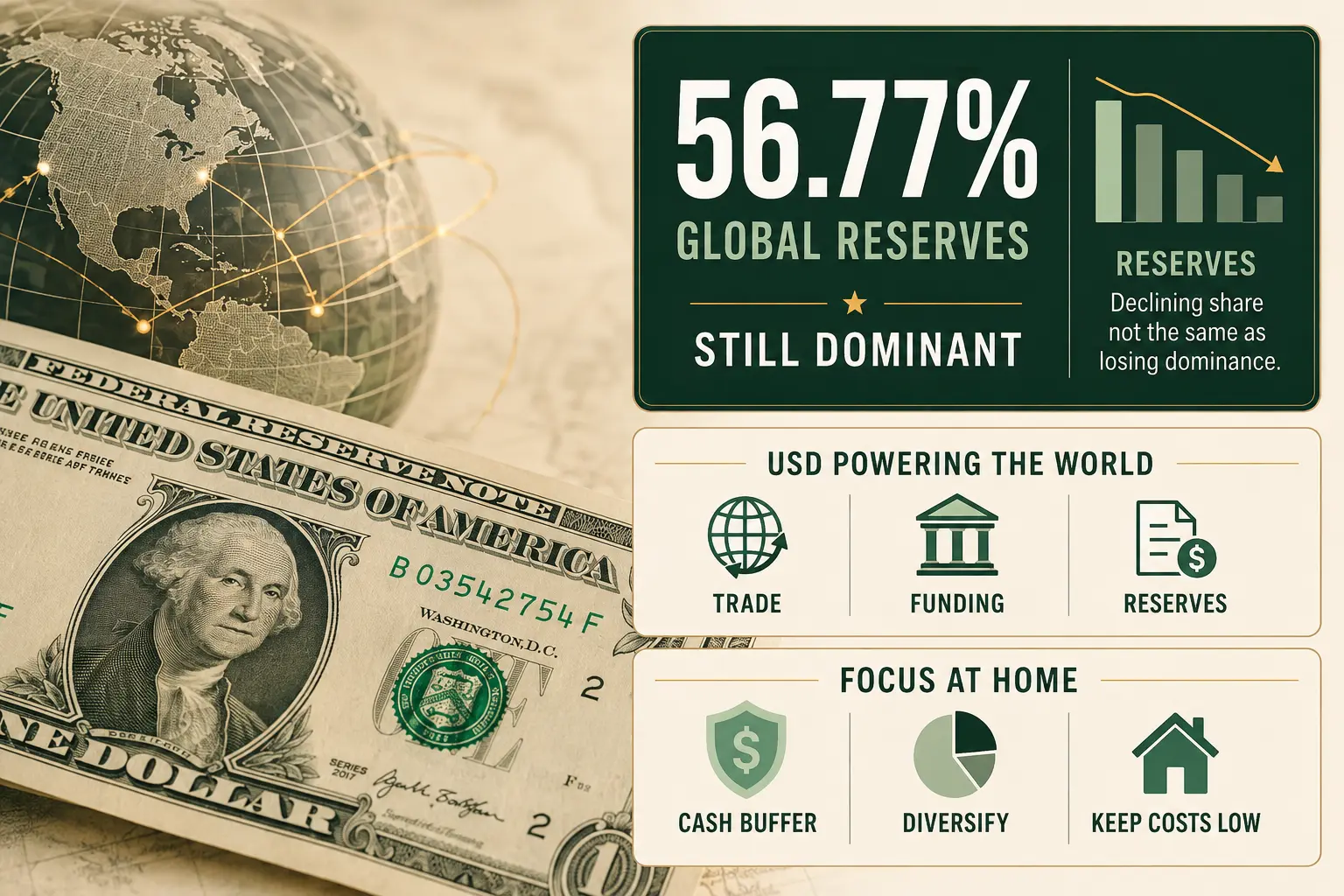
Yes. The dollar’s share has moved lower over time as central banks have spread part of their reserves across more currencies. The latest IMF COFER release placed it at 56.77% in 2025 Q4, down slightly from 56.93% in the prior quarter.
| Reserve currency group | Share of allocated reserves, 2025 Q4 |
|---|---|
| U.S. dollar | 56.77% |
| Euro | 20.25% |
| Chinese renminbi | 1.95% |
| Other identified currencies combined | 14.90% |
| Residual other currencies | 6.13% |
A declining share can reflect diversification without a clean switch from one dominant currency to another. Smaller currencies have gained reserve share, while the renminbi remains a small portion of reported holdings. Exchange-rate movements can also change measured shares from quarter to quarter.
Why the U.S. Dollar Still Dominates
A reserve currency needs more than a large economy. It also needs markets that can absorb huge transactions, assets that institutions can buy and sell quickly, dependable payment channels, and widespread acceptance across borders.
- Deep financial markets: U.S. Treasury and other dollar markets give large institutions room to move money at scale.
- Trade invoicing: Many international transactions are priced or settled in dollars even when no U.S. company is involved.
- Dollar debt: Governments, companies, and financial institutions outside the United States borrow in dollars.
- Bank funding: The dollar remains central to cross-border banking and global liquidity.
- Network effects: Each buyer, seller, lender, and bank using dollars makes it easier for the next participant to do the same.
The Federal Reserve’s 2025 review found that the dollar remained dominant across international usage measures. That does not make its position permanent. It does mean a handful of non-dollar trade agreements do not amount to an overnight replacement.
What “De-Dollarization” Really Means
De-dollarization describes efforts to reduce reliance on the dollar. A country might settle more trade in its own currency, hold a wider mix of reserves, create a regional payment channel, or borrow in a different currency.
These efforts matter, but they do not all carry the same weight. A bilateral trade agreement can reduce dollar use for a limited set of transactions while leaving reserve holdings, debt markets, banking relationships, and commodity pricing largely unchanged.
Could the Dollar Lose Its Dominant Role?
Yes, over a long enough period. Currency leadership has changed before. A faster loss of confidence could be driven by persistent inflation, weakened public finances, impaired market liquidity, capital restrictions, political instability, or a credible rival offering comparable scale and access.
The harder question is not whether change is possible. It is whether another currency or system can perform the dollar’s jobs at global scale. The euro is the second-largest reserve currency, but the euro area does not offer one unified government-debt market equal to the Treasury market. China is a major trading power, but capital controls and limits on market access reduce the renminbi’s appeal as an unrestricted global reserve asset. Gold and crypto assets can serve selected purposes, but neither currently replaces the dollar’s full trade, debt, banking, and payment infrastructure.
What a Weaker Dollar Could Mean for Your Money
A weaker dollar can make imported goods, overseas travel, and foreign services more expensive for U.S. buyers. It can also raise the dollar value of foreign investments and help some U.S. exporters compete abroad. The result is not identical for every household or business.
| If the dollar weakens | Possible effect |
|---|---|
| Imported goods | May cost more in dollar terms |
| International travel | May become more expensive |
| Foreign stock holdings | Currency translation may lift dollar returns |
| U.S. exporters | Products may become more competitive abroad |
| Inflation pressure | Imported inflation can add pressure, but it is only one driver |
Reserve-currency share is not a direct switch controlling grocery prices, mortgage rates, or stock returns. Those outcomes depend on many forces, including interest rates, energy prices, wages, productivity, taxes, supply, demand, and fiscal policy.
Five Practical Ways to Protect Your Finances
- Build a cash buffer in the currency you spend. If your bills are in dollars, an emergency fund in an accessible dollar account protects against near-term shocks better than a speculative currency trade.
- Own a broad mix of assets. Diversified U.S. and international stocks, bonds suited to your risk level, and cash reserves spread risk across companies, countries, and economic outcomes.
- Control high-cost debt. Paying down expensive variable-rate debt can offer a clearer benefit than trying to predict the next reserve-currency shift. Start with the Debt Management Guide.
- Keep investment costs low. Fees compound against you whether the dollar is strong or weak.
- Match decisions to your time horizon. Money needed soon should not depend on a volatile currency, commodity, or crypto forecast. Long-term money has more room for a diversified investment mix.
Make Your Money Plan Stronger Than the Headline
Build the basics first: a working budget, emergency savings, manageable debt, and diversified long-term investments.
Common Questions About the U.S. Dollar
Is the U.S. dollar still the leading reserve currency?
Yes. IMF data for 2025 Q4 show the dollar at 56.77% of allocated reserves, far ahead of the euro at 20.25%.
Does a lower reserve share mean the dollar is collapsing?
No. The share has declined over time, but the dollar still leads across reserves and several other international uses. A gradual move toward a wider mix of currencies is different from a sudden collapse.
Should I move my savings out of U.S. dollars?
Money for U.S. bills and near-term emergencies generally needs to stay liquid and stable in dollars. Long-term investors may gain foreign-currency exposure through diversified international funds without turning emergency savings into a currency bet.
Will the Chinese yuan replace the dollar?
The renminbi is used more widely than it once was, but it accounted for only 1.95% of allocated reserves in 2025 Q4. Capital controls and market-access limits remain major hurdles to a full replacement role.
Is gold or Bitcoin a replacement for dollars?
Neither currently performs all the dollar’s roles across trade invoicing, bank funding, debt markets, payments, reserves, and everyday U.S. spending. They also carry their own price, custody, and liquidity risks.
Sources
- IMF COFER, World Aggregates, Fourth Quarter 2025
- Federal Reserve: The International Role of the U.S. Dollar, 2025 Edition
- Bank for International Settlements: Dollar funding and global finance
Updated August 2026 · Money Bucket Editorial Team. This guide is educational and is not personal investment advice.