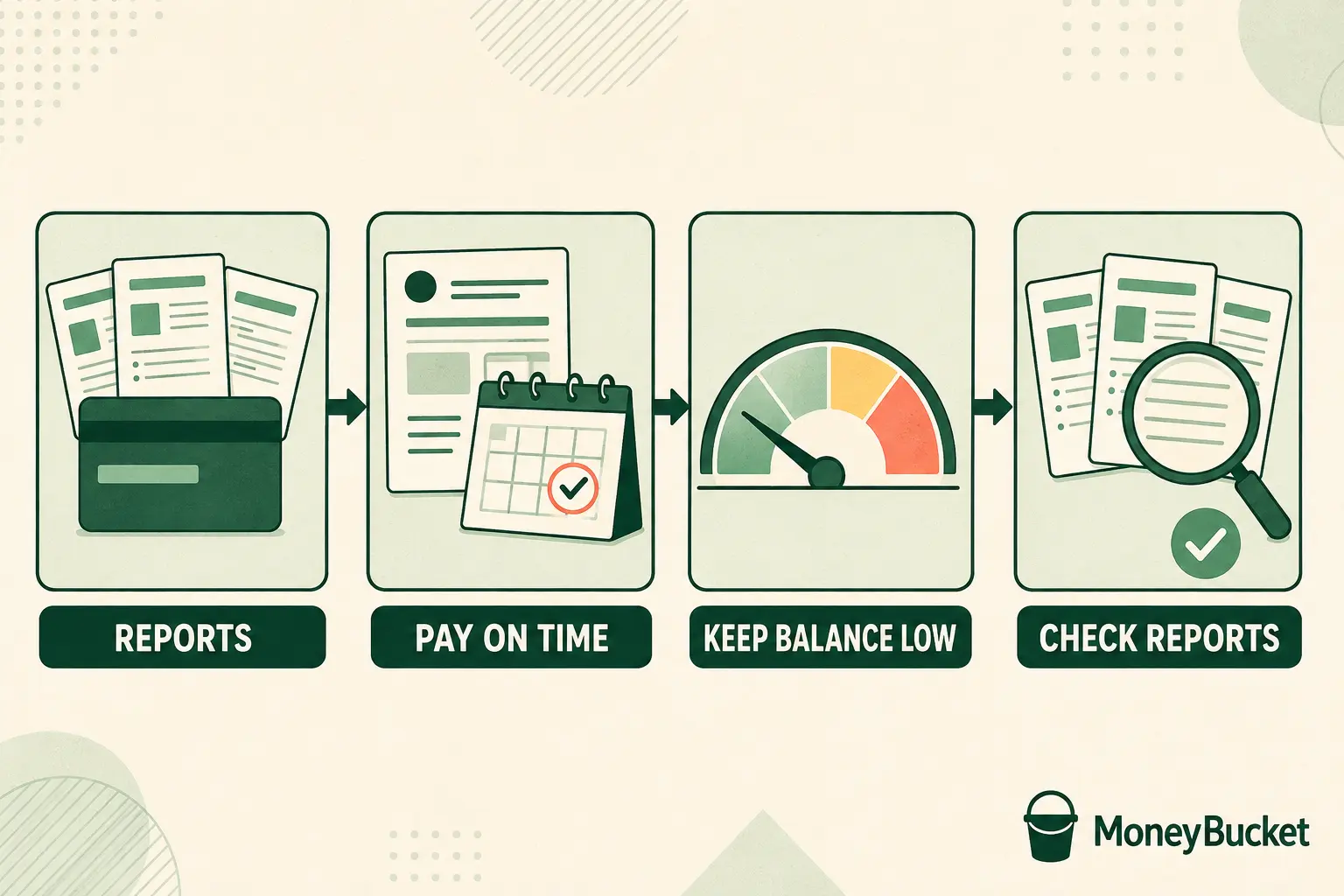
A credit card can build credit when the issuer reports the account and you manage it well. The safest approach is simple: put one planned expense on the card, pay the full statement balance by the due date and keep the balance small compared with the limit. This credit card guide explains the dates, balances and habits that matter without asking you to pay interest.
How a Credit Card Helps Build Credit
A credit score is calculated from information in a credit report. Credit card issuers may send account information to Equifax, Experian and TransUnion, the three nationwide credit reporting companies. A lender is not required to report to all three, so ask the issuer about its reporting policy before choosing a starter card.
Payment record
On-time payments can add positive account history. A missed due date can lead to fees, interest and credit damage. The Consumer Financial Protection Bureau says repayment history is usually the top factor in credit scores.
Reported balance
Score models compare revolving balances with available credit. A high balance can affect a score even when you pay it in full a day later, because the score uses the balance present when it is calculated.
Account age
An older account can provide a longer record of credit use. Age alone does not make an account worth keeping if it has a costly fee or creates a fraud or overspending risk.
New applications
Applying for a card can create a hard inquiry and a new account. Apply only when the card fits a real need, not merely to produce a short-term score change.
Credit scoring formulas differ, and the weight of each factor varies with the person and model. That is why a promised point gain, universal timeline or single perfect balance is not credible. See the broader good credit score guide for the difference between credit reports and scores.
Know the Four Dates on a Credit Card
Many credit-building mistakes come from treating every card date as the due date. They are not the same.
| Date | What it means | What to do |
|---|---|---|
| Purchase date | The day a charge is made. A pending charge may post later. | Record the purchase in your budget and keep the cash available. |
| Statement closing date | The billing cycle ends and the statement balance is set. Federal rules require the statement to show the cycle closing date and new balance. | Review every charge, the statement balance and the due date. |
| Payment due date | The deadline for the required payment on that statement. | Pay the full statement balance by this date to avoid interest on purchases when the grace period applies. |
| Reporting date | The date the issuer sends account information to a credit reporting company. It may be near the statement date, but practices vary. | Ask the issuer which balance it reports if a lower reported balance matters for an upcoming credit application. |
An Eight-Step Plan to Build Credit With a Card
- Choose a low-cost card that reports. Look for no annual fee or a fee you can plainly justify. Ask whether the issuer reports to Equifax, Experian and TransUnion. If standard cards are not available, compare secured cards from banks and credit unions.
- Set a spending rule before the first purchase. Put one small, planned expense on the card, such as a phone bill or transit pass. Do not charge more than the cash already reserved in your budget.
- Turn on account alerts. Use purchase, balance, due-date and suspected-fraud alerts. A low balance alert can be more useful than waiting for a monthly statement.
- Use minimum-payment autopay as a safety net. This lowers the chance that travel, illness or a forgotten date produces a missed payment. It is not permission to stop checking the account.
- Pay the full statement balance. Paying in full by the due date can build a positive payment record without interest on purchases when the grace period applies. You do not need to leave a few dollars unpaid.
- Keep the reported balance manageable. Do not wait for a supposed 30% cliff. Lower revolving balances relative to limits are generally better for scores. If a normal bill creates a high reported balance, make a payment before the issuer reports.
- Apply only when a new account has a purpose. More cards do not automatically produce better credit. Each application may add an inquiry, and each new account adds another payment and fraud-monitoring job.
- Check all three credit reports. Use AnnualCreditReport.com, the federally authorized site, to request free weekly online reports. Confirm the account, limit, balance and payment status are accurate.
Pair this plan with the alerts, budgeting and fraud steps in Using Credit Cards Responsibly.
How Much of the Credit Limit Should You Use?
Credit utilization is the percentage of revolving credit in use. It can be calculated for one card and across all revolving accounts.
| Reported balance | Credit limit | Utilization | Plain reading |
|---|---|---|---|
| $50 | $500 | 10% | A small share of the limit is reported. |
| $150 | $500 | 30% | This is not a scoring cliff or guaranteed safe zone. |
| $400 | $500 | 80% | Most of the available limit is in use. |
The 30% figure is a rule of thumb, not a universal threshold. FICO states that there is no fixed percentage that defines good use for every credit file. The safer lesson is to avoid getting close to the limit and keep reported balances as low as your normal cash flow permits.
A low reported balance does not require extra purchases. A card can report a zero balance after you pay it, and the account can still remain part of your credit history. If every card reports zero, that is not a reason to buy something you do not need.
Should You Use a Secured Credit Card?
A secured card requires a refundable deposit that usually helps set the credit limit. It can help build credit if the issuer reports the account. The deposit does not pay the monthly bill, so you must still make payments.
- Confirm reporting to the three nationwide credit reporting companies.
- Compare annual fees, monthly fees, interest rates and deposit rules.
- Ask how and when the deposit can be returned.
- Check whether the account can graduate to an unsecured card without closing the original account.
- Avoid products that make vague credit promises without clear reporting terms.
The CFPB lists secured cards as one possible way to start or rebuild history when the provider reports payments. A debit card or prepaid card usually does not create the same revolving credit history.
Should You Keep an Old Credit Card Open?
There is no blanket answer. Closing a card can reduce available credit, which may raise utilization when balances stay the same. Keeping it open may preserve the available limit and account history. A card can still be worth closing when it has an annual fee, encourages spending, creates account-management strain or raises fraud concerns.
- Pay or move any balance under terms you understand.
- Redeem rewards that would be lost.
- Move recurring charges to another payment method.
- Estimate utilization after the limit disappears.
- Ask whether a no-fee product change is available.
- Monitor the report to confirm the account is closed as requested.
The CFPB notes that closing a card may lower a score, but the effect depends on the credit file. Fees, spending control and fraud risk matter too.
How Long Does It Take to Build Credit?
There is no single timeline for every score or lender. For a FICO Score, a credit report generally needs at least one account opened for six months or more and at least one account reported within the past six months. That is a minimum scoring requirement, not a promise of a good score at month six.
After a score exists, improvement depends on the full report: payment record, balances, account age, new accounts, errors and any negative items already present. Some negative information can remain for years. Consistent payments and lower balances are repeatable actions, but nobody can promise an exact point increase by a set date.
Credit-Building Mistakes to Avoid
- Carrying a balance for no reason. Interest is a cost, not a credit-building fee.
- Paying only the minimum. It may keep the account current, but interest can grow and the balance can stay high.
- Chasing rewards before the habit is stable. A sign-up bonus is not worth debt, interest or missed payments.
- Opening cards to create credit mix. Apply for credit you need and can manage.
- Assuming a 30% balance is always safe. No universal cutoff guarantees a score result.
- Closing every unused card automatically. Compare the fee, risk and utilization effect first.
- Disputing accurate negative information. A valid dispute is for information that is wrong, duplicated or not yours. See the credit repair guide for a record-based process.
- Ignoring statements after setting autopay. Review charges, credits, fees and payment status every month.
Building Credit With a Credit Card: Questions
Do I need to carry a balance to build credit?
No. You can build a positive payment record while paying the full statement balance by the due date. Carrying a balance can create interest costs and is not required for a strong credit score.
How much should I charge each month to build credit?
There is no required purchase amount. One small planned expense can be enough to keep the account active. On-time payment and a manageable reported balance matter more than spending more.
Is 30% credit utilization a hard limit?
No. Thirty percent is not a scoring cliff. Credit scoring effects vary by model and credit file, and lower reported revolving balances are generally better than higher ones.
Can a secured credit card build credit?
It can when the issuer reports the account to credit reporting companies. Check reporting, fees, deposit-return rules and whether the card can graduate to an unsecured account.
Should I keep every old credit card open?
No blanket rule fits every card. Keeping a no-fee card may support available credit and account age, while closing can make sense when fees, overspending or fraud risk outweigh that benefit.
How long does it take to build credit with a card?
There is no guaranteed timeline. A FICO Score generally requires at least one account open for six months and recent reporting, but a good score depends on the full credit report and consistent management over time.
Source check: Consumer guidance, free-report availability and FICO scoring requirements were checked on August 28, 2026. Card terms and issuer reporting practices can change, so confirm them before applying.
Editorial note: This page provides general education, not financial, legal or credit-repair advice. Credit decisions and score effects depend on the lender, scoring model and individual credit file.