Income taxes are levies on earnings and other taxable income. Our Taxes hub explains the broader filing and planning topics that connect to this guide.
How is federal income tax calculated?
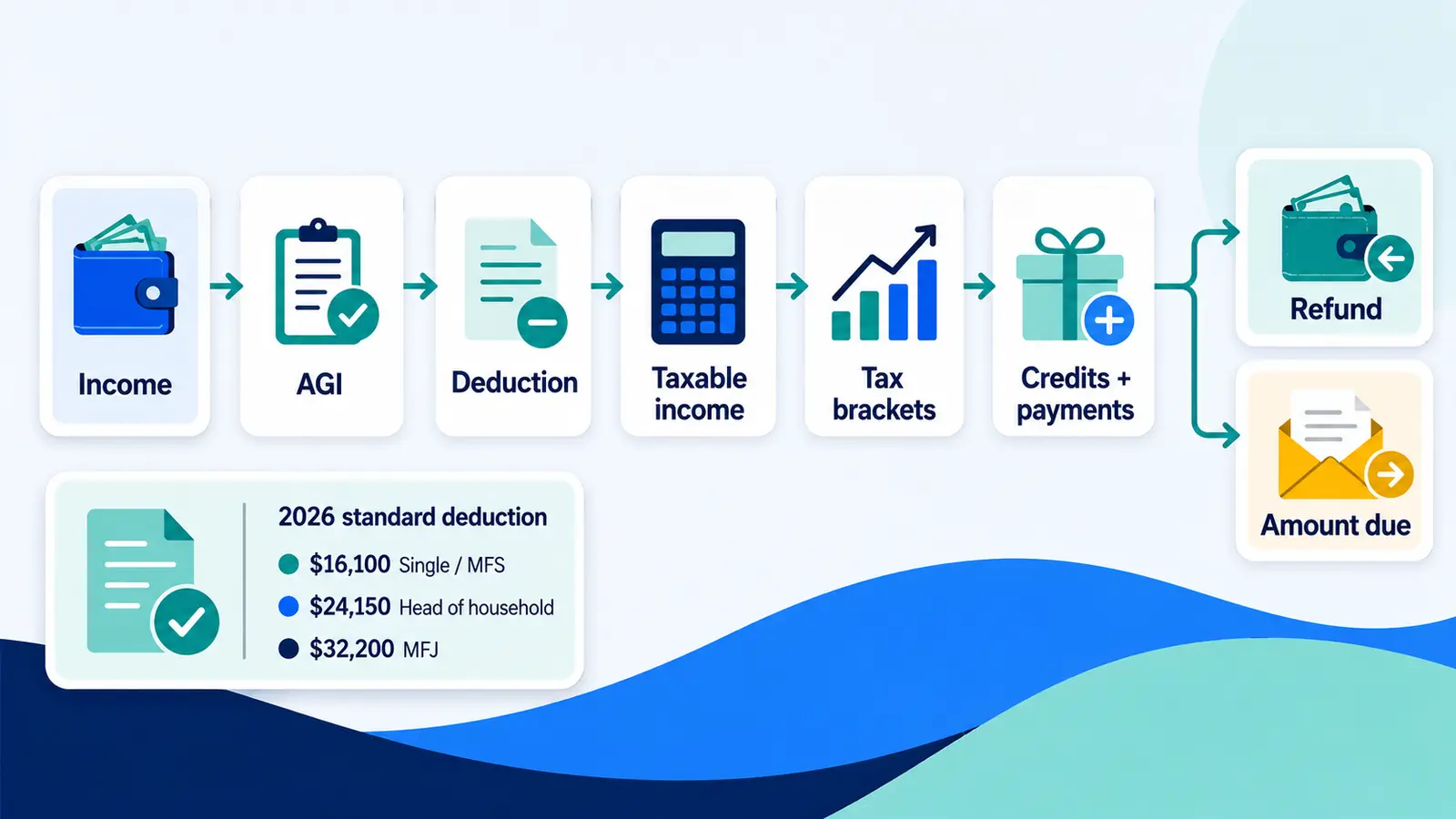
A simplified federal calculation starts with income, then accounts for adjustments, deductions, tax rates, credits, and payments. Your actual return may include additional taxes, special limits, phaseouts, or refundable credits.
- Add income that must be reported. This can include wages, self-employment income, interest, dividends, taxable retirement distributions, and other income.
- Subtract eligible adjustments. These produce adjusted gross income, commonly called AGI.
- Subtract either the standard deduction or itemized deductions. The result is generally taxable income.
- Apply the appropriate tax schedule. Marginal rates apply to layers of taxable income, not to every dollar at your top rate.
- Subtract eligible credits and tax payments. Withholding and estimated payments are compared with total tax to determine a refund or amount due.
What are the 2026 federal income-tax brackets?
The bracket that contains your last dollar of taxable income is your marginal bracket. Only the dollars within that band are taxed at that band’s rate. These thresholds apply to income earned in 2026, generally reported on a return filed in 2027.
2026 brackets for single filers
| Rate | Taxable income |
|---|---|
| 10% | $0 to $12,400 |
| 12% | Over $12,400 to $50,400 |
| 22% | Over $50,400 to $105,700 |
| 24% | Over $105,700 to $201,775 |
| 32% | Over $201,775 to $256,225 |
| 35% | Over $256,225 to $640,600 |
| 37% | Over $640,600 |
2026 brackets for married couples filing jointly
| Rate | Taxable income |
|---|---|
| 10% | $0 to $24,800 |
| 12% | Over $24,800 to $100,800 |
| 22% | Over $100,800 to $211,400 |
| 24% | Over $211,400 to $403,550 |
| 32% | Over $403,550 to $512,450 |
| 35% | Over $512,450 to $768,700 |
| 37% | Over $768,700 |
The IRS publishes separate thresholds for married filing separately, head of household, estates, and trusts. Filing status affects both the brackets and the standard deduction, so use the schedule that matches your federal return.
What is the 2026 standard deduction?
The standard deduction is a fixed amount that generally reduces taxable income if you do not itemize. For tax year 2026, the basic amounts are:
| Filing status | 2026 standard deduction |
|---|---|
| Single | $16,100 |
| Married filing separately | $16,100 |
| Head of household | $24,150 |
| Married filing jointly | $32,200 |
| Qualifying surviving spouse | $32,200 |
Some taxpayers may qualify for an additional standard deduction based on age or blindness. Dependents can also face a different calculation. Check the current IRS instructions for the return you file.
Should you take the standard deduction or itemize?
Most filers choose the larger allowable deduction. Itemizing may make sense when eligible expenses exceed the standard deduction for your filing status. Common categories can include certain medical expenses, state and local taxes subject to current law, home mortgage interest, and charitable contributions.
Eligibility limits and documentation rules differ by category. Compare the options using current federal forms and instructions rather than assuming an expense is fully deductible. Our guide to tax deductions and credits explains the distinction in more detail.
What is the difference between a tax deduction and a tax credit?
| Tax break | What it changes | Simple example |
|---|---|---|
| Deduction | Reduces income subject to tax | A $1,000 deduction does not normally reduce tax by $1,000. Its value depends on the tax calculation. |
| Credit | Reduces calculated tax, subject to eligibility and credit rules | A $1,000 nonrefundable credit can reduce eligible tax by up to $1,000 but generally cannot reduce it below zero. |
Credits can be refundable, partially refundable, or nonrefundable. Income limits, dependent rules, and other tests may apply. Review the current IRS requirements for each credit you plan to claim.
How do withholding and estimated tax payments work?
Federal income-tax withholding is a prepayment toward your tax bill, not your tax rate. Employers generally calculate withholding from pay and the information on Form W-4. A larger refund can mean you paid more during the year than your final tax liability, while an amount due can mean payments were too low or circumstances changed.
The IRS Tax Withholding Estimator can help employees review withholding after a job change, marriage, divorce, major income change, home purchase, or change in dependents. Use a recent pay stub and information for other income before starting.
Estimated tax payments may be needed when income is not subject to enough withholding. Examples can include self-employment, contract work, interest, dividends, rents, capital gains, and some retirement income. People earning through the gig economy should track income and deductible business expenses throughout the year.
How do federal and state income taxes differ?
Federal and state income taxes are separate systems. States can use different income definitions, deductions, credits, filing statuses, tax rates, residency rules, and deadlines. Some local governments also impose income taxes.
Working in one state while living in another, moving during the year, or working remotely can create filing questions in more than one jurisdiction. Start with the official revenue or taxation agency for each relevant state. Employer location alone does not determine every state filing obligation.
What records should you keep for an income-tax return?
- Wage and income statements such as Forms W-2 and 1099
- Brokerage, bank, retirement, and digital-asset tax forms
- Receipts and acknowledgments for deductions or credits you claim
- Health coverage and education records when relevant
- Business income and expense records for self-employment
- Copies of filed returns and proof of tax payments
- State residency, move, and work-location records when needed
Keep records long enough to support the items on your return under the applicable federal and state retention rules. Digital copies should be backed up and protected.
How can you do a 2026 income-tax checkup?
- Confirm the filing status you expect to use.
- List all expected wage, investment, retirement, and business income.
- Estimate eligible adjustments to income.
- Compare the standard deduction with potential itemized deductions.
- Review credits that may apply and their current eligibility rules.
- Check federal withholding using current pay information.
- Estimate payments for income without adequate withholding.
- Review official state tax guidance for every relevant jurisdiction.
- Organize supporting documents before filing season.
- Recheck after a major income, job, family, or residency change.
For a broader year-round process, see tax planning strategies. If a pay change affects your cash flow, the Pay & Work hub can help you review the rest of your budget.
Income-tax questions
What is the standard deduction for 2026?
The basic 2026 standard deduction is $16,100 for single filers and married people filing separately, $24,150 for heads of household, and $32,200 for married couples filing jointly and qualifying surviving spouses. Additional rules can apply based on age, blindness, or dependent status.
Are personal exemptions available in 2026?
No. The personal exemption amount remains $0 for tax year 2026. That is separate from the standard deduction and tax credits.
Does your marginal tax bracket apply to all your income?
No. Federal brackets apply progressively. Your marginal rate generally applies only to the portion of taxable income within that bracket, not to every dollar of income.
Is a tax credit the same as a tax deduction?
No. A deduction generally reduces income subject to tax. A credit generally reduces calculated tax, subject to that credit’s eligibility, refundability, and other rules.
Do you pay state income tax based only on your employer’s location?
Not necessarily. Residence, work location, reciprocity agreements, remote-work rules, and state-specific sourcing rules can all matter. Check the official tax agency for each state connected to your work or residence.
- IRS: Tax inflation adjustments for tax year 2026
- IRS Internal Revenue Bulletin 2025-45
- IRS resources for individuals
- IRS Tax Withholding Estimator
Source pages checked August 24, 2026.
This article provides general educational information and is not individualized tax, legal, or financial advice. Tax results depend on the full facts of a return and current law.