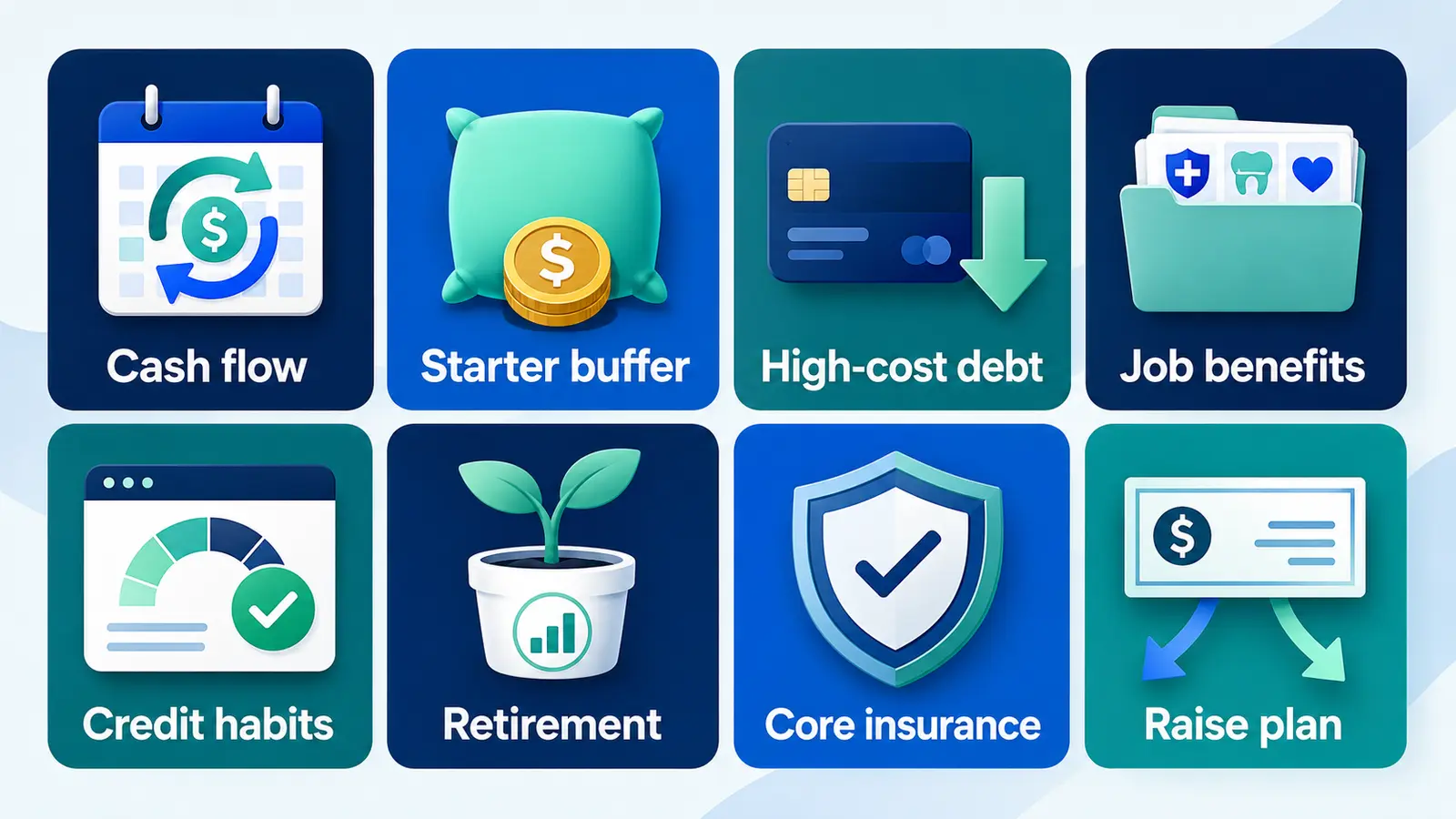
The Earning Money guide can help you evaluate pay, jobs, and extra-income options. In your 20s, what happens after income arrives matters just as much: a few repeatable systems can protect today’s cash flow while giving future choices more room.
Are you spending without a cash-flow system?
A budget does not need to predict every dollar perfectly. It needs to show what must be paid before the next paycheck, what can wait, and what you are choosing to save.
Start with a simple payday sequence:
- List income expected before the next payday.
- Reserve housing, utilities, food, transportation, insurance, and required debt payments.
- Move a planned amount to savings.
- Set a flexible spending amount for the remaining period.
- Review the result once a week and adjust the next cycle.
The Budgeting guide compares systems that work for regular and irregular income. The point is visibility, not a perfect spreadsheet.
Do you have a starter emergency buffer?
An emergency fund is cash set aside for unplanned costs or income disruption. The right target depends on rent, transportation, health needs, job stability, dependents, and other household risks. A generic three-to-six-month rule is not a useful first step for everyone.
Start with a smaller named target you can reach, such as an insurance deductible, a typical car repair, or one week of core expenses. Then keep building. CFPB guidance notes that even a small amount can add protection and that automatic recurring transfers can support consistency when account balances allow.
Use the Emergency Fund guide to choose a target and storage place.
Is high-cost revolving debt taking over your budget?
Credit-card interest can make yesterday’s spending compete with today’s rent, food, and transportation. If a balance is growing, the first job is to stop the gap from widening.
- List the balance, APR, minimum payment, due date, and promotional-rate expiration for every account.
- Keep required payments current where possible.
- Remove or reduce spending that is continuing to add to the balances.
- Choose a repayment order after core living costs and a workable buffer are covered.
- Contact the issuer early if the payment will not fit and ask about available hardship options.
The Understanding Debt guide explains APR, payment, term, and repayment priority without relying on blanket debt labels.
Have you reviewed all your job benefits?
Salary is only one part of compensation. A new job or annual enrollment period is a good time to review the benefits documents rather than accepting every default or overlooking a benefit you earned.
| Benefit | What to check |
|---|---|
| Retirement plan | Eligibility date, employee contribution, employer match, vesting, fees, and investment menu |
| Health plan | Premium, deductible, out-of-pocket limit, provider network, prescriptions, and employer funding |
| Disability coverage | Waiting period, benefit amount, duration, exclusions, and portability |
| Paid time off | Accrual, carryover, approval rules, and payout policy |
| Education or training | Eligible programs, reimbursement limits, service commitments, and tax treatment |
The Labor Department explains that employer retirement contributions can be subject to vesting schedules. Read the summary plan description and ask the plan administrator when a term is unclear.
Are you treating the credit score as the goal?
A score is an output based on information and a scoring model. The more durable goal is healthy account behavior and accurate credit reports.
- Pay required bills by the due date.
- Keep card balances manageable and avoid borrowing only to chase points.
- Review credit reports for accounts, balances, and personal information you do not recognize.
- Dispute errors with both the credit reporting company and the company that supplied the information when appropriate.
- Ignore businesses that promise to remove accurate negative information.
CFPB notes that requesting your own credit reports does not hurt your score. The Good Credit Score guide focuses on report accuracy and account behavior rather than quick-fix claims.
Have you checked the retirement match and vesting rules?
Starting early gives contributions more time to compound, but do not turn retirement saving into a pass-or-fail contest. First read the plan terms.
Check the employer match formula, how much you must contribute to receive the available match, when employer contributions vest, plan fees, investment choices, and whether automatic enrollment has already set a contribution rate. Your contribution is yours, while employer contributions can follow a vesting schedule depending on the plan.
If current cash flow cannot support a large contribution, begin with a sustainable amount and revisit it after a raise or debt payoff. Investor.gov’s compound-interest calculator can show how contribution amount, time, and an assumed return interact. Its result is an illustration, not a guarantee.
For account choices and plan terms, see the Retirement Planning guide.
Are major financial risks left uncovered?
Insurance is for losses that would be difficult to absorb with current income and savings. The right policies depend on your work, housing, transportation, health, dependents, assets, and legal requirements.
The Insurance and Financial Security guide provides a policy checkup across coverage types.
Does every raise become a higher fixed cost?
A raise can disappear quickly when the full increase is committed to rent, a car payment, subscriptions, or other recurring costs. Decide what the additional take-home pay will do before the first larger paycheck arrives.
A simple raise plan can divide the increase among three uses:
- current life: a deliberate improvement you value,
- financial resilience: emergency savings or expensive debt, and
- future goals: retirement or another planned objective.
Use the actual change in take-home pay, not only the change in gross salary. Taxes, benefit elections, and payroll deductions affect what reaches the bank. The Pay & Work guide can help you review the paycheck itself.
What can you fix in the next 30 days?
- Write one payday plan and review it after seven days.
- Open or label a starter emergency-savings bucket and fund it once.
- List every revolving balance, APR, and minimum payment.
- Download the benefits summary and retirement-plan match formula.
- Review your credit reports for errors or unfamiliar accounts.
- Confirm your retirement contribution and beneficiaries.
- Read the declarations page or benefit summary for current insurance.
- Write a split for the next raise, bonus, or extra paycheck.
You do not need to finish all eight at once. Fix the issue creating the most immediate risk, then make the next action small enough to repeat.
Money-in-your-20s questions
What should you do first with money in your 20s?
Start by making required bills visible, keeping payments current, and building a starter cash buffer. Then review expensive debt, job benefits, retirement contributions, and major insurance gaps.
How much should a 20-something keep in an emergency fund?
There is no single amount for everyone. Choose an initial target tied to a likely unplanned cost, then build toward more coverage based on core expenses, job stability, health needs, transportation, dependents, and other risks.
Should you pay debt or contribute to a 401(k) first?
Compare the debt’s APR and payment risk with the employer match, vesting rules, and your need for a cash buffer. Many people divide available money instead of treating the decision as all-or-nothing.
Does checking your own credit report lower your score?
No. CFPB states that requesting your own credit reports does not hurt your credit score.
Do all people in their 20s need life insurance?
No. Need often depends on whether another person relies on your income or unpaid work, as well as debts, final expenses, and existing resources. Review coverage based on responsibilities, not age alone.
- CFPB: Building an emergency fund
- CFPB: Credit reports and scores
- U.S. Department of Labor: Retirement plans, matching contributions, and vesting
- Investor.gov: Compound Interest Calculator
- Investor.gov: Diversification
- HealthCare.gov: Coverage options for people under 30
Source pages checked August 24, 2026.
This article provides general educational information and is not individualized financial, investment, insurance, tax, or legal advice. Product terms, plan rules, eligibility, and household needs vary.