Use the Earning Money guide to compare online selling with other ways to increase income. Selling online can mean clearing out personal items, running a resale business, making products, selling digital goods, or building an ecommerce operation. Those activities can look alike on a marketplace dashboard while carrying different costs and tax treatment.
Why is online sales revenue not the same as profit?
A marketplace may show $5,000 in sales. That does not mean the seller earned $5,000.
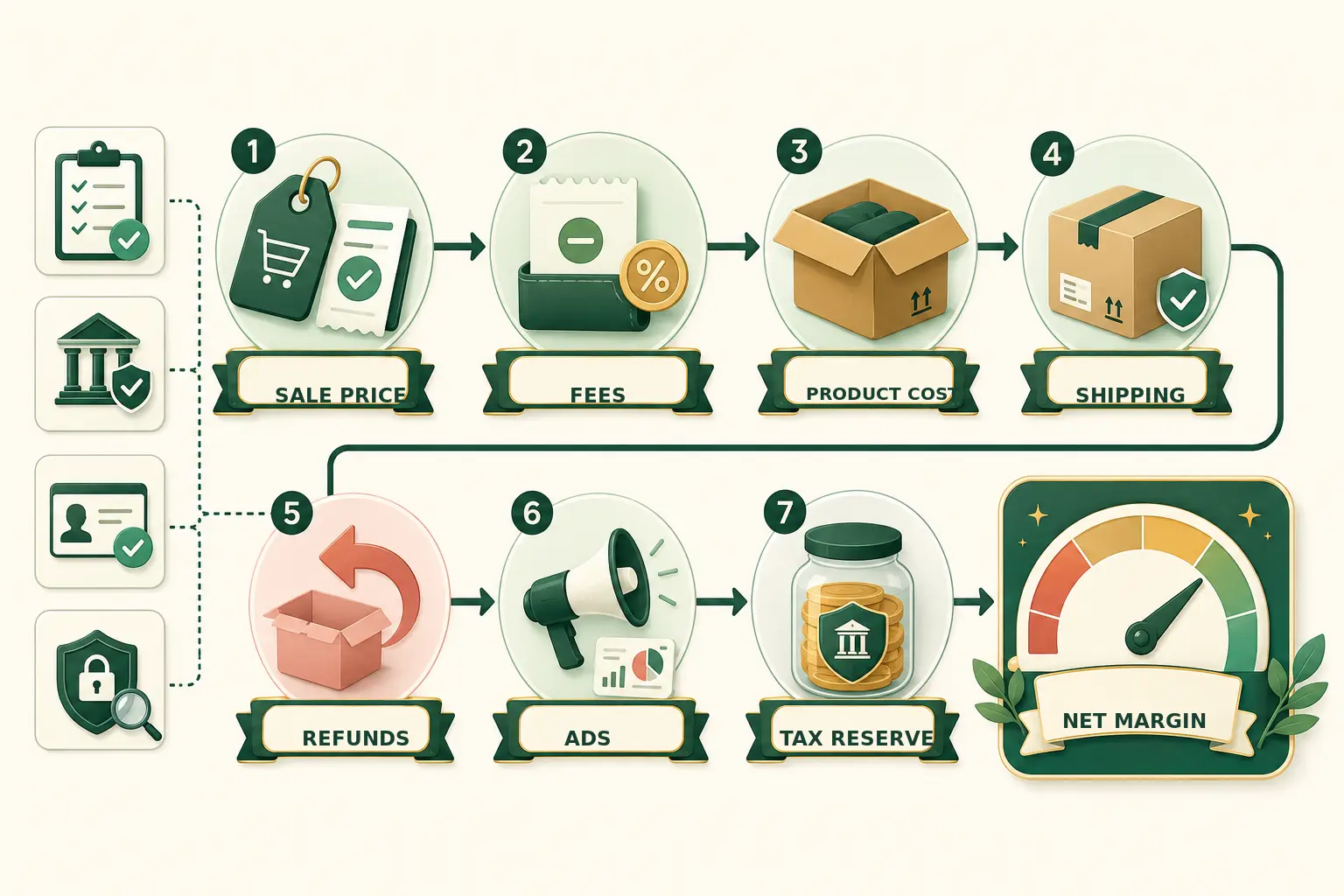
Sales revenue
minus marketplace and payment fees
minus product cost
minus shipping and packaging
minus refunds and chargebacks
minus advertising
minus other business costs
= estimated business profit before income and self-employment taxes
Online-selling profit example
| Line item | Amount |
|---|---|
| Revenue | $2,000 |
| Marketplace and payment fees | minus $260 |
| Product cost | minus $700 |
| Shipping and packaging | minus $240 |
| Advertising | minus $100 |
| Refunds | minus $80 |
| Estimated amount before taxes and other overhead | $620 |
This illustration is not a typical seller margin. Actual fees, costs, taxes, and return rates vary.
How are personal items treated differently from business goods?
If a personal item sells for less than its cost, the loss is generally not deductible. If it sells at a gain, the gain can be taxable. Business income and expenses follow different reporting rules.
Keep purchase records where available, sale records, marketplace reports, fees, refunds, shipping records, and other documents. Good records help explain whether a payment came from a personal item sold at a gain or loss, business inventory, a service, or another activity.
What are the current Form 1099-K reporting thresholds?
Form 1099-K does not decide whether income is taxable, and its gross amount is not business profit. The form may include fees, refunds, shipping, credits, discounts, or personal-item payments that require records and correct tax reporting.
Taxable business income must be reported even when no information form arrives. If a form includes personal transactions, an incorrect gross amount, or a payment that does not belong to you, follow the IRS correction and reporting steps rather than ignoring it. Use the Taxes hub to organize the broader filing work.
Which selling route fits the product and operating plan?
Online selling can overlap with the Gig Economy guide, especially when the product is a service or platform-arranged task.
Which marketplace fees can change the result?
Read the full fee schedule before selecting a marketplace. Costs may include:
- listing and transaction fees,
- payment-processing fees,
- advertising fees,
- shipping-label costs,
- subscription plans,
- currency conversion,
- storage or fulfillment fees,
- return costs, and
- penalties or reserve holds.
Run the math using the expected selling price and order size. A low headline fee can still lead to a higher total cost after mandatory charges.
When can online sales create state tax duties?
State and local rules vary. The U.S. Small Business Administration notes that a physical or economic presence in a state can create a duty to collect applicable sales tax. This connection is often called nexus, and each state can set its own standards.
Marketplace-facilitator laws may place some collection duties on a marketplace. That does not mean a seller has no registration, income-tax, business-license, annual-report, or other state duties. Check the revenue and business agencies for the states where the business operates or has enough activity to create a filing question.
What does the INFORM Consumers Act require from some sellers?
The federal INFORM Consumers Act can apply to high-volume third-party sellers of new or unused consumer products on covered online marketplaces. A covered marketplace may need to collect and verify banking, contact, and tax-ID information.
The federal definition generally covers a seller that reaches at least 200 separate sales or transactions and $5,000 in gross revenue during a continuous 12-month period within the prior 24 months. Only qualifying sales on the covered marketplace count, and the law contains definitions and exemptions that matter.
Some higher-volume sellers can face consumer-facing disclosure requirements. A marketplace may also require verification beyond the federal minimum. When asked for sensitive information, enter through the known marketplace site or app, not an unexpected email or text link.
How should sellers plan for returns, chargebacks, and fraud?
Build expected losses into pricing. Online sellers can face returns, lost packages, damaged shipments, card disputes, friendly fraud, counterfeit-payment attempts, account takeover, and marketplace suspension.
- Write a return policy that matches applicable law and platform rules.
- Keep proof of shipment and delivery when it may help resolve a dispute.
- Review unusual orders before shipping high-value products.
- Do not rely only on a payment screenshot.
- Keep business records outside the marketplace account.
- Use the Hacked Now guide if account access is compromised.
If a purchase, payment, or return creates a consumer-loss dispute, the Get My Money Back guide covers records and recovery paths.
Which advertising and review rules apply online?
Federal truth-in-advertising standards apply online. Product descriptions, performance claims, discounts, testimonials, and reviews should not mislead buyers.
Material connections with influencers or affiliates may need clear disclosure. Do not buy fake reviews or require a positive review as a condition of an incentive. Shipping promises and refund handling can also be governed by federal rules, platform policies, and state law.
What seven steps can a new online seller take?
- Define what you are selling and whether it is personal resale or business activity.
- Calculate product-level profit after fees and fulfillment.
- Choose a route based on customer demand, control, and total cost.
- Set up records for purchases, inventory, sales, fees, refunds, and taxes.
- Check licenses, sales-tax, marketplace, and identity-verification requirements.
- Write shipping, return, privacy, and customer-service procedures.
- Test with a small group of listings before committing large inventory or advertising spend.
Selling online FAQs
Do I owe tax on everything I sell online?
Not necessarily. Business profit is generally taxable, and a personal item sold at a gain can create taxable gain. A personal item sold for less than its cost generally does not create a deductible loss.
Will I get Form 1099-K?
You may. Many third-party settlement organizations must issue it when goods-and-services payments exceed $20,000 and more than 200 transactions, but a form may be sent below that threshold. Payment-card transactions follow separate reporting rules.
Does Form 1099-K mean the entire amount is profit?
No. The form generally reports gross payments, not deductible business expenses or the cost basis of personal items.
Do marketplaces handle all sales tax for sellers?
Do not assume they do. Marketplace-facilitator rules may handle collection in some cases, while a seller can still have registration, business, income-tax, license, or reporting duties.
What is a high-volume third-party seller under the INFORM Consumers Act?
The federal definition generally uses 200 or more transactions and $5,000 or more in gross revenue for new or unused consumer products on a covered marketplace during the stated period, subject to the law’s definitions and exemptions.
Which records should an online seller keep?
Keep purchase and inventory records, sales, marketplace reports, fees, refunds, shipping, advertising, tax forms, and customer-dispute documents. Retention needs vary by record and law.
- IRS: Understanding Form 1099-K
- IRS: What to do with Form 1099-K
- Federal Trade Commission: INFORM Consumers Act guidance for sellers
- Federal Trade Commission: Online advertising and marketing
- U.S. Small Business Administration: State and online sales tax duties
Tax, marketplace, advertising, and state rules can change. Check current federal and state guidance for the seller’s facts.