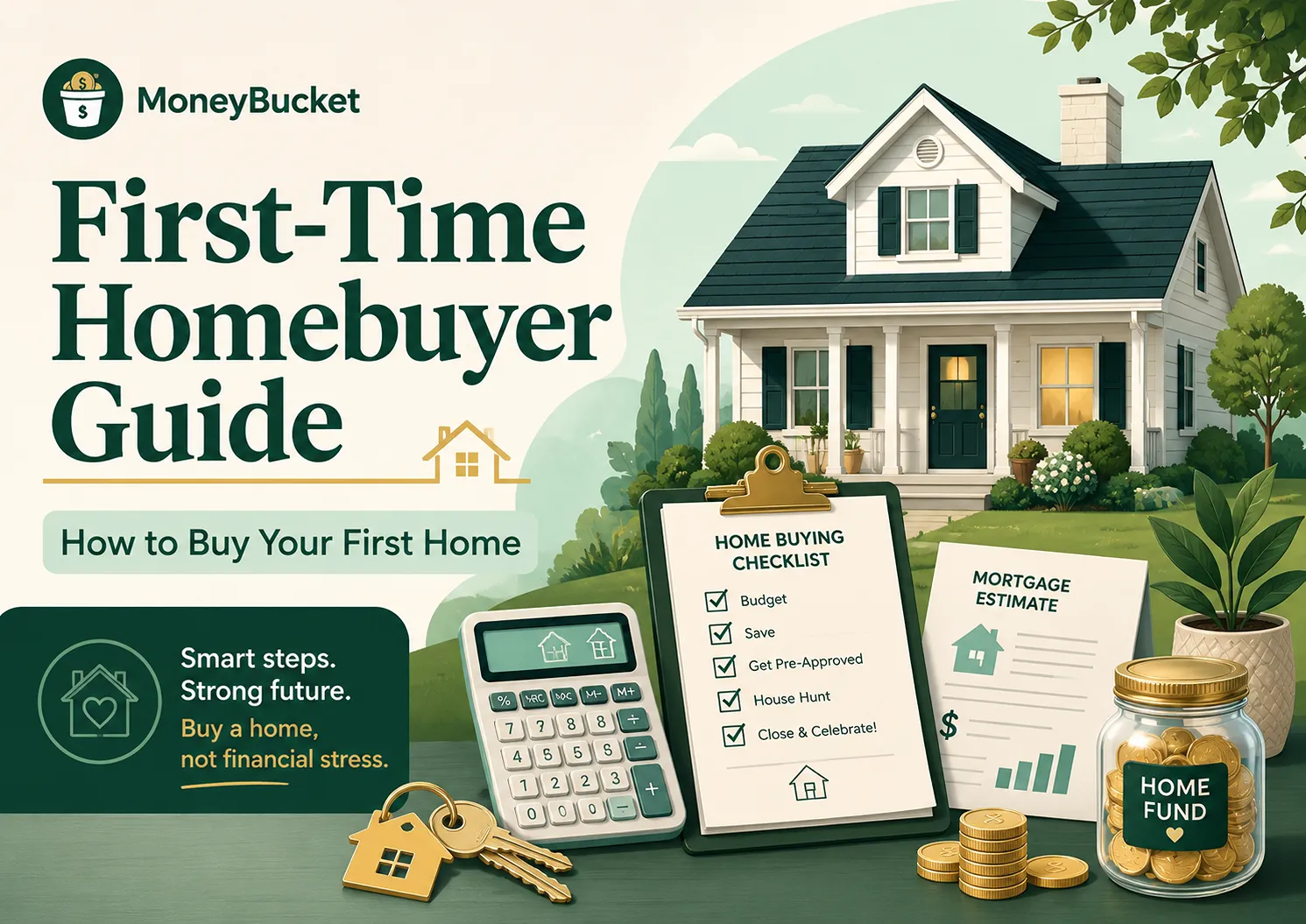
Buy Your First Home Without Letting the House Own You
Begin with the Saving and Investing guide to fit a home purchase into your wider financial plan. Buying your first home means balancing the down payment, closing costs, monthly payment, maintenance, insurance, taxes, and emergency savings. The CFPB’s home loan toolkit walks buyers through mortgage choices and closing costs.
First Question: Are You Ready to Buy?
Forget the idea that there is a magic age, salary or life milestone when you are supposed to become a homeowner. A better test is whether your finances can handle both buying the house and living in it afterward.
Income
Your income should be steady enough to handle the housing payment along with the rest of your normal expenses.
Savings
You need more than a down payment. Ideally, some cash remains available after closing for emergencies and the surprises that come with owning a home.
Debt
Existing debt does not automatically stop you from buying, but large monthly payments can squeeze both mortgage qualification and your day-to-day budget.
If buying would wipe out every dollar you have saved, work on your safety cushion first. Start with MoneyBucket’s Emergency Fund Guide and use the Budgeting Guide to see what a future housing payment would really do to your month.
Find Your Real Homebuying Number
A lender answers one question: how much might they lend you? You have a harder question to answer: how much can you spend on housing and still have a life?
Your Real Monthly Housing Cost
Start with the complete monthly picture, not just principal and interest.
Imagine the new housing cost leaving your bank account every month right now. Could you still build savings, handle a car repair, contribute toward retirement, buy groceries without stress and occasionally have fun? If the house works only when absolutely nothing goes wrong, the budget is too tight.
Try the payment before you buy the house
If your current housing costs are $1,500 and you think you can comfortably handle $2,300, try setting aside the extra $800 each month while you shop. You will build more cash for the purchase while learning whether that future payment actually feels comfortable. See How to Create a Household Budget for a deeper monthly spending plan.
How Much Cash Do You Need?
The down payment gets all the attention. Closing day has other ideas. Build your homebuying fund around the entire purchase rather than one number.
Do You Really Need 20% Down?
No. Twenty percent can be useful, but it should not be treated as a universal first-time homebuyer requirement. Mortgage programs have different down-payment rules and eligibility standards.
✓ A larger down payment may help you:
- Borrow less money
- Lower the monthly principal and interest payment
- Reduce certain mortgage-related costs
- Build more equity from day one
✕ But do not automatically:
- Empty your emergency fund
- Use every available dollar at closing
- Assume 20% is your only path to buying
- Ignore down-payment assistance programs
Instead of asking, “What is the biggest down payment I can make?” ask, “What down payment gives me a manageable mortgage while leaving enough cash to safely own the house?”
Know the Main Mortgage Paths
You do not need to become a mortgage expert. You do need enough knowledge to recognize that the first loan offered to you is not automatically the best loan for you.
Conventional Mortgage
A common mortgage path for buyers who meet lender requirements. Down-payment options, pricing and mortgage insurance can vary based on the loan and borrower.
FHA Loan
Government-insured financing that can be worth comparing for buyers who need a lower down-payment path or whose financial profile may fit FHA requirements.
VA Loan
Eligible veterans, service members and certain surviving spouses may have access to VA-backed financing with valuable homebuying benefits.
USDA Loan
Qualified buyers purchasing eligible properties may have access to USDA-backed financing. Property location and household eligibility rules matter.
Need the mortgage part explained without the alphabet soup?
Read MoneyBucket’s Mortgage Guide for more help understanding mortgage types, applications and the borrowing process.
Shop for the Mortgage Too
You are probably going to compare dozens of houses. Give the financing at least some of that attention. Compare more than the advertised interest rate. Look at the payment, fees, points, lender credits, mortgage insurance when applicable and the cash you need to close.
Your First-Time Homebuyer Roadmap
Here is the buying process stripped down to the decisions that matter most.
Get Your Money Ready
Review your budget, savings, income, credit and existing debt. Fix credit-report errors early and avoid taking on unnecessary new debt while preparing for a mortgage.
If debt is crowding out your ability to save, visit MoneyBucket’s Debt Management Hub.
Choose Your Personal Price Ceiling
Set the maximum monthly housing cost you want before a lender tells you the maximum loan they might approve. Your number should win.
Check Assistance Programs
Look for first-time buyer and down-payment assistance programs before you are deep into a purchase. Programs may have income limits, education requirements, participating lenders, property restrictions or other rules.
Get Preapproved and Compare Lenders
Preapproval can help you understand your financing range and show sellers that you are a serious buyer. Treat the approval amount as a ceiling, not a shopping assignment.
Shop for the Right Home
Separate needs from wants. Look beyond countertops and paint colors to taxes, insurance, commuting costs, major systems, maintenance, location and property condition.
Make an Offer Without Losing Your Mind
Set your maximum before negotiations become emotional. A bidding war can make another $10,000 feel tiny in the moment. It will feel considerably more real when you are the one repaying it.
Inspect What You Are Buying
A beautiful backsplash tells you very little about the roof, foundation, plumbing, electrical system or HVAC. Understand the condition of the expensive parts before the home becomes your expensive problem.
Review Everything Before Closing
Check the final numbers, complete your walkthrough, follow trusted closing instructions and ask about anything you do not understand. This is one of the biggest purchases of your life. Questions are free. Surprises are not.
What to Check When You Tour a House
The staging is designed to make you picture Christmas morning in the living room. Your job is to picture an ordinary Wednesday and a rainy Saturday when the basement starts smelling suspicious.
Location
Commute, traffic, parking, noise, nearby services and the things you regularly need.
Condition
Roof, foundation, windows, plumbing, electrical, HVAC, water intrusion and major repairs.
Carrying Cost
Taxes, insurance, HOA charges, utilities and maintenance can change the affordability equation.
Ugly paint is cheap. A failing roof is not. Outdated cabinet hardware is cheap. Foundation problems are not. Try not to reject a financially sensible house over easy cosmetic work while ignoring expensive structural or mechanical problems in a prettier one.
First-Time Homebuyer Traps Worth Avoiding
Buying the Approval Amount
A lender’s maximum is not your personal affordability number.
Emptying Your Savings
The house can need money almost immediately after closing. Keep a cushion when you can.
Counting Only the Mortgage
Taxes, insurance, utilities, fees and maintenance can make the real housing cost much larger.
Falling in Love Too Early
The perfect house becomes less perfect when emotion convinces you to ignore the price or condition.
Taking the First Loan Offered
Mortgage costs can differ. Compare offers and understand what you are paying.
Financing Everything Before Closing
Try not to celebrate mortgage approval by opening new accounts and financing a houseful of furniture before the purchase is complete.
Your Closing-Week Checklist
- Review the final mortgage terms and payment.
- Confirm how much cash you need for closing.
- Verify closing and payment instructions through trusted contacts.
- Complete the final walkthrough.
- Confirm agreed-upon repairs or property conditions.
- Avoid unnecessary new borrowing before the transaction closes.
- Keep copies of important purchase and loan documents.
- Know where your remaining emergency savings will live after closing.
The First Year: Your House Has a Budget Now
You got the keys. Great. Your checking account would now like a word.
Rebuild Cash
Start replenishing savings used during the purchase. Homeownership makes an emergency fund even more useful.
Start a Home Fund
Set aside money for maintenance and repairs so every broken appliance does not become a credit-card emergency.
Wait on Big Projects
Live in the house before spending heavily on renovations. You may discover that your priorities change once the house is part of everyday life.
Learn where the main water shutoff is before you need it. Future you, standing in an unexpected indoor waterfall at 11:47 p.m., will be deeply grateful.
First-Time Homebuyer FAQ
How much money do I need to buy my first home?
There is no one-size-fits-all amount. Your cash needs depend on the home’s price, mortgage, down payment, closing expenses and any assistance you receive. Remember to budget for moving, immediate repairs and money you want left in savings after closing.
Do first-time homebuyers need 20% down?
No. Different mortgage programs offer different down-payment requirements. Compare the cost of each option rather than assuming you must wait until you have saved 20%.
Should I pay off debt before buying a house?
Reducing costly debt can free up monthly cash and may improve your borrowing position, but you do not necessarily need to be completely debt-free. Compare your debt payments, savings, expected housing cost and cash reserves as one financial picture. Visit the Debt Management Hub if debt is limiting your options.
Should I get preapproved before looking at houses?
Preapproval can help define your financing range and can make you better prepared when you find a home you want. Your personal spending limit can still be much lower than the amount a lender is willing to finance.
Should I use all my savings for a bigger down payment?
Usually, you should consider what cash will remain after closing before putting every available dollar into the purchase. A homeowner with no savings can be one broken furnace away from expensive debt.
Is buying always better than renting?
No. Buying may make sense when you are financially ready, the home fits your budget and ownership fits your plans. Renting may make more sense when you need flexibility, expect to move, have limited cash reserves or would have to stretch too far to purchase.
What should I do first if I want to buy a house?
Start with your finances rather than property listings. Review your budget, emergency savings, debt and expected monthly housing limit. From there, learn your mortgage choices, check assistance programs and begin comparing lenders.
Buy a Home That Leaves Room for Your Life
Your first home does not need to prove anything. Run the full cost. Compare financing. Protect your savings. Inspect the property. Read what you sign.
Then buy the home that gives you something better than the biggest address you can finance: enough money left over to enjoy living there.