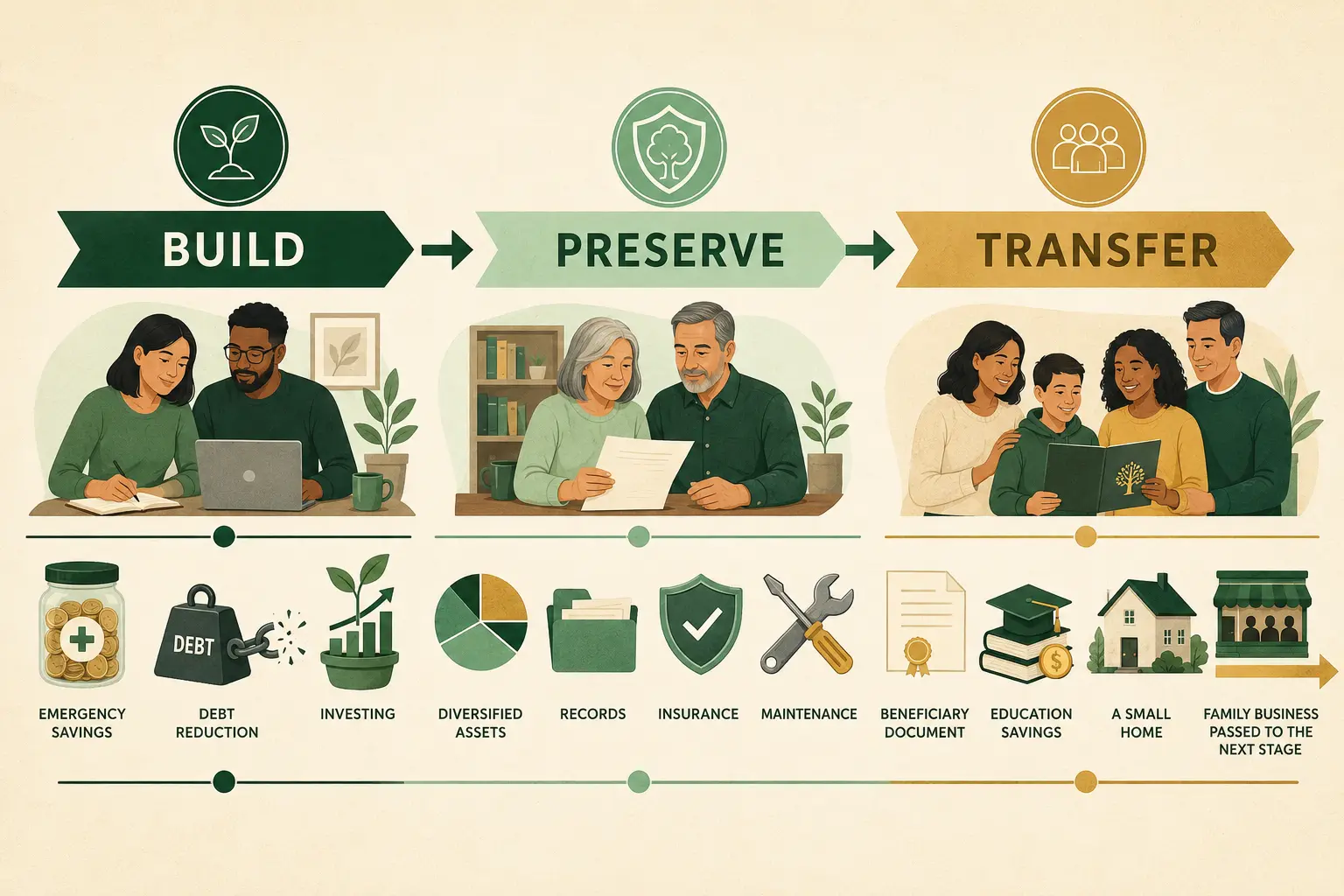
“Old money” is an informal label for wealth that has been owned and transferred within a family across multiple generations. It is not a legal, tax, or accounting category. The Earning Money guide covers ways to build income today. Here, the more useful idea is generational wealth: assets, businesses, property, education, or other financial resources that can benefit a later generation.
What does old money mean?
Old money usually describes inherited or long-established family wealth. The phrase may refer to assets that have passed through multiple generations, but it does not say how large those assets are, how they are managed, or whether they will last.
The Federal Reserve’s Survey of Consumer Finances tracks intergenerational transfers in forms that include inheritances, trusts, gifts, financial assets, real estate, and businesses. The Fed’s research shows that transfer amounts vary widely. That evidence is more useful than treating inherited wealth as one uniform social group.
How is old money different from new money?
“New money” is another informal label. It usually refers to wealth created more recently through a business, career, investment gain, intellectual property, or another source.
| Term | Common meaning | What the label does not tell you |
|---|---|---|
| Old money | Wealth inherited or held across multiple generations | Asset value, debt, cash flow, diversification, or durability |
| New money | Wealth created more recently by a person or family | How the wealth was earned, invested, protected, or spent |
| Generational wealth | Assets or advantages transferred to a later generation | Whether the transfer is large, permanent, equal, or free of legal and tax issues |
None of these terms proves that a household is financially healthy. The label does not reveal debt, spending, risk, legal ownership, or whether heirs can maintain the assets.
What can count as generational wealth?
Family resources can move between generations in many forms:
- A family business or ownership interest
- Real estate
- Cash and bank accounts
- Stocks, bonds, and investment funds
- Retirement assets with beneficiaries
- Life-insurance proceeds
- Trust assets
- Intellectual property or royalties
- Education funding
- Valuable personal property
The Federal Reserve’s research on family finances notes that direct transfers include both financial and nonfinancial assets, such as real estate or a business. It also describes indirect help, including education and home-purchase support.
How an asset transfers depends on ownership, beneficiary designations, estate documents, federal and state tax rules, and state law. Get qualified legal and tax advice for a transfer plan.
Why does inherited wealth sometimes disappear?
A large inheritance does not guarantee lasting security. Wealth can shrink because of:
- Concentrated investments
- Spending above sustainable cash flow
- Business losses
- High or poorly structured debt
- Taxes and transaction costs
- Family conflict
- Outdated beneficiary designations or estate documents
- Fraud
- Legal disputes
- Failure to maintain property or a business
Long-term preservation often depends on ordinary financial disciplines: controlling spending, keeping accurate records, maintaining assets, reviewing insurance, planning for taxes and legal ownership, and spreading investment risk.
Investor.gov explains that asset allocation depends on time horizon and risk tolerance. Its guidance also warns that diversification cannot prevent every loss, but it can reduce dependence on a single investment.
What does building generational wealth look like for a household?
Generational wealth does not require a famous surname or a large inheritance. It can begin with a household system that makes the next generation less financially fragile.
- Build an emergency reserve. Cash can keep a repair, medical bill, or income interruption from becoming expensive debt.
- Reduce high-cost debt. Lower interest costs can free cash for saving and ownership.
- Save and invest consistently. Use goals, time horizon, risk tolerance, fees, and diversification to guide the plan.
- Keep beneficiaries current. Review beneficiary forms after marriage, divorce, birth, death, or another major change.
- Maintain basic estate documents. State law governs many details, so use qualified counsel.
- Protect key assets. Review property, liability, life, disability, and business risks that apply to the household.
- Teach the household money system. Records and clear instructions help later generations understand assets, bills, insurance, and professional contacts.
The practical lesson is not to copy an old-money aesthetic. It is to build assets that are durable, understandable, and connected to the people and purposes you care about.
Which MoneyBucket guides can help?
- Emergency Fund for the first layer of household resilience
- How to Start Investing for account and investment basics
- Investment Risk for diversification, liquidity, and concentration checks
- Estate Planning Checklist for questions and documents to review with qualified professionals
Frequently asked questions
Is old money a legal or financial category?
No. It is an informal social label. Ownership, tax, estate, and accounting rules use defined legal and financial terms instead.
How many generations does wealth need to last to count as old money?
There is no official threshold. The phrase generally means wealth held across multiple generations, but its use depends on context.
Can a modest home count as generational wealth?
Yes. Generational wealth can include a home, education funding, a business, investment accounts, or another resource that benefits a later generation.
Does inherited wealth guarantee financial security?
No. Debt, taxes, poor cash flow, concentration, fraud, disputes, spending, and weak planning can reduce or eliminate inherited assets.