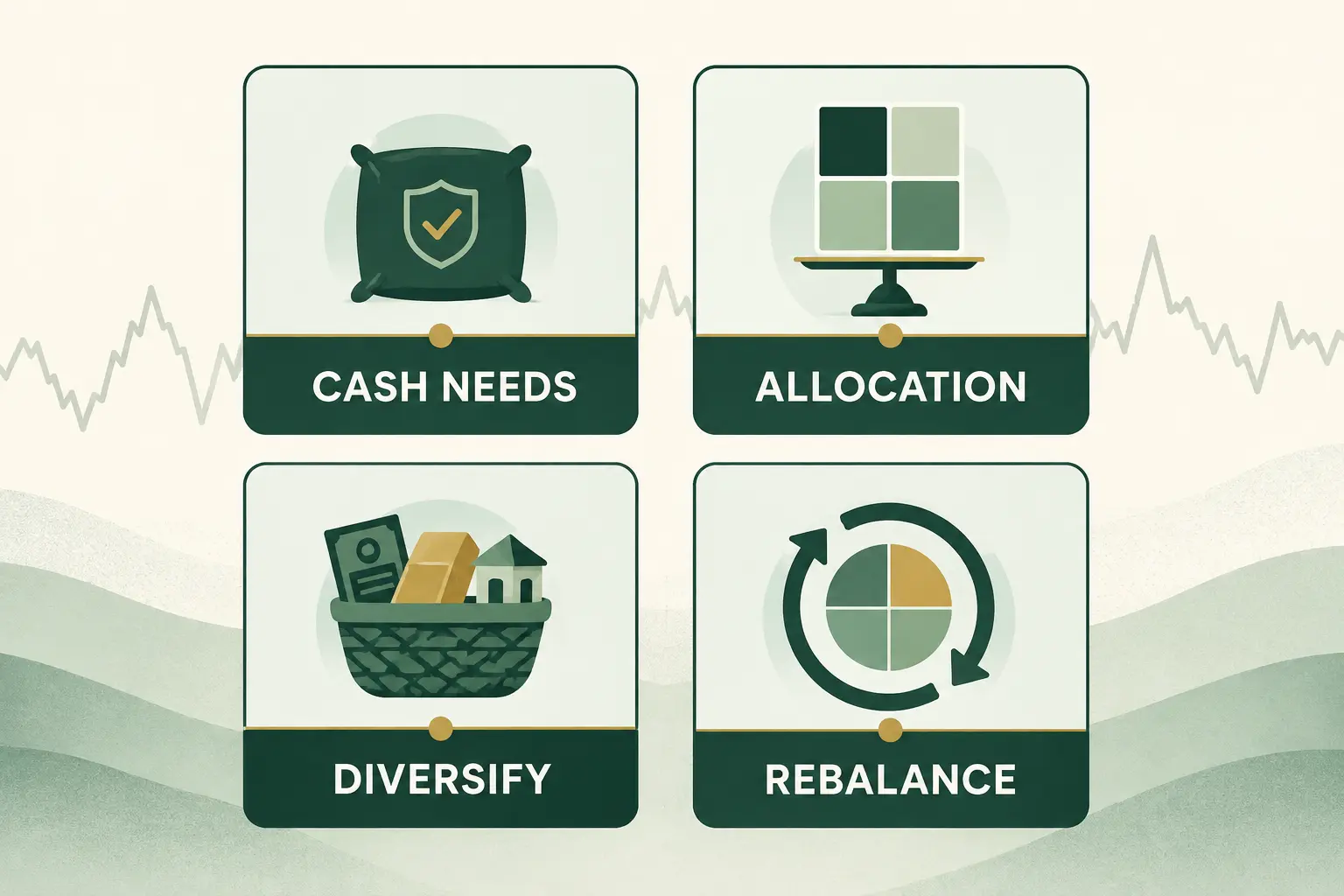
The MoneyBucket Saving & Investing hub starts with goals, risk and time. Those anchors matter more when prices are moving fast. A market decline may call for a review, but it does not tell you where the bottom is or which asset will recover first.
Your first job is to separate a change in your life from a change on a screen. If your income, cash needs, time horizon or ability to absorb loss has changed, the plan may need work. If only the account balance changed, check the written plan before making a trade.
What should you do during market volatility?
Protect money needed soon, confirm your time horizon and asset allocation, measure concentration, and follow written rules for contributions and rebalancing. Do not borrow to buy a dip. Do not assume a falling asset is cheap. Check unfamiliar investments and sellers through official records before sending money.
Economic volatility and market volatility are not the same
Economic volatility
Changes in inflation, interest rates, employment, growth, credit conditions or business activity can affect household income and expenses.
Market volatility
Investment prices move up and down, sometimes sharply. Different stocks, bonds, funds and other assets can react in different ways.
The two can overlap, but they do not create a reliable trading signal. A weaker economy does not reveal the market’s lowest point. A market decline does not prove that every asset is a bargain. Build your response around the parts you can check.
1. Protect cash needed before the market has time to recover
Start outside the brokerage account. List the money you may need for essential bills, a job interruption, insurance deductibles, a home or car repair, tuition, a home purchase or another near-term goal.
Money with a short deadline should not depend on a quick market recovery. The right amount and location depend on the goal, account rules, household income and access needs. If the emergency reserve is thin, use the MoneyBucket emergency fund guide to set a cash target and milestones.
2. Match the allocation to the goal, time horizon and loss capacity
Asset allocation is how investments are divided among categories such as stocks, bonds and cash. Investor.gov explains that the mix is personal and depends in part on the investing time frame and risk tolerance.
Ask four separate questions:
- Goal: What must this money do?
- Time horizon: When might withdrawals begin?
- Loss capacity: Could a decline force a sale or damage an essential goal?
- Risk tolerance: Can you stay with the chosen mix when the balance falls?
Feeling nervous is not, by itself, a new time horizon. Feeling fearless is not proof that a concentrated portfolio is safe. Use the MoneyBucket investment risk guide to review liquidity, loss capacity, concentration and the risks attached to each holding.
3. Measure concentration before adding to a falling position
Diversification spreads money among investments. It can reduce the damage caused by one company, sector or asset failing, but it cannot prevent all losses.
Check how much of the portfolio depends on:
- One employer’s stock
- One company or industry
- A small group of technology, energy or financial companies
- Crypto assets or another highly volatile category
- One rental market or property type
- Private deals that are hard to value or sell
Then look inside funds. Owning several funds does not ensure diversification when they hold many of the same companies. Investor.gov’s asset allocation and diversification guide explains the role of both allocation across asset types and diversification within them.
4. Decide contribution rules before the next rough week
A scheduled retirement-plan contribution or automatic investment can remove day-to-day guessing. If income, debt, emergency savings and the goal are still on track, the existing schedule may still fit. Market movement alone does not require a new contribution plan.
Pause and recalculate when the household facts changed. A layoff, reduced hours, new high-interest debt, a drained emergency fund or a shorter goal deadline can change how much is safe to invest.
Do not create a large automatic purchase in a panic simply because prices fell. Write the amount, frequency, account and conditions for changing it. If you are still building the basics, start with MoneyBucket’s beginner investing steps.
5. Rebalance by a written rule, not a headline
Rebalancing returns a portfolio to its chosen asset mix after price changes pull holdings away from their targets. Investor.gov notes that some people use a calendar interval while others act when an asset category moves beyond a preset band.
A written rule should state:
- The target percentage or range for each asset category
- How often the portfolio will be checked
- How far a category may drift before action is considered
- Whether new contributions can restore the mix
- How taxes, trading costs and account rules will be reviewed
Rebalancing is not a promise that the market will turn. It is a way to return risk to the level chosen for the goal. Tax effects can differ between taxable and tax-advantaged accounts, so check them before selling.
6. Keep margin and other borrowed money out of a dip-buying decision
Borrowing magnifies the result in both directions. Investor.gov warns that a margin investor can lose more than the amount invested, face a demand for more cash or securities, and have holdings sold by the brokerage firm without consultation.
The danger grows during a fast decline. The loan remains, interest continues and the broker’s action can remove the choice to wait. Credit-card cash advances, personal loans and home-secured borrowing add their own rates, fees and repayment risks.
7. Separate job and income risk from investment risk
A household can be concentrated even when the investment account looks varied. If your pay, bonus, health insurance and stock holdings all depend on one employer or industry, one downturn can hit income and investments together.
Review:
- Employer stock inside and outside a retirement plan
- Unvested equity and bonus assumptions
- The emergency reserve if job replacement may take longer
- Insurance deductibles and coverage tied to employment
- Upcoming expenses that assumed a bonus or stock sale
These checks may support a different cash reserve or a lower employer-stock concentration. They do not tell you what the market will do next.
8. Research unfamiliar investments and urgent crisis pitches
Uncertainty gives dishonest sellers an opening. Be careful with a pitch that uses urgency, secret access, guaranteed returns, steady gains in every market or pressure to move money away from a regulated account.
Before sending money:
- Write down the legal name of the investment, seller and firm.
- Check the seller or professional through Investor.gov’s background-check links.
- Read the registration filing, offering document, fees, withdrawal limits and loss risks.
- Confirm the website and phone details independently. Do not rely on contact information supplied in a message.
- Stop if the seller blocks questions or demands an immediate transfer.
The SEC has warned that fraudsters use periods of uncertainty to attract victims. Its investment scam alert lists guaranteed high returns, unregistered sellers and unusually steady performance as warning signs.
Run a complete financial review, not only a portfolio review
- Cash for near-term goals and emergencies is separate from long-term investments.
- High-interest debt and upcoming bills are included in the monthly plan.
- Retirement contributions still fit current income and cash flow.
- The asset allocation still matches each goal and withdrawal date.
- Company, sector, employer-stock and speculative holdings are measured.
- Beneficiary designations match current wishes.
- Life, disability, health, home and auto coverage still match household risks.
- The rebalancing rule is written and taxes or fees are checked before trades.
| What changed? | Do not assume | Next check |
|---|---|---|
| Only market prices moved | A lower price proves value or marks the bottom | Compare current holdings with the written allocation and rebalancing rule |
| Income fell or work became less stable | The old contribution amount still fits | Review bills, cash reserves, debt and contribution capacity |
| A goal moved closer | The old risk level still fits the deadline | Review time horizon, liquidity and loss capacity |
| One holding became a larger share | Several account names mean the portfolio is diversified | Measure overlap and concentration across all accounts |
| A new seller promises safety and high returns | Urgency or a professional-looking site proves legitimacy | Check registration, filings, fees, access limits and seller history |
Market-volatility questions
Should I sell everything when the market falls?
A market decline alone does not answer that question. Check the goal, time horizon, cash needs, asset allocation, taxes, fees and ability to absorb loss. A sale may fit a changed plan, while a panic sale can turn a temporary decline into a permanent loss.
How do I know when the market has reached the bottom?
You cannot identify a market bottom in advance with certainty. Build decisions around the household facts you can measure, then use written contribution and rebalancing rules instead of a short-term forecast.
Is a falling stock automatically a bargain?
No. The price may have fallen because the company’s finances, industry or outlook changed. Review the investment’s current value, risks, fees and fit in the full portfolio. The old price is not proof of what it is worth now.
Should I keep investing the same amount during a downturn?
Keep or change a planned contribution based on income, emergency savings, debt, cash needs, goal and account rules. If those facts are stable, the existing schedule may still fit. If they changed, recalculate before sending more money.
How often should I rebalance?
There is no single schedule for every investor. Common methods include checking at set intervals or when an asset category moves beyond a preset band. Use a written rule and consider taxes, costs and account limits before trading.
Does diversification prevent losses?
No. Diversification can reduce the damage caused by one company, sector or asset, but broad markets and several asset categories can fall at the same time. It manages some risks rather than removing all risk.
Write the rule before the next headline
Start with four lines: cash needed soon, target allocation, contribution schedule and rebalancing trigger. Add the conditions that would make you review each one.
Sources and further reading
- Investor.gov: Asset Allocation and Diversification
- Investor.gov: Diversify Your Investments
- Investor.gov: Rebalancing
- Investor.gov: Understanding Margin Accounts
- Investor.gov: Tips for 2026
- Investor.gov: Investment Scam Complaints on the Rise
MoneyBucket provides general educational information, not individualized investment, tax or legal advice. Investments can lose value. Account rules, taxes, fees, insurance needs and household circumstances differ. Consider a qualified financial professional who is acting as a fiduciary and a tax professional when a decision depends on your full situation.