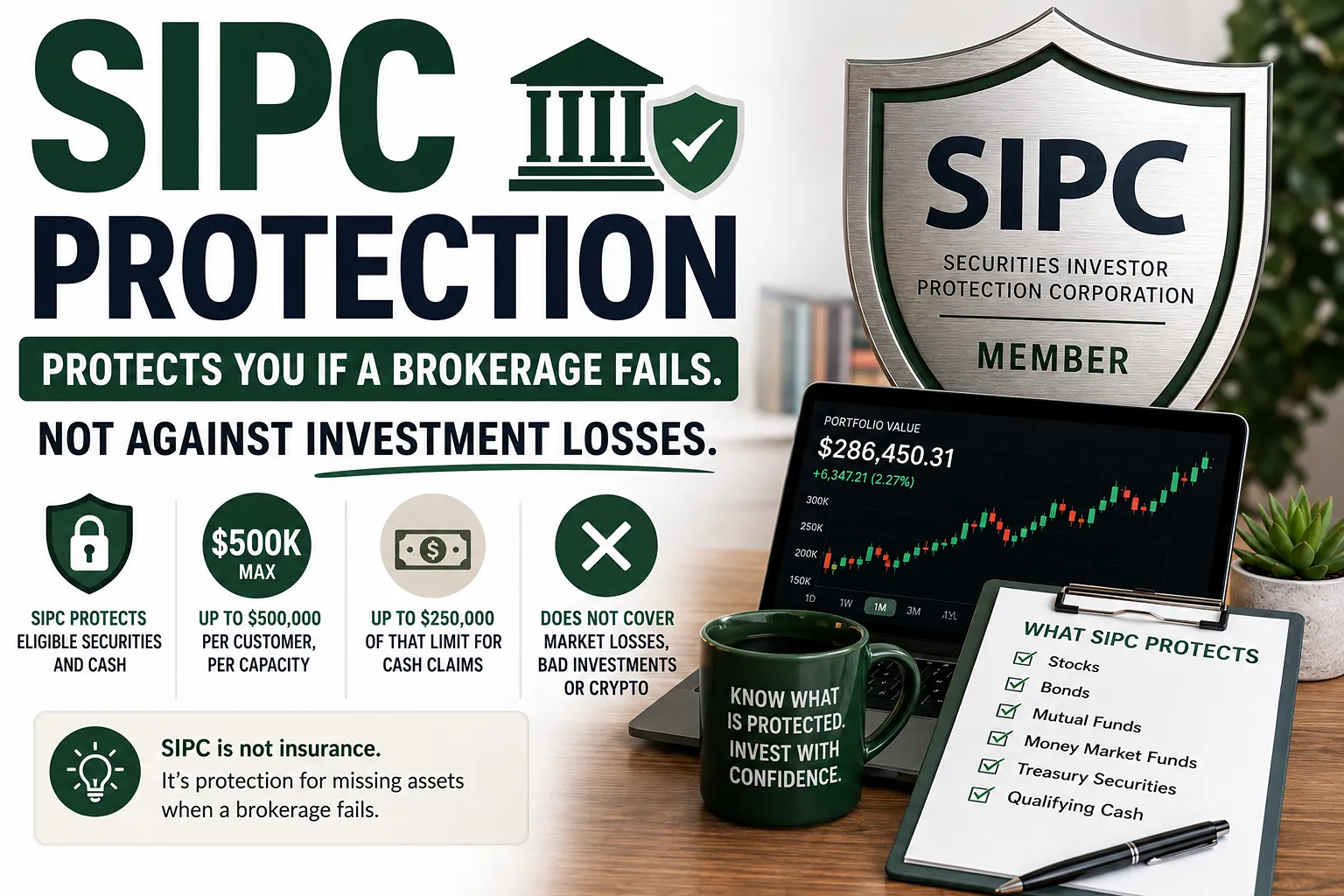
SIPC Protects You if a Brokerage Fails. It Does Not Protect You From a Bad Investment.
Begin with the Risk Management guide before relying on brokerage-account protections. SIPC may help restore missing cash and securities when a member brokerage fails, but it does not protect against market losses or every asset and account. The SEC explains how investors can verify SIPC membership and avoid look-alike sites.
The Fastest Way to Understand SIPC
Ask one question: Why is the money missing?
Your Brokerage Fails
Your statement says you own stocks, bonds or other protected securities, but the brokerage collapses and customer assets are missing.
SIPC protection may apply.
Your Investment Loses Value
You bought a stock for $100 and the market price falls to $40. The shares are still in your brokerage account.
SIPC does not reimburse the $60 market loss.
If an investment performs badly, a company goes bankrupt, the stock market crashes or you make a poor investment decision, SIPC does not restore your account to its old value.
How Much SIPC Protection Is There?
Standard SIPC Protection Limits
The $250,000 cash amount is part of the $500,000 total protection. It is not an extra $250,000 added on top.
If an eligible customer has $400,000 of missing protected securities and $50,000 of qualifying cash in one protected capacity, the combined $450,000 is within the standard $500,000 SIPC limit.
What Does SIPC Protect?
SIPC protection focuses on eligible securities and qualifying cash held for customers of a SIPC-member brokerage when the firm fails financially and customer property is missing.
Stocks
Shares of stock held as protected customer securities can fall within SIPC protection.
Bonds
Eligible bonds and Treasury securities can qualify as protected securities.
Mutual Funds
Mutual fund shares held at a SIPC-member brokerage can be protected customer securities.
Money Market Mutual Funds
A money market mutual fund is a security, not a bank deposit, and can receive SIPC treatment when held as protected customer property.
Treasury Securities
Eligible U.S. Treasury securities held through a SIPC-member brokerage can be protected.
Qualifying Cash
Cash held by the brokerage for the purpose of investing in securities can qualify, subject to the $250,000 cash limit.
What Does SIPC Not Protect?
📉 Market Losses
SIPC does not repay losses caused by an investment dropping in value.
🎯 Bad Investment Advice
SIPC protection is not a guarantee that a broker’s recommendation, investment strategy or financial advice will make money.
💱 Foreign Exchange Trades
Foreign exchange trades are not among the securities SIPC identifies as protected customer securities.
📊 Most Commodity Futures
Commodity futures contracts generally are not protected, subject to narrow exceptions under SIPC rules.
📄 Certain Unregistered Investments
Investment contracts that are not registered with the SEC may fall outside SIPC’s definition of a protected security.
🪙 Many Crypto Assets
Do not assume an asset receives SIPC protection merely because you can buy it through an investment app or brokerage.
Protection depends on the firm, the asset, how the asset is held and whether it meets the legal definition used under SIPC rules.
What Happens if a Brokerage Firm Fails?
A failed brokerage does not automatically mean every customer’s portfolio vanished. Brokerage firms are required to keep customer property separate under securities rules, and SIPC proceedings focus on returning customer property when assets are missing.
The Firm Fails
A SIPC-member brokerage becomes financially unable to meet obligations to customers.
A Liquidation Begins
A trustee can take control of the failed firm’s books, records and customer-property process.
Accounts May Be Transferred
Customer accounts can sometimes be transferred in bulk to another solvent brokerage firm.
Missing Property Is Addressed
Customer property is returned through the liquidation process, with SIPC advances available within applicable limits when protected assets are missing.
Customers may need to file a claim when their account is not transferred to another brokerage. Missing a required claim deadline can affect protection, so do not ignore notices connected with a brokerage liquidation.
Have Multiple Brokerage Accounts? The Account Title Matters
SIPC does not simply multiply $500,000 by the number of account numbers you have.
Protection is based on what SIPC calls separate capacity. Accounts held in the same capacity at the same brokerage are generally combined for SIPC-limit purposes.
Two Individual Accounts
You have two taxable brokerage accounts at the same firm, both held only in your name.
Those accounts do not automatically receive two separate $500,000 SIPC limits simply because the brokerage assigned two account numbers.
Individual + Joint + IRA
You have an individual account, a qualifying joint account and a traditional IRA at the same SIPC-member brokerage.
Those accounts can represent different capacities, with separate SIPC protection limits applying to each capacity under SIPC rules.
SIPC vs. FDIC: Similar-Sounding Protection for Different Problems
Bank Deposit Protection
FDIC insurance protects eligible deposits when an FDIC-insured bank fails.
- Checking accounts
- Savings accounts
- Money market deposit accounts
- Certificates of deposit
The standard FDIC insurance amount is $250,000 per depositor, per insured bank, for each ownership category.
Brokerage Customer-Property Protection
SIPC protection applies when a SIPC-member brokerage fails and eligible customer securities or qualifying cash are missing.
- Stocks
- Bonds
- Mutual funds
- Money market mutual funds
- Certain other protected securities
The standard SIPC limit is $500,000 per customer in each separate capacity, including up to $250,000 for qualifying cash claims.
A money market mutual fund is an investment security and can fall under SIPC protection at a qualifying brokerage. A money market deposit account is a bank deposit and can qualify for FDIC insurance at an insured bank.
Your Brokerage Cash May Not All Be Protected the Same Way
Many investment firms automatically move uninvested cash through a sweep program. Where the cash goes can determine whether FDIC insurance or SIPC protection is relevant.
Cash Left at the Brokerage
A qualifying free credit cash balance held at a SIPC-member broker for securities investing can receive SIPC protection, subject to the applicable cash and total limits.
Bank Sweep
Cash swept into participating FDIC-insured banks can receive FDIC deposit insurance under the bank sweep’s structure and applicable FDIC limits.
Money Market Fund Sweep
Cash invested into a money market mutual fund becomes an investment in a security. At a SIPC-member brokerage, eligible shares may fall under SIPC protection rather than FDIC insurance.
The cash balance visible on an investing app may actually sit at a bank, remain at the brokerage or be invested in a money market fund. Those arrangements can have different interest rates, risks and protections.
Does SIPC Protect Cryptocurrency?
Do Not Assume It Does
SIPC says it does not protect a digital or crypto asset that does not qualify as a security under the Securities Investor Protection Act.
Digital asset investment contracts that are not registered with the SEC do not qualify as SIPA securities simply because they are held by a SIPC-member brokerage.
The practical rule is simple: seeing “Member SIPC” at a company does not mean every crypto asset or crypto-related product offered through that company receives SIPC protection.
First ask whether the firm handling the account is a SIPC member. Then ask whether the actual asset is protected under SIPC rules. Do not stop after answering only the first question.
How to Check Your Brokerage Protection Before You Need It
- Confirm that the legal brokerage entity holding your securities is a SIPC member.
- Do not rely only on an app’s brand name. Find the actual broker-dealer named in the account agreement and statements.
- Understand whether your account is individual, joint, IRA, Roth IRA, trust or another capacity.
- Find out where uninvested cash is swept.
- Know whether cash is receiving SIPC protection, FDIC insurance or another treatment.
- Review your brokerage statements for missing securities or unauthorized activity.
- Save statements and trade confirmations so you have records of what the firm says you own.
- Understand the protection status of crypto or unusual investments before buying them.
Review brokerage statements instead of treating them as inbox clutter. Make sure holdings, trades, withdrawals and cash balances match what you expect.
SIPC Protection Does Not Replace Investment Risk Management
SIPC can help with a very particular disaster: a failed brokerage with missing eligible customer property.
It does not solve the much more ordinary ways investors lose money.
Owning Too Much of One Investment
A brokerage can operate perfectly while an undiversified portfolio loses enormous value. Use the investment risk guide to review the market and portfolio risks that remain even when brokerage-failure protection applies.
Buying Something You Do Not Understand
SIPC membership does not turn a complicated or speculative product into a safe investment.
Falling for Fraud
SIPC protection is not a universal reimbursement fund for every investment scam or fraudulent transaction.
Paying Too Much in Fees
A protected brokerage account can still quietly lose purchasing power to high fees, poor investment choices or unnecessary trading.
For the investing side of the equation, use MoneyBucket’s Investing Money Guide.
SIPC Protection FAQ
What is SIPC?
The Securities Investor Protection Corporation is a nonprofit corporation created by Congress. It works to restore eligible customer securities and qualifying cash when a SIPC-member brokerage firm fails financially and customer property is missing.
Is SIPC the same as FDIC insurance?
No. FDIC insurance protects eligible bank deposits at FDIC-insured banks. SIPC protection addresses eligible customer securities and qualifying cash when a SIPC-member brokerage fails and customer property is missing.
How much does SIPC protect?
Standard SIPC protection is limited to $500,000 for securities and cash per customer in each separate capacity at a member brokerage, including a $250,000 limit for claims for cash.
Does SIPC cover stock market losses?
No. SIPC does not reimburse you because stocks, bonds, funds or other investments decline in market value.
Does SIPC protect cash in a brokerage account?
Qualifying cash held at a SIPC-member brokerage for the purpose of purchasing securities can receive SIPC protection, with a $250,000 limit for cash claims inside the overall $500,000 limit. Cash moved into a bank sweep may instead receive FDIC insurance under applicable bank-deposit rules.
Are money market funds FDIC insured?
Money market mutual funds are investment securities, not bank deposit accounts, so they are not FDIC-insured deposits. Eligible money market mutual fund shares at a SIPC-member brokerage can receive SIPC treatment if the brokerage fails and protected customer assets are missing.
Do I get $500,000 of SIPC coverage for every brokerage account?
Not simply because you have multiple account numbers. SIPC groups accounts according to separate capacity. Two individual accounts held in the same name at the same brokerage are generally combined for protection-limit purposes, while recognized separate capacities can receive separate protection.
Are an IRA and Roth IRA separately protected by SIPC?
SIPC identifies a traditional IRA and a Roth IRA as separate capacities, so each can qualify for its own applicable SIPC protection limit when held at the same member brokerage.
Does SIPC protect Bitcoin or cryptocurrency?
Do not assume that it does. SIPC says digital or crypto assets that do not qualify as securities under SIPA are not protected. An unregistered digital asset investment contract does not become SIPC-protected simply because it is available through a SIPC-member firm.
What happens if my brokerage shuts down?
If customer assets remain properly accounted for, they may be transferred to another brokerage. If a SIPC-member brokerage enters a SIPC liquidation and customer property is missing, the trustee works to recover and distribute customer assets, with SIPC advances available within legal limits for eligible claims.
How do I know if my brokerage is a SIPC member?
Check the legal broker-dealer named on your brokerage statements or account agreement against SIPC’s official member list. Do not assume every financial app, bank affiliate or investment service is itself the SIPC-member entity holding your assets.
SIPC Protects the Account System, Not Your Investment Decisions
Check that your brokerage is a SIPC member. Understand how your accounts are titled. Know where your cash sits. Keep your statements. Know which assets qualify.
Then remember the part SIPC cannot do for you: choose investments that make sense.