Should You Take Social Security at 62?
For related guidance, begin with the Retirement Planning Guide, then return here for this focused explanation. Age 62 is the first chance many workers get to claim Social Security retirement benefits. It is also the point where a rushed decision can lock in a smaller monthly payment for life. Filing early is not automatically a mistake, but it should solve a real problem or support a clear household strategy.
What Happens If You Claim Social Security at 62?
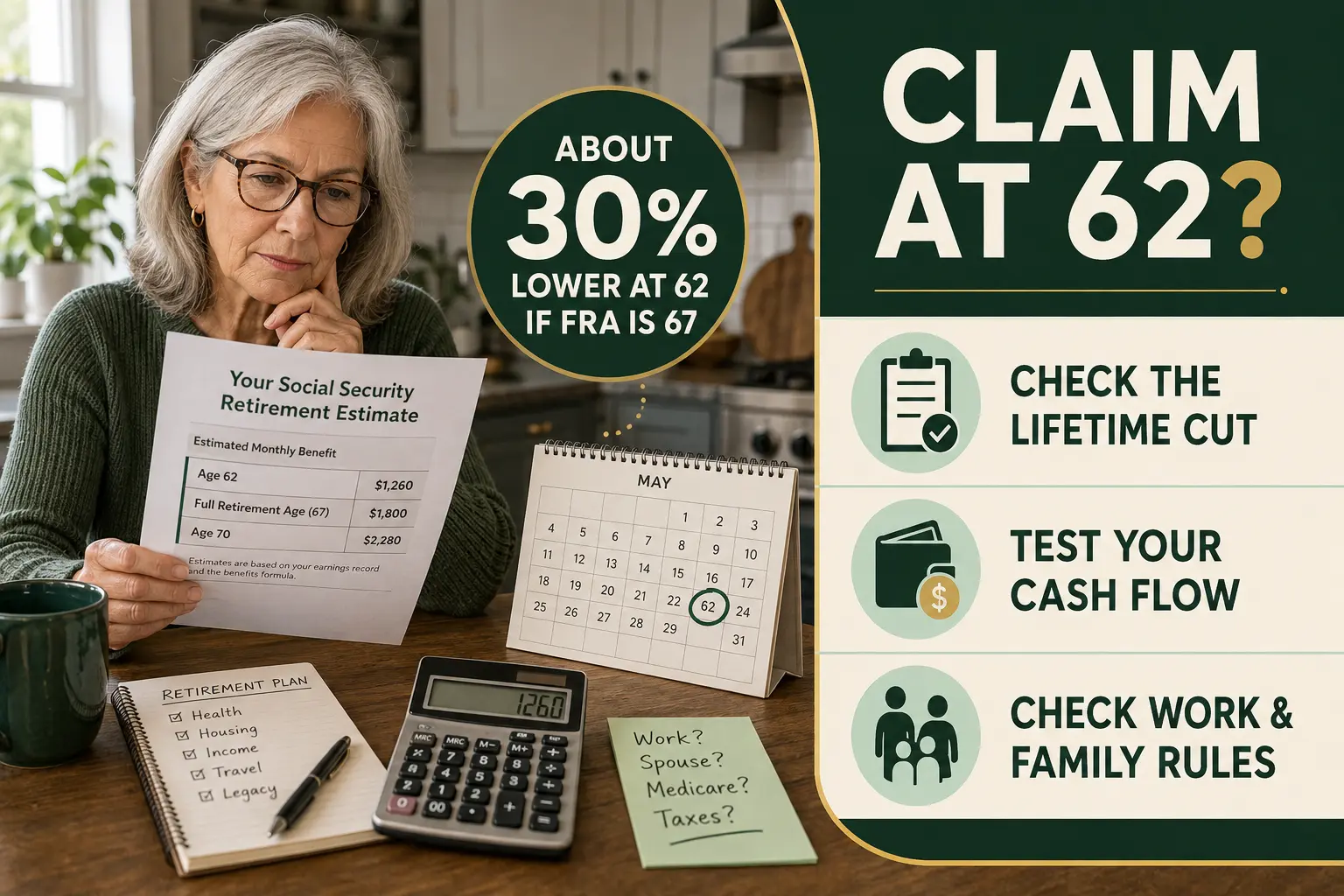
Social Security calculates a full retirement benefit based on your earnings record and full retirement age. For people born in 1960 or later, full retirement age is 67. Starting at 62 means accepting payments up to five years early, so the monthly amount is reduced.
| Claiming age | Approximate share of full benefit if FRA is 67 | If the full benefit is $2,000 |
|---|---|---|
| 62 | 70% | About $1,400 per month |
| 67 | 100% | $2,000 per month |
| 70 | 124% | About $2,480 per month |
These figures show the scale of the choice, not a personal estimate. Your actual payment depends on your earnings record, birth date, claiming month, and benefit type. Check your current estimate in your my Social Security account.
Does Your Birthday Change the First Month You Can Claim at 62?
Yes. Social Security’s retirement-benefit rules use an age-attainment convention that can make the day of the month matter. SSA says a person attains a particular age on the day before the birthday. For reduced retirement benefits at 62, the person generally must be age 62 throughout the entire month.
That means someone born on the first or second day of a month may be entitled to retirement benefits for the month of the 62nd birthday. Someone born later in the month generally cannot be entitled for that birthday month and may first qualify for the following month. This is an entitlement-month rule, not a reason by itself to claim early. Check your exact birth date, benefit estimate, filing month, and current SSA rules before applying.
Primary SSA sources: Retirement Benefits — Entitlement Requirements; How the Day of Birth Affects Benefits.
Seven Times Claiming at 62 May Make Sense
1. You Need Income for Essential Expenses
If work ends unexpectedly and savings cannot safely cover housing, food, insurance, and medicine, an early benefit may protect the rest of your finances. Compare the permanent reduction with the cost of draining an emergency fund, carrying high-interest debt, or selling investments during a poor market.
2. Your Health May Shorten Your Retirement
Poor health or a shorter family life expectancy can make earlier payments more valuable. This is not a simple break-even calculation. Consider whether a spouse may later depend on a survivor benefit, whether disability benefits could apply, and whether your savings can support a delay.
3. You Have Little or No Earned Income
Claiming while working can cause benefits to be withheld before full retirement age. If you have stopped working or earn below the annual limit, that rule may have little effect. In 2026, the limit is $24,480 for someone under full retirement age for the entire year. Social Security withholds $1 for every $2 earned above that amount.
4. Claiming Unlocks Benefits for Eligible Family Members
A child who is unmarried and under 18, age 18 or 19 and a full-time K-12 student, or who developed a qualifying disability before age 22 may receive a benefit on a retired parent’s record. A spouse caring for an eligible child may also qualify. Family payments are subject to a family maximum, commonly about 150% to 180% of the worker’s full benefit.
5. You Are Coordinating Survivor and Retirement Benefits
Survivor benefits follow different filing rules from ordinary spousal benefits. Someone eligible for both a survivor benefit and a retirement benefit may be able to claim one first and switch to the other later. This choice is valuable enough to confirm directly with Social Security before applying.
6. Your Household Has a Higher-Earning Spouse Who Plans to Delay
A lower earner may claim earlier while the higher earner delays, giving the household income now and allowing the larger retirement benefit to grow. The higher earner’s record often matters most to the future survivor, so both life expectancies and the surviving spouse’s income needs belong in the calculation.
7. You Have a Clear Plan for the Payments
Early claiming may support a sound plan when the payments cover a deliberate retirement-income gap and preserve other assets for a defined reason. It is much harder to defend when the money simply disappears into routine spending. Write down what the benefit will replace, how long it is needed, and what changes at full retirement age or age 70.
When Waiting Is Usually Stronger
- You can cover current expenses without costly debt or large retirement-account withdrawals.
- You are healthy, expect a long retirement, or want more protection against outliving savings.
- You are the higher earner in a married household and want to strengthen a future survivor benefit.
- You are still earning well above the retirement earnings-test limit.
- You have not yet compared your age-62, full-retirement-age, and age-70 estimates.
The 2026 Work Rule Before Full Retirement Age
| Your 2026 situation | Earnings limit | Withholding rule |
|---|---|---|
| Under full retirement age all year | $24,480 | $1 withheld for every $2 above the limit |
| Reach full retirement age in 2026 | $65,160 before the FRA month | $1 withheld for every $3 above the limit |
| At full retirement age | No earnings limit | No retirement earnings-test withholding |
Withheld benefits are not simply lost. Social Security recalculates the benefit at full retirement age to account for months in which checks were withheld. Wages and net self-employment income count for the earnings test; pensions, annuities, investment income, and capital gains generally do not.
Do Not Confuse Social Security With Medicare
Starting Social Security at 62 does not start Medicare. Most people first become eligible for Medicare at 65. If you retire before then, price health coverage for the gap before filing. Our guide to what Medicare does not cover can help you plan for costs that may remain after enrollment.
A Five-Question Claiming Check
- What are your real estimates? Record the monthly amounts at 62, full retirement age, and 70.
- What problem does filing now solve? Name the expense or income gap rather than treating 62 as an automatic start date.
- Will work reduce current checks? Compare expected wages or net self-employment income with the 2026 limit.
- Who else is affected? Check spousal, survivor, child, and divorced-spouse rules.
- What protects the older version of you? Test the plan at ages 80, 85, and 90, not only during the first year.
Use the broader retirement planning guide to connect this choice with savings, debt, health coverage, and spending. For benefit types and eligibility basics, see the MoneyBucket Social Security guide.
Frequently Asked Questions
Can I claim Social Security at 62 and still work?
Yes. Before full retirement age, some benefits may be withheld if earned income exceeds the annual limit. For 2026, the limit is $24,480 if you remain under full retirement age all year.
Is the age-62 reduction permanent?
The early-filing reduction generally continues for life. Cost-of-living adjustments apply to the reduced benefit. A later recalculation may raise the amount when benefits were withheld under the earnings test.
Can I change my mind after filing?
Social Security permits limited options. You may be able to withdraw an application within 12 months if you repay benefits paid on the record. After full retirement age, you may also suspend retirement benefits to earn delayed credits until age 70. Check the current rules before acting.
Does filing at 62 hurt my spouse’s survivor benefit?
It can. A worker’s early claim may affect the survivor amount, while delaying the higher earner’s retirement benefit can strengthen protection for a surviving spouse. Ask Social Security for estimates covering both spouses.
What is the break-even age for claiming at 62?
There is no single break-even age for everyone. It changes with the benefit estimates, claiming month, taxes, investment returns, work income, spouse strategy, and lifespan. Compare cumulative benefits, but also compare monthly income late in retirement.
Before You File
Get your estimates, list essential monthly expenses, check the work rules, and model the effect on anyone who may claim on your record. Filing at 62 can be a rational choice when it protects a carefully defined need. Waiting can buy a larger lifelong payment when your current resources give you room to delay.
Sources: U.S. Social Security Administration retirement, earnings-test, family-benefit, survivor-benefit, and retirement-age guidance. Dollar limits shown are for 2026 and should be checked again in later years.