Use the Earning Money guide to compare gig work with jobs, raises, and other income options. Gig work can include delivery driving, freelance services, task work, online selling, property rentals, creative work, or other on-demand income arranged directly or through a digital platform.
What counts as gig work?
The IRS describes gig activity as earning income through on-demand work, services, or goods, often using an app or website. Examples include:
- rides and deliveries,
- errands and household tasks,
- freelance professional services,
- creative work,
- online selling,
- renting property or equipment, and
- other temporary or on-demand work.
Gig work can be part time or full time. It may overlap with self-employment, a side business, or an employment relationship. The label alone does not settle worker status.
Are gig workers employees or independent contractors?
A platform or contract cannot settle the question merely by using the word “contractor.” The actual working relationship matters. Tax, wage-and-hour, unemployment, workers’ compensation, and state laws can use different tests.
A worker generally cannot waive employee rights or choose contractor status when the law treats the relationship as employment. If an arrangement may be misclassified, read the current Department of Labor worker-status guidance and check the relevant state labor agency.
Why does worker classification matter?
| Area | Employee treatment may include | Independent contractor treatment may include |
|---|---|---|
| Federal wage rules | Minimum wage and overtime protections when covered and nonexempt | Not covered by the FLSA employee protections for that work |
| Tax handling | Employer payroll withholding | Tracking income and expenses, self-employment tax, and possible estimated payments |
| Operating risk | Employer may supply more tools, coverage, and administration | Worker may supply equipment, insurance, records, and business administration |
| Benefits and programs | Eligibility can depend on the employer, plan, hours, and law | Worker may need to arrange retirement saving, insurance, and leave independently |
Do not assume every employee receives every benefit or that every contractor works under the same terms. Compare the actual arrangement and the law that governs it.
Is gig income taxable?
Gig income generally must be reported even when it is part time, temporary, paid in cash, or absent from an information form. A self-employed worker with $400 or more in net earnings from self-employment must generally file a federal return, and self-employment tax rules may apply. Estimated tax payments may also be needed.
Keep records for gross payments, platform fees, mileage where relevant, supplies, equipment, insurance, advertising, software, professional fees, and other business expenses that may qualify under tax rules. A cost is not deductible merely because a platform calls it a business expense.
The Taxes hub can help organize the tax side of gig work, while the IRS gig-work tax guide covers federal records, expenses, estimated payments, and filing.
How do you calculate real hourly gig pay?
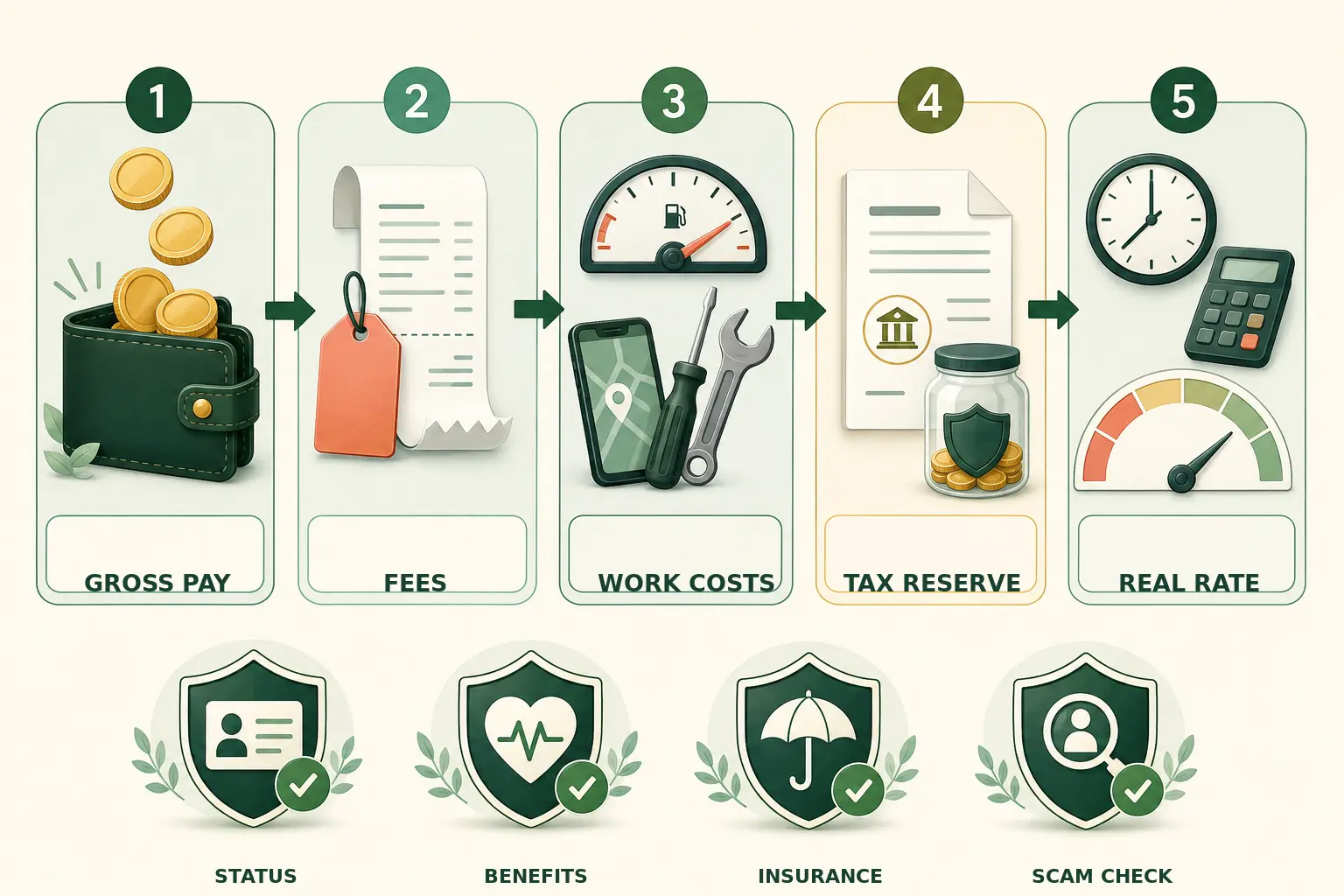
A gig advertised at $25 per hour may not produce $25 per hour of usable income. Start with this sequence:
Gross gig revenue
minus platform fees
minus work-related operating costs
minus a tax reserve
= estimated money remaining
Estimated money remaining ÷ all work time = estimated real hourly pay
Count all work time, not only paid task time. That can include waiting, travel between tasks, customer messages, supply purchases, invoicing, equipment care, bookkeeping, and other required administration.
Gig pay example
Suppose a worker receives $600 in gross platform payments for 24 total hours of work-related time.
| Step | Amount |
|---|---|
| Gross platform payments | $600 |
| Platform fees | minus $60 |
| Fuel and other direct operating costs | minus $90 |
| Money before a tax reserve | $450 |
| $450 divided by 24 hours | $18.75 per hour before the tax reserve and longer-term costs |
This illustration is not a national earnings figure. Actual costs, taxes, time, and pay vary by worker and job.
Which benefits and costs may be missing from the app?
Compare gig work with a job using more than cash pay. Ask whether you are giving up or paying separately for:
- health insurance and paid time off,
- retirement contributions and disability coverage,
- workers’ compensation and unemployment protection,
- equipment and commercial or rideshare insurance,
- vehicle wear, bookkeeping, and tax preparation, and
- unpaid administrative time.
A higher gross hourly rate can still produce lower total compensation. The Self-Employment Pros and Cons guide can help compare income control with the added responsibilities.
What platform and account risks should you check?
Read the platform agreement for payment timing, fees, refund rules, deactivation procedures, disputes, insurance, background checks, data collection, and the conditions under which prices or compensation may change.
Keep copies of earnings statements and tax documents outside the platform account. If access is suspended, you should still have your own records. Do not build a fixed household obligation around income you cannot control.
How can you spot a gig-work scam?
Fake recruiters and task scams can imitate remote and gig opportunities. The Federal Trade Commission warns that scammers may send unexpected job messages, offer vague online work, pay a small amount at first, then demand that the target deposit money.
- Do not pay money to get paid.
- Do not deposit a check and send part of the money back.
- Do not buy gift cards or cryptocurrency for an employer.
- Do not deposit your own money to unlock task earnings.
- Verify the business before sending identity documents.
- Treat a vague offer through an unexpected text or messaging app as a warning sign.
A credible opportunity should make the work, pay structure, business identity, and payment method clear before you send money or sensitive information. Compare safer remote options in the Online Work guide.
What five questions should you ask before accepting a gig?
- What is the actual work? The offer should explain the task, customer, deliverable, and payment terms.
- What is the real net hourly rate? Subtract fees and costs, reserve for taxes when needed, and count unpaid work time.
- Am I an employee or in business for myself? Check current legal tests instead of relying on the app label.
- Which protections do I lose or need to buy? Compare insurance, leave, retirement, stability, and worker protections.
- What happens if the platform changes its rules? Plan for payment delays, fee changes, account suspension, and uneven demand.
For more ways to compare side income, use the Earning Extra Money guide.
Gig economy FAQs
Is gig income taxable?
Yes. Gig income generally must be reported even if it is part time, temporary, paid in cash, or not reported on a tax form.
Does receiving a 1099 make me an independent contractor?
Not by itself. A tax document does not override the legal tests used to determine employment status.
Do gig workers need estimated tax payments?
Some self-employed gig workers may need estimated payments. The answer depends on the worker’s full tax situation and other withholding.
Can a company call me a contractor if I work like an employee?
The label is not conclusive. Classification depends on the facts and the federal, state, or local law that applies.
How do I compare gig pay with a regular job?
Compare net hourly pay after expenses and unpaid time, then account for benefits, stability, insurance, and worker protections.
Which expenses should gig workers track?
Track gross payments, platform fees, mileage where relevant, supplies, equipment, insurance, software, advertising, and professional fees. Tax treatment depends on the expense and the worker’s facts.
- IRS Gig Economy Tax Center
- IRS: Manage taxes for gig work
- U.S. Department of Labor: 2026 worker-classification proposal FAQs
- U.S. Department of Labor Fact Sheet 13
- Federal Trade Commission: Job scams
Worker status and tax treatment depend on the facts and the law that applies. Check current federal and state guidance for your work arrangement.