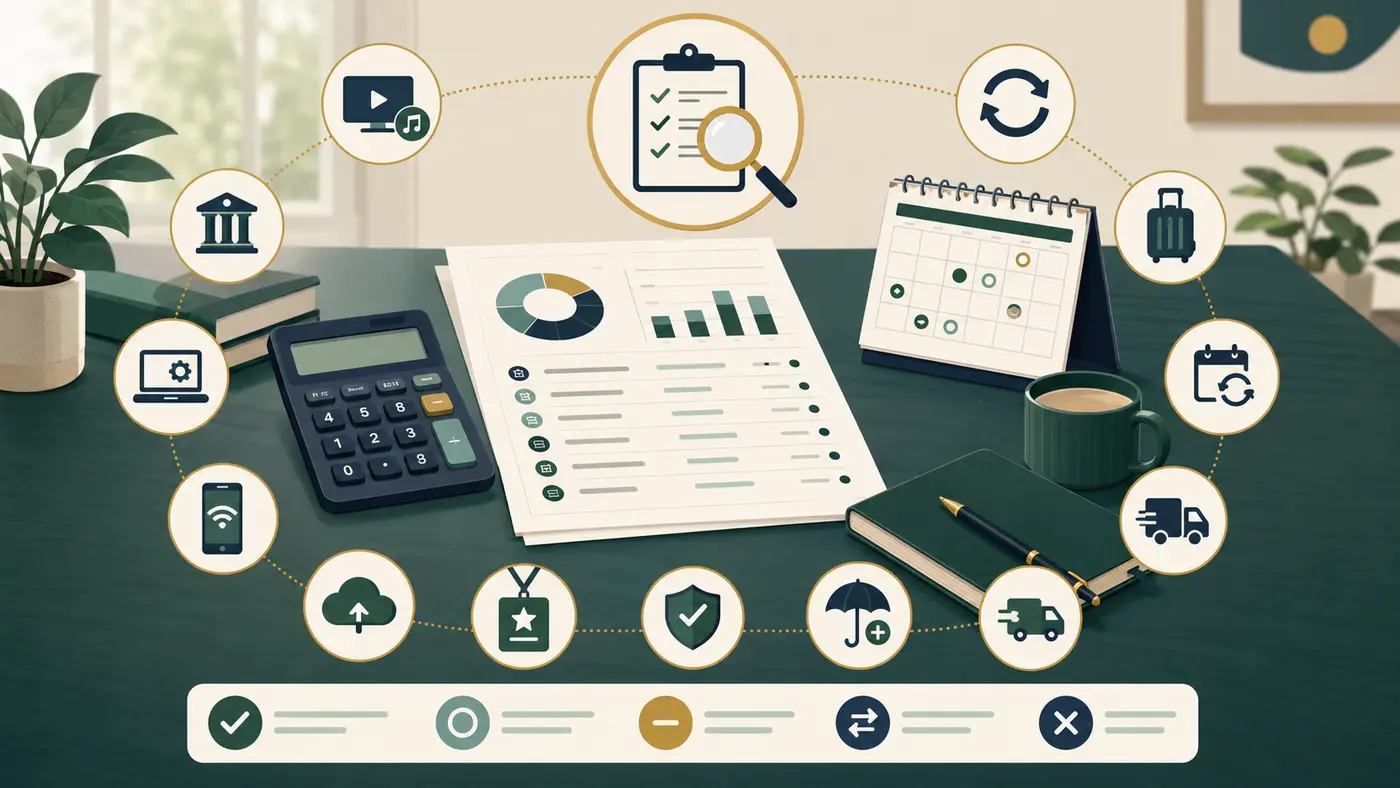
Before cutting a recurring expense, confirm what it costs over a full year, how often you use it, what problem it solves, what happens if it is removed, and whether a lower-cost substitute is workable. This review process supports the broader MoneyBucket saving and investing hub without assuming that every subscription, service, fee, or protection product should disappear.
How do you build a recurring-expense audit?
Use at least the last 12 months of bank, card, wallet, and app-store records so annual, quarterly, and seasonal charges appear. Search statements for the same merchant name, including abbreviations and billing-company names.
| Record | What to capture | Why it matters |
|---|---|---|
| Charge | Merchant, amount, date, payment method, billing frequency | Shows the real annual cost and where to monitor cancellation |
| Contract | Plan, term, renewal date, promotion end, cancellation steps, early fee | Prevents a cut from creating a larger charge or service gap |
| Use | Last use, frequency, household users, peak season | Separates unused services from useful but underused ones |
| Value | Time saved, risk reduced, work supported, substitute cost | Captures benefits that are not obvious on a statement |
| Decision | Keep, reduce, switch, pause, cancel, review date | Turns the list into an action plan |
Convert each charge to a common period. Monthly cost times 12 works for a stable subscription. For irregular services, total the actual 12-month charges and note any promotion or one-time fee.
See the behavior behind the numbers: Play Lifestyle Creep to test how small upgrades and memberships build across 12 fictional months.
Which decision should you make for each expense?
Keep or reduce
Keep when the current service is used, affordable, and difficult to replace. Reduce by changing the tier, frequency, storage, speed, seats, or optional features while preserving the core benefit.
Switch, pause, or cancel
Switch when a comparable alternative lowers total cost. Pause for a temporary need or seasonal service. Cancel when the benefit is gone and the exit terms are acceptable.
Do not count a switch as savings until setup fees, equipment, taxes, lost discounts, time, and overlapping billing are included. Set a review date for anything you keep on a trial basis.
1Are media and content subscriptions being used?
List video, music, news, audio, gaming, creator, and digital-reading services. Check direct billing and billing through app stores, device makers, mobile providers, or other bundles.
- Count active household users and the last meaningful use.
- Check whether the same content is available through another paid service you already have.
- Compare an ad-supported, lower-resolution, individual, or seasonal tier.
- Confirm whether downloads, profiles, saved lists, or purchases survive cancellation.
Rotating one service at a time can reduce overlapping charges, but only if the household will maintain the schedule and does not repay setup or promotional costs.
2Do memberships still match your routine?
Review gyms, clubs, professional groups, warehouse programs, roadside programs, coworking, hobby communities, and paid loyalty memberships. Separate benefits you used from benefits that only looked valuable at signup.
- Compare annual dues with documented discounts or services used.
- Check guest, family, location, class, and access limits.
- Review notice periods, freezes, cancellation method, and joining fees if you return.
- Keep professional or community memberships when the real benefit exceeds the cost.
3Can telecom costs be reduced without losing needed service?
Review mobile lines, internet, landline, television, hotspots, device insurance, international features, and equipment fees together. A low advertised price may exclude taxes, equipment, installation, or the rate after a promotion.
- Measure actual data, speed, coverage, line, and hotspot needs.
- Check device payoff, trade-in credits, bundle discounts, and contract effects before switching.
- Compare equipment purchase with recurring rental only when compatibility and support are clear.
- Ask for the total monthly price after the current promotion ends.
The FCC National Broadband Map can show providers that report service at an address and the technologies and maximum advertised speeds they report. Verify price, installation, performance, and terms directly with the provider.
4Which bank and payment fees are avoidable?
Review monthly maintenance, overdraft, insufficient-funds, out-of-network ATM, wire, transfer, paper statement, card replacement, and account-inactivity fees. Use the institution’s current fee schedule, not an old comparison article.
- Check balance, deposit, transaction, and account-combination requirements for a waiver.
- Turn on low-balance and transaction alerts where useful.
- Review overdraft settings and lower-cost alternatives offered by the institution.
- Compare accounts by total expected fee, access, support, deposit insurance status, and service fit.
The FDIC account-fee guide explains common maintenance, minimum-balance, overdraft, and ATM fees. Check the current disclosure for your specific account.
5Are software, apps, and cloud storage duplicated?
Inventory productivity, design, security, tax, finance, photo, backup, and cloud services. Check charges through the vendor, app store, employer, school, device bundle, and family plan.
- Find overlapping features and duplicate storage.
- Count the seats and devices actually used.
- Check file format, export, retention, and access after downgrade.
- Confirm whether an employer or school license is approved for personal use before relying on it.
Export important files before changing a plan. A cheaper tier is not useful if it blocks needed history, collaboration, backup, or file recovery.
6Do monitoring and protection plans solve a real problem?
Review credit monitoring, identity products, device protection, home monitoring, extended support, roadside coverage, and account alerts. Check what is already available through a financial institution, insurer, employer, device warranty, or free public tool.
- Identify the exact event the service covers or detects.
- Separate monitoring from reimbursement, restoration help, repair, or insurance.
- Read limits, exclusions, deductibles, waiting periods, and claim steps.
- Check whether alerts are timely and whether you act on them.
Do not cancel a useful protection simply because another product has a similar name. Compare the written coverage and your exposure. The identity theft protection guide explains free freezes, fraud alerts, monitoring, and recovery steps.
7Are insurance add-ons or warranties overlapping?
Review optional riders, service contracts, rental protections, phone coverage, travel add-ons, and extended warranties against existing insurance, card benefits, manufacturer coverage, and emergency savings.
When overlap exists, decide which policy responds first, what proof a claim requires, and whether losing one product also removes a discount or related benefit.
8How much do delivery and convenience charges add?
Separate the product price from delivery, service, small-order, priority, packaging, tip, and membership charges. Compare the same basket with pickup or direct purchase, including your time and transportation.
- Calculate the average total fee per order.
- Check whether a membership changes prices or only removes one fee.
- Consolidate orders when it does not increase waste.
- Keep accessibility, caregiving, safety, and time constraints in the decision.
A convenience service can be worth its cost. The goal is to see the full charge and choose it deliberately.
9Are equipment rentals and device plans still economical?
Review modem, router, alarm, water, appliance, phone, tablet, and other equipment charges. Determine whether the item is rented, financed, leased, or included with service.
- Find the remaining payoff, return deadline, and nonreturn fee.
- Check whether buying compatible equipment transfers setup, repair, or security-update duties to you.
- Compare total remaining payments with replacement cost and expected life.
- Save return receipts and serial numbers.
10Which home services, storage, and utility add-ons can change?
Review storage units, lawn care, cleaning, pest control, water treatment, maintenance plans, premium energy programs, trash options, and other recurring home services.
- List seasonal frequency and the last service performed.
- Check cancellation notice, minimum term, and equipment ownership.
- Compare a reduced schedule or narrower scope with full cancellation.
- Include safety, physical ability, tools, disposal, and time before replacing a service with do-it-yourself work.
For a storage unit, compare the stored items’ replacement value and real likelihood of use with the annual cost, moving cost, and time needed to sort them.
11Which small renewals are hiding in statements?
Search for annual domains, newsletters, donations, games, in-app purchases, vehicle services, clubs, photo plans, filters, household refills, and other low-dollar charges. A small amount can escape attention when billed through a wallet or bundled statement.
- Search 12 months of statements by recurring merchant and amount.
- Review app-store and wallet subscriptions separately.
- Mark renewal dates at least two weeks ahead.
- Keep confirmation emails, cancellation records, and the final expected charge.
The FTC subscription guide recommends reading trial and renewal terms, knowing how to cancel, monitoring statements, and keeping cancellation records.
How do you cancel without creating a new problem?
- Download records, invoices, files, rewards, and other information you need.
- Check the billing cycle, notice period, early fee, return requirement, and service end date.
- Cancel through the provider’s official process and save the confirmation.
- Return equipment with tracking and keep the receipt and serial number.
- Remove payment authorization only after understanding any remaining valid balance.
- Monitor statements for the next expected billing period.
If a company keeps charging after a valid cancellation, contact the company and the card or bank promptly using trusted contact information. The FTC advises keeping records and disputing charges you did not authorize through the payment provider’s process.
What should you review before making the cuts final?
| Question | Evidence |
|---|---|
| Did the change lower annual cost? | New price plus fees, equipment, setup, lost discounts, overlap, and cancellation charges |
| Did the replacement preserve the needed outcome? | Coverage, speed, access, support, data, reliability, and household use |
| Did the cancellation actually finish? | Confirmation, returned-equipment receipt, account status, and later statements |
| Did the cut shift cost somewhere else? | Time, transportation, risk, late fees, data loss, repair, or a second service |
| Will the expense return automatically? | Renewal terms, pause end date, promotion end, and calendar reminder |
Move verified savings to a named goal, debt payment, reserve, or budget category. Otherwise the lower charge may be absorbed by other spending without improving the plan.
Frequently asked questions
Which expenses should I review first?
Start with charges you do not recognize, no longer use, recently increased, duplicate another service, or renew soon. Then review larger contracts where a change requires more preparation.
How far back should I check for subscriptions?
Review at least 12 months so annual, quarterly, and seasonal charges appear. Include bank, card, wallet, app-store, and payment-platform records.
Should I cancel every unused subscription?
Usually an unused service deserves review, but first check cancellation fees, stored data, equipment returns, household use, and whether a temporary pause or lower tier is a better fit.
Is switching providers always cheaper?
No. Include installation, devices, taxes, lost bundles, promotion end dates, overlap, time, and service quality. Compare total expected cost over the same period.
How do I prove I canceled a recurring charge?
Save the dated confirmation, screenshots or emails, chat or call notes, equipment-return tracking, and later statements. Keep records until the final billing cycle is clear.
Primary consumer sources
- Federal Trade Commission: Free trials, auto-renewals, and subscriptions.
- Federal Trade Commission: How to stop subscriptions you never ordered.
- Federal Deposit Insurance Corporation: Overdraft and account fees.
- Federal Communications Commission National Broadband Map.
Pricing, renewal terms, cancellation rules, plan features, coverage, and fees change. Verify current terms directly with the provider before changing a service.