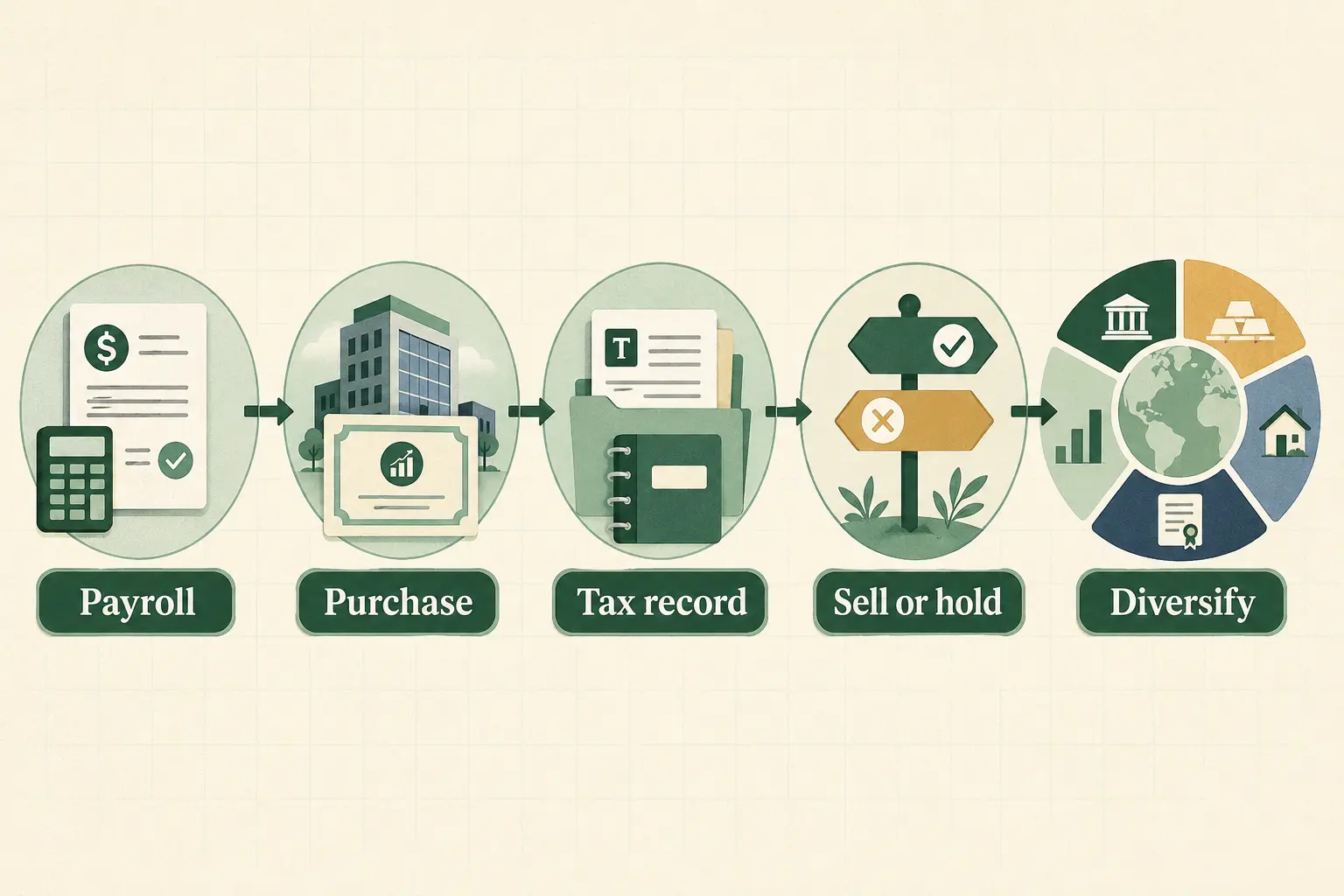
Start with the Investing Money guide before deciding how an employee stock purchase plan fits your portfolio. An ESPP can let eligible employees buy company shares through payroll deductions, sometimes at a discount. That benefit can be valuable, but the plan also ties more of your money to the company that already provides your paycheck.
The plan document controls the discount, lookback formula, offering period, purchase dates, eligibility, fees, sale restrictions, and exit rules. Federal tax treatment also depends on whether the plan qualifies under Internal Revenue Code Section 423 and when the shares are sold.
What is an employee stock purchase plan?
An employee stock purchase plan lets participating employees set aside part of each paycheck to buy employer stock under the plan’s rules. Payroll deductions usually accumulate during an offering period, then purchase shares on a stated date. A plan may use a discount, a lookback price, both, or neither. Do not assume another employer’s plan describes yours.
Some plans qualify under Section 423 and receive statutory stock-option treatment. Other employee purchase programs are nonqualified plans with different tax rules. The label “ESPP” alone does not answer the tax question.
Read these ESPP terms before enrolling
| Plan term | What to find | Why it matters |
|---|---|---|
| Plan tax status | Whether the offering qualifies under Section 423 | Statutory and nonqualified plans can create different tax timing and reporting. |
| Contribution rule | Payroll percentage or dollar limit, change windows, and refund rules | A deduction that is too high can leave ordinary bills unfunded. |
| Purchase formula | Discount, lookback dates, price source, and purchase date | The actual formula determines the purchase advantage. |
| Sale access | Holding requirements, transfer delays, trading windows, and fees | An intended quick sale may not be available when expected. |
| Employment changes | What happens after leave, termination, or a job change | Contributions may be refunded or handled under another plan rule. |
| Records | Grant date, purchase date, purchase price, fair market values, Form 3922, and sale confirmation | These records support the holding-period and basis calculation. |
A discount is not a guaranteed profit
A purchase discount can create an advantage on the purchase date, but the share price can fall before you sell. Fees, taxes, trading limits, and a concentrated position can also reduce the benefit. A plan with a lookback may change the purchase price, yet it does not remove market risk after the shares arrive.
Measure the actual transaction instead of calling the discount free money. Record the payroll deductions, purchase price, market value, fees, taxes, and the amount of employer stock already held through other accounts or equity awards. If the plan offers no clear sale route, the risk lasts longer than the purchase calculation suggests.
Section 423 ESPP taxes and the holding-period test
For a Section 423 employee stock purchase plan, the IRS says you generally do not include an amount in gross income when you receive the grant or exercise the option to buy shares. Taxable compensation and capital gain or loss may be reported when the stock is sold or otherwise disposed of.
The holding-period rule is not simply “hold for one year.” The IRS says the requirement is met only when you do not sell until the end of the later of:
- one year after the stock was transferred to you, or
- two years after the option was granted.
Meeting the holding period does not mean the entire result becomes tax-free. The sale can still include ordinary compensation income and capital gain or loss. Failing the holding-period test changes the ordinary-income calculation. The IRS stock-plan FAQs explain both routes.
Why Form 3922 and basis records matter
Your employer should provide Form 3922 when a qualifying Section 423 transfer meets the reporting rules. The form reports dates and values that help track the holding period and cost basis. Keep it with the plan statement, purchase confirmation, brokerage history, Form W-2, Form 1099-B, and sale confirmation.
Do not assume the basis shown on a brokerage tax form completes the ESPP calculation. Ordinary compensation included in income can affect adjusted basis. A missed adjustment can cause the same economic income to be counted twice or produce the wrong gain or loss. Use the MoneyBucket tax guide for broader filing context, and consider a qualified tax professional when the sale or record trail is complex.
Company-stock concentration can outweigh the discount
An ESPP can increase employer-stock exposure while your wages, bonus, health coverage, career, and unvested awards already depend on the same company. Investor.gov warns that a company decline can hurt the investment and employment at the same time.
There is no universal employer-stock percentage that fits every worker. Measure the position across the full portfolio before setting a payroll deduction or sale policy. Review the result with the investment risk guide.
Run a stress case in which the share price falls while a bonus is reduced or employment becomes less secure. The point is not to predict a company failure. It is to see whether one event could damage several parts of the household plan at once.
A six-step ESPP decision framework
- Protect cash flow first. Do not set a payroll deduction that leaves essential bills, required debt payments, or a basic emergency fund unfunded.
- Calculate the plan’s actual purchase formula. Use the discount, lookback dates, purchase date, fees, and contribution limits in your document. Ignore generic assumptions from another company’s plan.
- Confirm the tax status. Identify whether Section 423 applies. Record the grant, purchase, transfer, and sale dates before estimating tax treatment.
- Choose a sale policy before the purchase date. A quick sale can reduce concentration, while a longer hold can change tax treatment and market exposure. Write down the purpose of the hold and the loss you can carry.
- Check company trading rules. If blackout periods, preclearance, or an employer trading policy applies to your role, follow the company’s instructions. A plan purchase does not promise unrestricted sale access.
- Count the shares in the full plan. Include the ESPP, workplace plan, vested awards, and other employer shares. If ESPP proceeds are moved elsewhere, review how they fit retirement accounts, such as a Roth IRA, and the broader retirement plan.
ESPP warning signs to fix before the next purchase
- You cannot explain the purchase formula using the plan document.
- You do not know whether the plan qualifies under Section 423.
- You expect to sell at once but have not checked transfer delays or trading rules.
- Employer stock has accumulated across several accounts without being totaled.
- You cannot find Form 3922 or the grant and purchase records.
- Payroll deductions are pushing normal expenses onto a credit card.
- You are holding only because the discount feels like a guaranteed return.
Frequently asked questions
Is an ESPP discount free money?
No. A discount can create value on the purchase date, but the share price can fall. Taxes, fees, sale limits, and employer-stock concentration can reduce or erase the benefit.
Do all ESPPs offer a 15% discount?
No. Discounts, lookbacks, offering periods, and purchase formulas differ by plan. Some plans use other terms. Read the current plan document rather than assuming a standard percentage.
Do I only need to hold Section 423 ESPP shares for one year?
No. The IRS holding-period test uses the later of one year after the shares were transferred to you or two years after the option was granted.
What is Form 3922?
Form 3922 reports information for certain stock transfers under a Section 423 employee stock purchase plan. Its dates and values can help track the holding period and cost basis.
How much employer stock should I own?
There is no single percentage for every investor. Count employer stock across all accounts and awards, then weigh income dependence, time horizon, loss capacity, other assets, and the purpose of the shares.
Primary sources
- IRS: Stocks, options, splits, and traders FAQs
- IRS Topic 427: Stock options
- IRS: About Form 3922
- Investor.gov: Ten Things You Should Know About Investing
- Investor.gov: Asset allocation and diversification guide