Real Estate Investing: Strategies, Pros and Cons
Start with the Guide to Saving and Investing for the broader topic, then use this page for the details below. Real estate investing can mean owning a rental, renovating a property, buying REIT shares, joining a private deal, or renting part of a home you occupy. The best route is not the one with the loudest profit claim. It is the one that fits your cash reserves, time, borrowing risk, need for liquidity, and willingness to manage people and property.
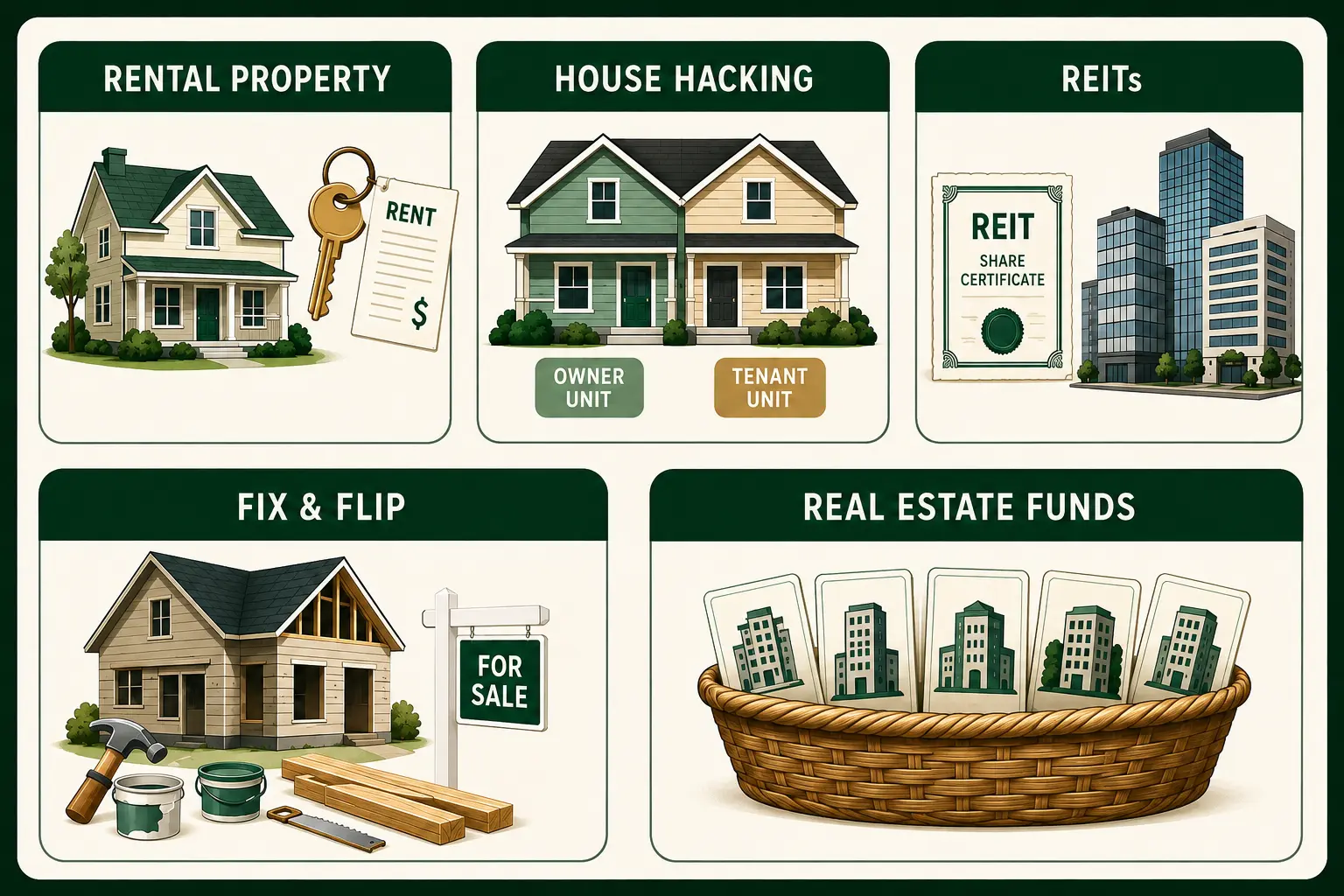
Five Types of Real Estate Investment Strategies
| Strategy | What You Own | Main Advantage | Main Risk | Best Fit |
|---|---|---|---|---|
| Long-term rental | A house, condo, or small multifamily property | Possible rental income plus long-term appreciation | Vacancy, repairs, tenant issues, and local price declines | Investors with reserves and time or paid management |
| House hacking | A home you occupy while renting rooms or units | Rental income may offset part of your housing cost | Less privacy and landlord duties at home | Owner-occupants willing to share space or manage nearby tenants |
| Fix and flip | A property bought for resale after renovation | A shorter project than a long-term rental | Cost overruns, delays, financing costs, and a weak resale market | Experienced operators with construction knowledge and a cash buffer |
| Publicly traded REIT | Shares in a company that owns or finances real estate | Easy access, professional management, and stock-market liquidity | Share-price swings, interest-rate sensitivity, and no control over properties | Investors seeking real estate exposure without direct property management |
| Private deal or crowdfunding | An interest in a private property, fund, or project | Access to deals outside public markets | Fees, limited disclosure, illiquidity, platform risk, and possible total loss | Investors who understand the documents and can lock money up |
Direct ownership offers control, but control comes with work and concentrated risk. Publicly traded REITs are easier to buy and sell, but their prices can move with the stock market. Private offerings may keep your money locked up for years. Read the offering documents, fee schedule, conflicts, and exit rules before committing funds.
Pros and Cons of Real Estate Investing
Possible Advantages
- Rental income may provide cash flow after all costs.
- Property may appreciate, though appreciation is never guaranteed.
- A fixed-rate mortgage can keep principal and interest stable while rents and other costs change.
- Real estate can behave differently from stocks and bonds.
- Owners may qualify for tax deductions or depreciation based on their facts.
Possible Disadvantages
- One property can concentrate a large amount of money in one location.
- Repairs, vacancies, legal disputes, and insurance increases can erase projected profit.
- Debt magnifies both gains and losses.
- Direct property is slow and costly to sell.
- Tax rules, leases, permits, and landlord duties add complexity.
Tax treatment depends on property use, participation, income, ownership structure, and current law. The IRS explains that rental income and expenses are generally reported in the year they are received or paid, and residential rental property is usually depreciated under the applicable recovery rules. A tax professional can apply those rules to your situation.
How to Compare a Rental Property
A listing price and expected rent are not enough. Build a monthly estimate that includes every predictable drain on cash:
- Gross rent: Use market evidence, not the seller’s best-case number.
- Vacancy: Assume some months will produce no rent.
- Operating costs: Include taxes, insurance, utilities you pay, maintenance, repairs, association fees, licensing, bookkeeping, legal costs, and management.
- Capital expenses: Budget for roofs, heating and cooling systems, appliances, plumbing, and other large replacements.
- Financing: Count principal, interest, lender fees, and any mortgage insurance.
- Exit costs: Selling can include commissions, transfer charges, repairs, concessions, and taxes.
For a deeper process, use the guides to build a real estate investment portfolio, compare potential properties, and evaluate rental-property ownership.
Financing: Where Real Estate Risk Gets Bigger
Borrowing can let you control an asset with less cash, but it also creates a payment that continues through vacancies and price declines. Investment-property loans often require stronger credit, larger down payments, and more reserves than owner-occupied mortgages.
FHA-insured financing is generally for a principal residence, not a property purchased only as an investment. A qualifying owner-occupant may buy a one- to four-unit home and rent the other units, subject to program and lender rules. Do not describe FHA financing as a general shortcut for buying a standalone investment property.
A home equity loan or HELOC can put your current home at risk. If the investment fails and payments stop, the lender may foreclose on the home securing the debt. Read the real estate financing guide before choosing a loan.
REITs: Real Estate Without Being the Landlord
A publicly traded REIT lets you buy shares through a brokerage account. It can provide exposure to apartments, warehouses, data centers, offices, hotels, healthcare properties, or mortgages without requiring you to repair a sink or screen a tenant.
Non-traded REITs are different. They can charge high upfront fees, offer limited redemption options, and calculate share values less frequently. A distribution is not the same as profit; part of it may come from borrowed money or the return of investor capital. Check whether the product is publicly traded, how it is valued, when you can sell, and what every layer of fees costs.
A Real Estate Investing Decision Checklist
- Name the goal. Income now, long-term growth, housing-cost relief, or a short resale project require different plans.
- Protect emergency cash. Do not treat a credit card as the repair reserve.
- Choose your workload. Direct property needs active oversight even when a manager is hired.
- Set a loss limit. Decide how much cash, time, and borrowing risk you can accept.
- Verify local facts. Check rents, vacancy, taxes, insurance, permits, flood and hazard exposure, tenant rules, and planned development.
- Read the exit terms. Know how long a sale may take and what it could cost.
- Get independent help. Use qualified legal, tax, inspection, insurance, and lending professionals who are not paid only when you buy.
Frequently Asked Questions
What is the easiest way to start investing in real estate?
For many people, a diversified publicly traded REIT fund is easier to buy, sell, and monitor than a rental property. Easy access does not mean low risk. REIT prices can fall, dividends can change, and fund fees matter.
Is rental property passive income?
Rental property can produce income, but direct ownership is rarely passive. Owners must handle financing, compliance, tenants, repairs, records, insurance, and vacancies. A property manager can reduce daily work but adds cost and still needs oversight.
How much money do I need to invest in real estate?
The amount depends on the route. A REIT share or fund may require far less cash than a direct purchase. Property buyers need the down payment, closing costs, inspections, initial repairs, and reserves for vacancies and major expenses. See how much to invest in real estate for a fuller planning framework.
Can real estate lose value?
Yes. Local job losses, excess supply, natural hazards, high borrowing costs, neighborhood changes, poor maintenance, or a broad recession can reduce property value and rent. Leverage can leave an owner owing more than the property can sell for after costs.
Are REITs safer than rental property?
They carry different risks. A diversified public REIT fund may reduce the single-property risk of direct ownership and is easier to sell. It still has market, interest-rate, sector, management, and fee risk. A rental offers more control but places property, financing, tenant, and local-market risk on the owner.