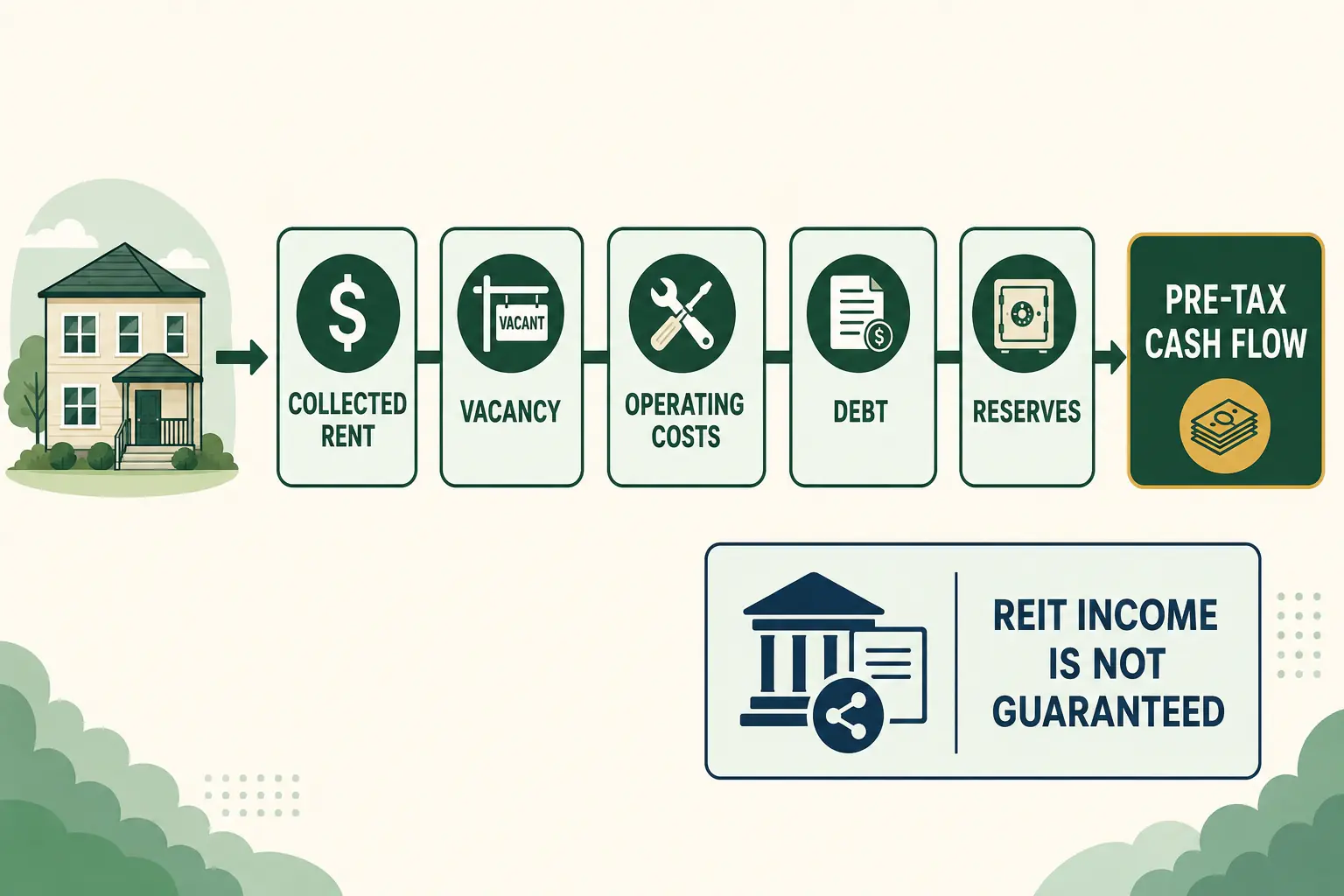
Start with the Real Estate Investing guide before treating a rent check or REIT distribution as profit. Real estate income is the money an investment produces, but the usable amount is what remains after vacancies, operating costs, financing, reserves, and taxes are considered.
What counts as real estate income?
For a rental property, gross rental income is money received for the use of the property. The IRS rental income and expenses guidance explains that rent and some related payments are generally included in rental income. Allowable expenses, improvements, depreciation, and loss limits follow separate tax rules.
For investment planning, gross rent is not the same as spendable profit. A property that collects $2,000 a month does not automatically produce $24,000 of usable annual income. Empty months, repairs, insurance, taxes, management, debt payments, and large replacements can consume much of that amount.
How do you calculate pre-tax rental cash flow?
Collected rent and other property income
minus operating expenses
minus debt service
minus planned reserves for major repairs and replacements
= pre-tax cash flow
This is a planning formula, not a tax-return formula. Mortgage principal, depreciation, improvements, passive-activity limits, and other tax items may receive different treatment. Keep the property cash-flow worksheet separate from the tax records.
How much rental income should you expect to collect?
A listing may show market rent or scheduled annual rent. Your budget needs a cautious estimate of what will reach the account.
Vacancy
Allow time between tenants and periods when a unit is offline for repairs.
Collection risk
Plan for late payments, nonpayment, and the time needed to resolve an account.
Concessions
Include move-in incentives, free-rent periods, and leasing costs.
Seasonality
Use local evidence when demand or rental rates vary through the year.
Verify rent assumptions with comparable signed leases, current property records, local vacancy data, and a qualified property manager when needed. A hopeful listing price is not evidence of collected income.
Which operating expenses belong in the property budget?
Count the costs required to keep the property available, insured, maintained, managed, and compliant. Common categories include:
- Property taxes and property or landlord insurance
- Repairs, routine maintenance, and owner-paid utilities
- Property-management, advertising, and leasing costs
- Association fees and services such as landscaping or pest control
- Bookkeeping, tax preparation, and other professional costs
- Licensing or inspection costs when they apply
IRS Publication 527 covers residential rental income, expenses, depreciation, personal use, and recordkeeping. Tax deductibility depends on the facts and current rules. An ordinary repair and a property improvement may not receive the same treatment.
How does financing change real estate income?
If a property has debt, include the required payment after operating expenses. Track the interest rate, principal-and-interest payment, escrowed amounts, adjustable-rate terms, balloon dates, and any refinancing assumption.
Use the Financing Real Estate Investments guide to compare debt terms, then test how the payment holds up if rent falls, a unit stays empty, or a major repair arrives.
Why do reserves matter before you call the remainder income?
A rental can look profitable for months and then need a roof, heating or cooling system, water heater, plumbing repair, appliance replacement, or heavy turnover work. Set aside cash for predictable but irregular costs.
The reserve amount depends on the property’s age, condition, systems, insurance deductibles, tenant turnover, and number of units. A reserve contribution is part of the property plan. It is not spare money left after every dollar of cash flow has been spent.
Is appreciation the same as income?
No. Appreciation is an increase in market value. It is not recurring cash income, and it is not guaranteed. A property can rise in value while producing weak cash flow. It can also produce cash flow while its market value stays flat or falls.
If a deal only works because a future buyer is expected to pay much more, label that assumption clearly. Do not count an unrealized value increase as money available for current bills.
What does cash-on-cash return tell you?
One simple planning measure is annual pre-tax cash flow divided by total cash invested. Total cash invested may include the down payment, closing costs, immediate repairs, and other cash needed to place the property in service.
Which rental-property records should you keep?
Keep records for rent, other receipts, operating expenses, debt payments, purchase basis, improvements, depreciation, and sale-related costs. The IRS notes that records support tax reporting and help an owner monitor the property’s financial performance.
A tax deduction does not turn a poor expense into a good expense. Paying $5,000 for a property problem still uses $5,000 of cash even if part of the cost receives tax treatment. Ask a qualified tax professional how current rules apply to the property and ownership structure.
How can REITs produce real estate income?
A real estate investment trust owns or finances income-producing real estate or related assets. Publicly traded REITs can provide real estate exposure without directly buying and operating a rental property. They may make distributions, and their share prices can rise or fall.
The income is not guaranteed. Results depend on the underlying properties, debt, management, expenses, and market conditions. Investor.gov’s REIT guide explains the distinction between publicly traded and non-traded REITs. Its non-traded REIT bulletin warns about limited liquidity, valuation difficulty, fees, and conflicts of interest.
How do direct rentals and publicly traded REITs compare?
| Question | Direct rental property | Publicly traded REIT |
|---|---|---|
| How much can you start with? | Often requires substantial cash, financing, and reserves. | Shares can usually be purchased in smaller amounts through a brokerage account. |
| Who manages the asset? | The owner manages the property or pays a manager. | The REIT’s management team operates the portfolio. |
| How concentrated is the exposure? | Often concentrated in one property and local market. | Depends on the REIT’s properties, sectors, geography, and debt. |
| How quickly can it be sold? | A sale can take time and carries transaction costs. | Publicly traded shares can usually be sold during market hours, though price can change sharply. |
| Is income guaranteed? | No. Rent, occupancy, costs, and financing can change. | No. Distributions can change and share value can fall. |
Neither route is automatically safer or more profitable. Match the choice to the goal, time horizon, liquidity needs, concentration risk, and capacity for loss. The Investment Risk guide explains those planning factors. If real estate will make up a meaningful share of your assets, use the real estate investment portfolio guide to review cash flow, reserves, leverage, and concentration across holdings.
What should you check before relying on real estate income?
- I separated gross rent from net pre-tax cash flow.
- I used cautious vacancy and collection assumptions.
- I listed operating expenses separately from debt payments.
- I am funding repair and replacement reserves.
- I am not counting appreciation as current income.
- I understand the financing terms and refinancing risk.
- I reviewed property insurance and liability needs.
- I know that local landlord, licensing, and housing rules may apply.
- I have records for income, expenses, basis, and improvements.
- If I am considering a REIT, I know whether it is publicly traded, non-traded, or private.
Real estate income FAQ
Is rental income the same as rental profit?
No. Rent received is gross income. Pre-tax cash flow depends on operating costs, financing, vacancies, reserves, and other expenses.
Is property appreciation passive income?
No. Appreciation is a change in value, not recurring cash income, and the increase is not guaranteed.
Can a rental property have positive cash flow but still be a poor investment?
Yes. The property may have excessive concentration risk, deferred maintenance, weak insurance, unfavorable financing, legal problems, or a purchase price that makes the expected return unattractive.
Are REIT distributions guaranteed?
No. REIT distributions can change, and REIT share values can rise or fall. Review the REIT, its filings, fees, debt, property exposure, and liquidity before investing.
Should reserves be counted as a rental expense?
For cash-flow planning, reserve contributions reduce the money available to spend. Tax treatment is separate, and money placed in a reserve is not automatically a deductible expense.
Continue your real estate plan
How Real Estate Makes MoneySeparate cash flow, principal paydown, value change, and net sale proceeds.
Investing MoneyCompare accounts, asset types, diversification, fees, and a first-investment path.
Primary sources
- IRS Topic 414: Rental Income and Expenses
- IRS Publication 527: Residential Rental Property
- IRS: Rental Real Estate Income, Deductions, and Recordkeeping
- Investor.gov: Real Estate Investment Trusts
Educational information: This guide does not recommend a property, REIT, loan, tax position, or legal structure. Tax and local property rules depend on the facts.