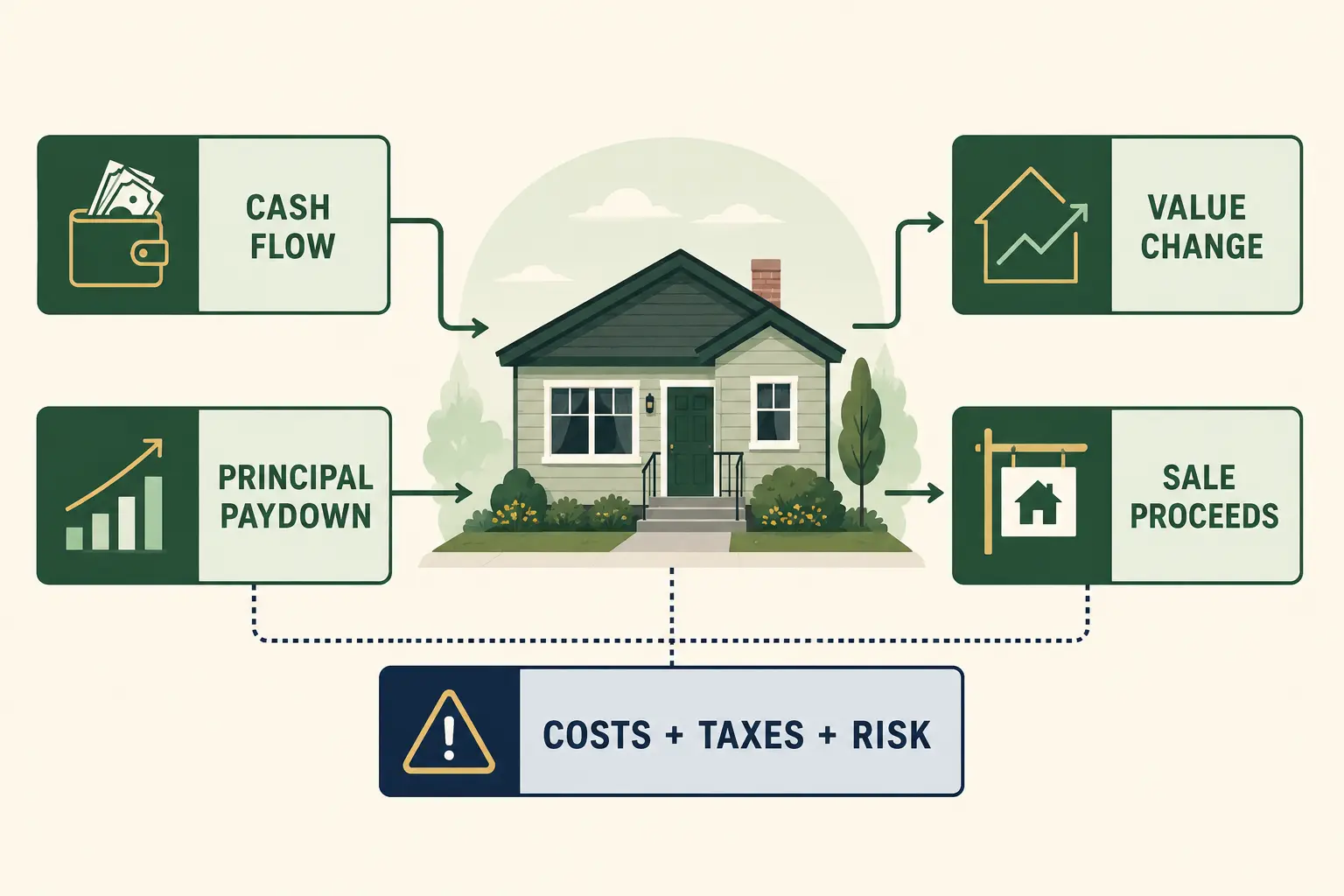
Start with the Real Estate Investing guide before treating appreciation or leverage as a profit plan. A clear analysis separates recurring cash flow, changes in equity, net sale proceeds, taxes, and the cash you had to put at risk.
Where can a real estate return come from?
| Return source | What it means | What can weaken it |
|---|---|---|
| Net rental cash flow | Collected property income left after operating costs, debt payments, and planned reserves. | Vacancy, repairs, rising insurance, taxes, management, and financing costs. |
| Principal paydown | The part of an amortizing loan payment that reduces the debt balance and may increase owner equity. | It is not spendable income, and borrowing against it creates new debt. |
| Value change | A rise or fall in the property’s market value. | Appreciation is uncertain, local, and unrealized until a sale or other transaction. |
| Net sale proceeds | Money left from a sale after loan payoff, selling costs, other debts, and taxes. | A lower sale price, high transaction costs, depreciation history, and tax rules. |
Tax treatment can change what you keep, but a tax deduction is not a separate source of investment profit.
How does net rental cash flow make money?
Rental cash flow is the money left after collected rent and other property income are reduced by operating expenses, debt payments, and planned reserves. Do not start with monthly rent minus the mortgage.
Collected rent and other property income
minus vacancy and operating expenses
minus debt payments
minus planned repair and replacement reserves
= pre-tax cash flow
Include vacancy, repairs, insurance, property taxes, management, owner-paid utilities, association fees, maintenance, leasing costs, and replacement reserves. For a fuller worksheet, use MoneyBucket’s Real Estate Income guide.
IRS Publication 527 covers residential rental income, expenses, depreciation, personal use, and recordkeeping. A planning worksheet is not the same as a tax return, so keep the two calculations separate.
How can principal paydown increase equity?
With an amortizing mortgage, part of each payment may reduce the loan principal. As the balance falls, the owner’s equity can increase even if the property value does not change.
Does property appreciation always create a gain?
No. A property may rise in market value, stay flat, or fall. Appreciation is uncertain and local. A more cautious analysis asks whether the property still makes sense if appreciation is modest or absent.
Do not count an unrealized value estimate as money available for current bills. Do not build a purchase around a required future appreciation rate unless you can absorb the loss when that assumption misses.
How do you estimate net proceeds from a property sale?
The sale price is not the same as profit. A sale estimate can include the remaining loan payoff, broker or selling costs, transfer and closing costs, other debts or liens, the property’s adjusted tax basis, depreciation history, and applicable taxes.
Sale price
minus selling and closing costs
minus loan payoff and other property debt
minus estimated taxes
= estimated net sale proceeds
IRS Publication 544 explains that gain or loss on a sale can depend on the amount realized, adjusted basis, depreciation, property use, and recapture rules. Use current tax guidance or a qualified tax professional for an actual transaction.
Why can leverage raise both gains and losses?
Financing lets an investor control a property with less cash than an all-cash purchase. That can raise the return on the investor’s cash when the property performs well. It can also magnify losses.
Debt creates required payments even when a unit is vacant, a tenant does not pay, repairs spike, insurance or property taxes rise, the property value falls, or refinancing becomes more expensive.
Use the Financing Real Estate Investments guide to compare loan terms and stress-test the payment.
How can you measure the total real estate return?
Track every dollar of cash put in and every dollar taken out. Cash invested may include the down payment, closing costs, immediate repairs, renovations, carrying costs before occupancy, and later capital calls.
Cash received may include net rental distributions and sale proceeds after debt and selling costs. Refinancing proceeds add cash but also create or replace debt, so label them separately. Changes in equity may matter even when no cash is distributed, but keep unrealized equity separate from cash income.
A deal can have positive cash flow and still produce a poor overall return if the investor overpaid or later absorbs a large loss. A deal can also have little cash flow but gain value. Measure the entire outcome instead of relying on one attractive number.
How should you estimate profit from a house flip?
A flip is a business project, not automatic investment profit. Results depend on the purchase price, rehabilitation budget, financing, taxes, insurance, utilities, permits, contractor performance, holding time, selling costs, and final sale price.
Expected sale proceeds
minus purchase and closing costs
minus renovation and carrying costs
minus financing and selling costs
minus taxes and contingency
= estimated profit before surprises
Increase the contingency before increasing projected profit. Keep inspection, title, permit, contract, and legal claims general unless qualified advisers review the deal and local rules.
Do tax deductions guarantee a profitable property?
No. Rental real estate can involve deductions, depreciation, adjusted basis, passive-activity limits, at-risk rules, and sale rules. The result depends on the property, taxpayer, ownership, and activity.
Tax treatment affects after-tax results. It does not erase the economic cost of a weak purchase, high debt, vacancy, or repairs. Use tax rules to estimate what you keep, not to justify a property that fails the operating and downside tests.
How can REITs make money?
A REIT can provide real estate exposure without direct ownership of a rental property. Publicly traded REITs may produce distributions and share-price gains or losses. Their results still depend on the underlying real estate, debt, management, expenses, and market conditions.
Investor.gov’s REIT guide distinguishes publicly traded, non-traded, and private REITs. Non-traded REITs can carry liquidity, valuation, fee, and conflict-of-interest risks that differ from publicly traded REITs.
Which five numbers should you screen before investing?
1. Cash required
Total cash needed at purchase, including closing costs, repairs, and initial reserves.
2. Annual pre-tax cash flow
Expected collected income after cautious expenses, debt payments, and reserves.
3. Debt and payments
Loan balance, required payment, rate changes, maturity, and refinance assumptions.
4. Exit costs
Expected selling costs, debt payoff, tax estimate, and sale-price assumption.
5. Downside result
Outcome if rent, occupancy, repair cost, or sale price is worse than expected.
If a deal works only in the optimistic case, it has little room for error. The Investment Risk guide can help frame concentration, liquidity, time horizon, and capacity for loss.
How can two properties with different debt compare?
Property A may require less cash but carry a high loan payment and thin reserves. Property B may require more cash yet have lower debt and stronger expected cash flow.
Property A may show the higher projected return when every assumption works. Property B may have the larger safety margin. Neither is automatically better. The choice depends on liquidity, income stability, time horizon, workload, and the ability to absorb a bad year.
What belongs on a real estate profit checklist?
- I separated gross rent from net cash flow.
- I included vacancy, repairs, and replacement reserves.
- I know how much cash is tied up in the investment.
- I understand the debt payment and refinance risk.
- I did not assume appreciation is guaranteed.
- I estimated selling costs before projecting profit.
- I understand that principal paydown is equity, not current income.
- I did not count a tax deduction as profit.
- I modeled a downside case.
- I can carry the investment without relying on a quick sale.
Real estate return FAQ
What is the most common way rental property makes money?
A rental property can produce net cash flow when collected rent exceeds operating costs, debt service, and reserves. It can also build equity through principal paydown and changes in property value.
Does real estate always appreciate?
No. Property values can rise, remain flat, or fall. Appreciation depends on local market conditions and should not be treated as guaranteed.
Is equity the same as profit?
No. Equity is the value of an ownership interest after debt. It can increase through principal paydown or appreciation, but it is not cash income unless the property is sold or the equity is borrowed against.
Do tax deductions make real estate automatically profitable?
No. Tax treatment affects after-tax results, but deductions do not eliminate the economic cost of a bad purchase, high debt, vacancy, or repairs.
Continue your real estate plan
Build a Real Estate PortfolioSet limits for debt, concentration, reserves, and review points as holdings grow.
Measure Real Estate IncomeCalculate rental cash flow and compare direct property with REIT income.
Primary sources
- IRS Publication 527: Residential Rental Property
- IRS Publication 544: Sales and Other Dispositions of Assets
- Investor.gov: Real Estate Investment Trusts
Educational information: This guide does not recommend a property, REIT, loan, tax position, or legal structure. Tax and local property rules depend on the facts.